Showing posts with label building the bestiary. Show all posts

Monday, February 8, 2021

The State of the Blog (and the Tim)

In the process of looking up something that I had shared here a couple of years ago, I realized that I had not posted anything new since August. I've been meaning to post a few things during that time, but lacked the motivation to make it happen. So here's a very quick update of where things stand in the many lands of Studded Plate. (Warning: There's a bit about a friend I lost very recently at the end of this column. I'm still figuring out how to talk about it online...or in general) 

Freeport and 5E: The 5E and Fantasy AGE versions of Death in Freeport were released just as I was finishing up that last post in August. I intend to run one version or the other sometime this year. I also have a few items to compose "Freeport and..." articles about at some point: the latest Unearthed Arcana articles (only two since August), Ghosts of Saltmarsh, and possibly Kobold Press's Tome of Beasts (which I'm slowly making my way through). And whenever I acquire Tasha's Cauldron of Everything, I will almost certainly have something to say about using that book with Freeport.

Time of the Tarrasque: This Pathfinder campaign went on hiatus back in 2019, and to be very honest, I'm not sure if it will ever restart at this point. 

The Kynthiad: The solo Greek myth BESM game that I run for my wife Erika is still going, though the end of the campaign is finally approaching. In our last few sessions, Kynthia has been instrumental in definitively ending the Trojan War--with Troy emerging victorious, and many Greek going home without their kings. Now we just have to figure out how she's going to stop Typhon's return, which will make a fitting conclusion to the story--and free up some headspace for me to run other games. 

Building the Bestiary: I would almost certainly have added another installment or two of this series by now, except that the pandemic has forced us to go online for most of our gaming, which means I'm producing far fewer LEGO minis for games. (We do play occasional games in person within our "bubble," but I've been GMing far fewer of those than I used to.)

On a related note, I have not purchased any of the new Minifigures series that have been released since the pandemic started. If and when I do, I will post reviews, but I don't know if that will happen before the end of mandatory social distancing.

Pathfinder Society and Starfinder Society: Erika and I are still heavily involved in organized play for Pathfinder (1E & 2E) and Starfinder. All of these games have been strictly online since March or so, except for occasional games within our "bubble" (such as the Starfinder AP we started recently). I earned my third GM Star for Pathfinder Society 1E just before the end of 2020, but Erika has shot way ahead of me there, and is closing in on her fifth (and final!) GM Star. She became a Venture Officer for our local store about a year ago, so has been running a lot of games for that venue, as well as for several online conventions. We're both playing a lot more PFS 2E and Starfinder now than we have in the past, because it's easier to find games to play in now that we're online. Erika has GMed a couple of 2E scenarios so far, and her first Starfinder game this past month. I haven't tried GMing 2E yet, but have a few Starfinder games under my belt, and intend to run more as I get more familiar with the system. (I still have a ways to go before my first GM Nova, though.)

Grey Angels: I have been intending to write more about the (new and old) adventures of Trick Tillinghast, one of my characters in the long-running "Grey Angels" campaign (using Buffy/Angel Unisystem) that revived for a "reunion arc" at the end of 2019. Sadly, our main GM, Cassandra Lease, died rather suddenly at the beginning of this month. All of us in the game have been close friends with her for upwards of 15 years, so we're all still reeling from this loss. At some future date, we may try to find some way to continue playing in the world that she invited us to help her create, because it would be a damn shame to never again revisit those characters. But we're nowhere near ready to contemplate how to do that yet, apart from agreeing that some day, when we're ready, we very much want to have a long, involved discussion about it. Sharing stories about Cass among her circle of friends has been very helpful to us, and very necessary. When I'm ready to, I will probably share some more stories from the game here, in her memory. She would have liked that. 


I received this Abe Sapien figure as a gift from Cass early on in the Grey Angels game. She used the movie version of Abe as the visual reference for the Tritons, the sea demon race from which my very first GA character, the mage Baz Olmstead, was descended.

Wednesday, August 7, 2019

Time of the Tarrasque: Another Hiatus (and the State of the Blog)

I've decided that I need to take a break from running my "Time of the Tarrasque" campaign. One of my players recently started a new job that makes him unavailable at our traditional gaming time, and finding an alternate time that is good for everyone is proving elusive. I've also been feeling some GM burnout lately (this game takes a lot more effort to prep than, say, running an occasional Pathfinder Society scenario), and the last couple sessions have suffered for it. We hope to resume the game at some future date, but I can't say how long that will be at this time.

I've also decided to cut back on how often I post to this blog. I managed to keep up a rate of one post every week for over 4 years, but I missed a week or two this summer due to a shortage of free time. And with Tarrasque on hiatus, I won't have those session summaries to post for the duration (though I may occasionally report on other games that my group uses that time for). Instead, I'll be aiming for 1 or 2 posts per month, on whatever topics inspire me enough to write about them.

Needless to say, I won't be doing #RPGaDay this year. I only just now recalled that it happens every August, so I've already missed the first week. I did take a quick look at this year's list, but the format has changed from discreet questions to mere one-word prompts, which I find less inspiring than past years.

One project that I do plan to tackle here soon is a new "Building the Bestiary" installment (or two). (We [mostly] have our house back in order following the construction we did this spring, so we have some of our clean, flat work surfaces back again!) By design, that series sticks pretty close to the D&D Monster Manual and first Pathfinder Bestiary, but Tarrasque and PFS have also kept me busy building monsters from later sourcebooks. So I may need to start a sort of companion series showcasing the more interesting models that fall outside "Building the Bestiary's" current mandate.

Wednesday, April 3, 2019

Spring update

I'm not going to have time to write a regular game content post this week, due to a combination of factors:
  • This is a peak time for my day job in graduate admissions.
  • My wife and I are putting an addition on our house, which has made the rest of the first floor a disaster area until the new space is ready.
  • We're taking our kids are going to a gaming convention this weekend. My wife is GM-ing enough to earn a free badge, so I've been doing what I can to help her prep without getting spoiled for adventures I haven't played.
  • We're greedy fools who haven't cut back on our busy gaming schedules while all this is going on. 
So, instead, I thought I'd talk briefly about my plans for the blog over the next few months:

My "Time of the Tarrasque" session summaries will continue as the campaign progresses. We are currently playing every 2 or 3 weeks, so expect to see those roughly twice a month. I try to get those written up and posted fairly promptly because I, and some of my players, find them helpful reminders of what we did last time.

I plan to write a couple more installments of my "Building the Bestiary" series in the near future (magical beasts, and maybe monstrous humanoids), but those will have to wait until our house isn't a disaster area and I actually have enough clean space to build and photograph my brick critters again. (A few have already been built--including three sizes of owlbears!--because I needed them for recent Pathfinder Society scenarios.)

The LEGO Group is releasing Disney Minifigures Series 2 on May 1, so expect a review of those sometime next month. With Toys 'R' Us out of business, it's become more difficult to acquire the minifigures I want. (Oh, how I miss having a local LEGO Store!) However, my FLGS recently started stocking LEGO toys, just in time for me to collect The LEGO Movie Minifigures Series 2. I look forward to their help in acquiring this new series as well.

Of course, those topics won't fill up all the weekly slots, so I'll be on the lookout for other things to write about. If you have a question or subject that you'd like to see me tackle, please let me know in the comments!

Tuesday, December 25, 2018

2018 in Review: The Blog

"Studded Plate" is now four years old!

I started this blog in late 2014, and has been a weekly blog since early 2015. This time last year, I posted a brief review of what I had accomplished on my blog during 2017. In the interest of monitoring my own progress, and assisting any new readers I've acquired since then, I've decided to make this an annual tradition. 

To quote last year's review: "I write about roleplaying games, LEGO toys, and how I combine the two, with occasional forays into my other hobbies. I have a number of ongoing series that I add to as I find the time and inspiration. These include session summaries for the campaigns that I Game Master, reviews of RPG and LEGO products, and other subjects." Each item below includes a link to either the series index (if I've created a separate page for one) or to the most recent installment (which usually includes a list of links to earlier columns).

"Building the Bestiary" is my series on how I build LEGO miniatures for my tabletop role-playing games. It focuses on the first Pathfinder RPG Bestiary and the D&D 5E Monster Manual. It's my longest-running series here (19 installments plus the Index), but I only finished two new columns for it this year (Aberrations and Celestials).

I wrote more reviews of collectible LEGO Minifigures Series in 2018 than I did in 2017, covering The LEGO Ninjago Movie, The LEGO Batman Movie Series 2, Series 18: Party, and Harry Potter & Fantastic Beasts.

"Time of the Tarrasque" is a homebrew Pathfinder campaign that I started in January 2017. We had a hiatus of about a year due to some players moving away and others (including myself) having dramatic changes in employment, but we were finally able to start again in September with a smaller group. We've completed 17 sessions of this game so far, so I have finally made an index page for it.

I continued running Tales from the Yawning Portal (D&D 5E) for my wife and children. However, my kids are now playing in local Pathfinder Society games regularly, and "Time of the Tarrasque" has restarted, so we all have less time to devote to this game. That has seriously delayed us finishing The Forge of Fury, but I hope to fit that in soon so we can leave this campaign at a better stopping point while we wait for a good time to start the next adventure.

Speaking of Pathfinder Society, I've played nearly three times as many sessions this year as I did in 2017 (as of writing this, I have played or GMed 107 adventures in 2018). I also earned my first GM star (for running 10+ games) this year. I won't be able to GM as often now that Tarrasque has started up again, but I do plan to continue running occasional scenarios when needed. I rarely discuss those games here in my blog, but many of my "Building the Bestiary" models have seen use in those games (or originated in prep for them), and I recently posted photos of the iconic character minis that I built for PFS. 

I posted a couple of articles about Green Ronin's Fantasy AGE system towards the end of 2017, with the intention of doing more, but other games have taken up too much of my GM headspace to follow through with Fantasy AGE this year.

I did, however, continue my series of Freeport 5E articles. 2018 featured installments about using Volo's Guide to MonstersXanathar's Guide to Everything, the Sword Coast Adventurer's Guide, and Mordenkainen's Book of Foes with Green Ronin's Freeport setting; using the Book of the Righteous and Cults of Freeport together; and more reviews of new "Unearthed Arcana" and "Plane Shift" material. In addition, I backed four Kickstarters for third-party 5E products this year: Mini-Dungeon Tome (AAW Games), Tome of Horrors (Frog God Games), Strongholds & Followers (Matt Colville), and Pirate Campaign Compendium (Legendary Games). Once I receive my print copies of the last two, I plan to give them similarly Freeport-focused reviews. (I backed the first two at the PDF level only, so might or might not do the same with them.)

I participated in #Drawloween in 2016, but worked far too much overtime in October 2017 to do so that year. This year, I didn't care for the list of prompts for #Drawloween (too many weird, overly limiting puns), so instead decided to try #Inktober (which used single words). I posted those drawings in small batches here in the blog, but you can also see the whole set at my DeviantArt gallery.

During my 35+ years of gaming, I've almost always drawn portraits of my RPG characters, but for some reason, I went over two years in Pathfinder Society without drawing any of those PCs. I drew my first one during #Inktober this year, and drew and posted another (Cassilda Tillinghast) soon after. I've drawn a third PFS PC since then, and plan to do more, but I haven't decided yet how I want to share them here on my blog. (Meanwhile, I'll be posting them to DeviantArt as I finish them.)

Monday, December 10, 2018

Building the Bestiary #19: Celestials


It's the time of year when we start to see hosts of angels everywhere, so it seems appropriate to turn our attention this week to building models for those paragons of virtue: the celestials.

Celestials are innately good-aligned outsiders from the Upper Outer Planes. In most D&D and Pathfinder campaigns, they usually appear as allies rather than enemies, most often joining a fight through summoning spells. However, as beings of pure good, they will hold mortals to high standards, and will often punish those who (knowingly or not) profane a sacred site or who abuse their trust. In exceptionally rare cases, a celestial may fall from grace, and become a villain every bit as dastardly as the fiends that they were once tasked to battle.

A few celestials have already been covered in previous "Building the Bestiary" columns. See #6: Four-Legged Friends for the pegasus and unicorn, and #16: Serpentine Creatures for the couatl; all three of these creatures are considered celestials in D&D 5E. I've also presented one angel model (in #15: For the Birds), but this column offers new models for each type in the Bestiary.

For titans, see #3: Giants about building oversized humanoid minis. The Monster Manual's empyreans are Huge, while Bestiary 2's Elysian titans are Colossal. I haven't covered any Colossal creatures in this series yet, but I plan to devote at least one future column to additional techniques for models of that size.

Aasimar

Part-Celestials


Aasimars are native outsiders descended from humans (and sometimes other bumanoids) who interbred with celestials. They appear mostly human, though many have metallic hair, skin, or eye colors, so simply choose minifigures with the appropriate coloration. A few have halos, which can be added by attaching a transparent 2x2 radar dish to the stud on the minifigure's head; a clear 1x1 round plate can give it more altitude. (See the planetar angel later in this column for an example.)

Creatures with the celestial or half-celestial template look little different from the base creature, except that many have gold or silver coloring, and the latter template adds wings (see #15: For the Birds).

Agathions


Agathions (Bestiary 2) are neutral good outsiders who combine humanoid and animal features. The weakest, the cat-like silvanshee, can be represented by a black cat figure.

Most others agathions can be built using animal-like minifigures such as those from the Legends of Chima theme: Eagle or Raven Tribe characters for avorals, Lion for leonals, and Fox for vulpinals. (For the avoral's wings, use the Eagle Tribe's wing assembly or see "Building the Bestiary" #15: For the Birds.)

The orca-like cetaceal can be built like a merfolk (see #2: Underwater Races), but with black and white parts. In the photo below, the tail is from The LEGO Batman Movie Minifigures, the torso from an Avengers: Infinity Gauntlet villain, and the head from the Minifigures Geisha Girl.

A draconal has a snake-like body; see #16: Serpentine Creatures for options. The easiest method is to use a Ninjago or Medusa snake body as shown here, which also fills a Large space nicely without needing a base. This model uses a Crocodile Tribe head and torso and Bat Tribe wings (both from Legends of Chima).

(L-R): Leonal, Avoral, Draconal, Silvanshee, Cetaceal, Vulpinal

Detail of the solar's
wing attachments

Angels


Angels may be of any good alignment, and can be found throughout the upper planes, as well as pursuing missions almost elsewhere. "Building the Bestiary" #15: For the Birds presented one method of building an angel (with brick-built wings), but here I've built separate models for the three ranks appearing in the first Bestiary: astral devas, planetars, and solars. In Pathfinder (but not in D&D 5E), the more powerful the angel, the more wings it has. In order to mount the planetar's and solar's extra wings. I've used small plates to attach more clip plates to the back of the minifigure. The two senior angels are Large, so have been mounted on appropriately sized bases. The heavily armored solar uses the oversized Axl minifigure from Nexo Knights as a starting point, both for its size and for the 2x2 studs on its back.

Astral Deva

Planetar

Solar

Archons


Archons are lawful good outsiders. The weakest, the lantern archon, is described as an orb of light, though the Bestiary picture shows a filigree-like frame around that light. The photo below shows examples of both interpretations.

For the hound archon, use a canine-headed minifigure such as a werewolf (LEGO Studios, Monster Hunters), Wolf Tribe (Chima), or Anubis Warrior (Pharoah Quest).

Trumpet archons are built just like a two-winged angel (see above).

Hound Archon, Trumpet Archon, three Lantern Archons

Azatas


Azatas are chaotic good outsiders who strongly resemble elves or fey. The Lord of the Rings, Hobbit, and LEGO Elves themes are the best sources of parts to convey this look.

Bralani and ghaele look like majestic elves with obviously magical weapons, so can be built with normal minifigure parts. I've used an Elves minidoll for the bralani, and LOTR elves for the ghaele's head and hair.

The lillend requires a bit more work, as they are Large, with snake-like lower bodies. Like the draconal agathion above, this model uses a Ninjago serpent body. These azatas have bardic abilities, so adding a musical instrument (like the brick-built lyre shown here) is a nice touch.

(L-R): Bralani, Ghaele, Lillend

Appendix: Past "Building the Bestiary" Columns

[#0]: How to Cheat (at Building) a Dragon
#1: Humanoids
#2: Underwater Races
#3: Giants
#4: Undead
#5: Tiny Creatures
#6: Four-Legged Friends
#7: Oozes
#8: Spell Effects
#9: Elementals
#10: Devils
#11: Aquatic Animals
#12: Vermin
#13: Non-OGL Monsters
#14: Plants
#15: For the Birds
#16: Serpentine Creatures
#17: Demons
#18: Aberrations
Index

Wednesday, June 27, 2018

Building the Bestiary #18: Aberrations

Froghemoth, rust monster, cloaker, and chuul.

Between a change of jobs and a hefty amount of gaming, it's been over six months since my last "Building the Bestiary" column. I've given a great deal of thought to what to cover in this next installment, and settled on aberrations. In D&D 3E and Pathfinder lore, aberrations are unnatural creatures, often with alien origins connected to the Far Realms (3E) or the Dark Tapestry (PF). Many aberrations have alien anatomy such as tentacles, or the wrong number of eyes or mouths, but not all can be identified in this way.

My past columns in this series have featured a number of aberrations, which I won't be covering in this installment as a result:
However, this still leaves an even dozen of Things That Should Not Be.

Starting Small

The simplest aberrations are also the smallest. A will-o'-wisp can be represented by a crystal ball or other transparent brick, by a skull-faced minifigure head "floating" on a clear brick, or even by an unusual color of flame.


A choker is a short black-skinned humanoid with unnaturally long arms. You can represent these long arms by attaching a lever to each of the minifigure's hands, or by attaching 1x2 plates with clips on the end (which become the claws). For the latter, attach the hand to the post inside the bottom of the plate; this gives better "clutch" than simply inserting the stud-sized hand into the end of a 1xN plate.


An intellect devourer looks like a giant brain on legs. so showing or suggesting the brain is the key element. The photo shows a couple of examples of brainy bodies: a clear minifigure head printed with a brain (a classic brain in a jar) and the brainy "headpiece" from the Alien Conquest theme's Alien Empress. The plate that forms the legs of the latter is inverted, so the head/brain is attached with a Technic half-pin. In the absence of special pieces like these models use, a 2x2 domed brick placed on four legs would be a good approximation.

A gibbering mouther is a mass of protoplasm covered in eyes and mouths. Rendering this as a Medium-sized mini is a bit challenging, but still possible using the smallest SNOT bricks, toothed plates, horns (for tongues), and eye tiles.

Building a mimic depends on the form it has taken to disguise itself. The classic example is a chest which sprouts a toothy maw and pseudopods when it attacks. To build one, simply attach bricks with clips to the handles of a LEGO treasure chest. A tongue can be made with a small Castle cape attached to a few bricks that sit inside the chest.

To create other disguises for a mimic, take an existing part or assembly (such as a sarcophagus or door) and find ways to attach a mouth and attacking limbs to existing LEGO models. If those parts can be quickly added to the base item when combat begins, even better.


Rust monsters resemble giant beetles more than anything else, so can easily be built with some of the techniques from my column on Vermin. The two models shown here are built from a variety of small plates and bricks. The one on the left uses two 1x2 plates with bars to attach the front legs (to the lower plate) and head and antennae (upper plate).


The rust monster on the right is built around a base of three 1x1 SNOT ("studs not on top") bricks. The middle one has studs on four sides; the other two each have studs on two sides, and are attached sideways to the center brick. 1x1 plates with top-clips are used for the beak and to attach the tail. The faucets forming the upper legs are inserted into holes in the side-studs.

Larger Horrors

SNOT bricks are also used heavily in the bodies of my otyugh models, in order to attach their three legs, two tentacles, and a decorated plate for the mouth. The eyestalk (featuring a headlight brick) is centered on the body using a 2x2 jumper plate.

A roper can be built using gray bricks in a vaguely conical shape, with an eye and a mouth added. Include some rock-textured bricks if you have them. The photo shows a couple of examples, as well as a stalagmite model that can be used for a camouflaged roper. (This idea works best if you already build parts of your dungeon scenery in bricks.) A roper's tendrils can be created with the same smooth, curved parts as the otyugh's tentacles (above), minifigure whips (as shown here), or fully jointed subassemblies (like the snakes in my Serpentine Creatures column).

Cloakers resemble giant bats or manta rays. The old LEGO manta ray (see Aquatic Animals) is a little oversized for a Large creature, but would still do nicely if given an appropriate base and a couple clear bricks to make it fly.

I have presented two brick-built models here to demonstrate different approaches to crafting a giant ray- or bat-like monster. The first one combines a hinged wing technique (see For the Birds) with a hinged tail (see Serpentine Creatures). A couple of jumper plates on the base plate allow it to stand upright in an attack posture.


The other model is based on the giant vampire bat from the LEGO Games HEROICA set Ilrion. The base of this model--a special SNOT brick with bat/dragon wings attached using 1x1 clip plates--is very versatile, and has been used in other official sets such as the microscale Minecraft Ender Dragon (see How to Cheat (at Building) a Dragon). A couple of toothed plates provide ears or horns, and a printed 1x1 tile suggests the gaping mouth. The same model can be used for a dire bat or mobat, and a rider can be added by using a microfigure (or by using the anti-studs in the legs of a seated minifigure, though the result will be a little off-center).


A chuul is a large lobster-like monster with a mass of tentacles around its mouth. For my model, I've built the body and limbs out of a variety of hinges and ball-and-joint connectors. The tentacles are a couple of seaweed bricks attached to the head with clips. This miniature is a little bit oversized for a Large creature, but it was a challenge to fit the amount of articulation I wanted into this size. (As it was, I kept the front pair of walking legs straight and rigid to help the model's overall stability.)


Massive Abominations

The first Pathfinder RPG Bestiary includes two Huge aberrations: the aboleth and froghemoth. My models for these two monsters are actually older than most of the others in this column--I built them for fun some years ago, and have made minimal changes to them for this column. (The aboleth has seen play since then, in my last Freeport campaign.)

An aboleth has a vaguely fish-shaped body, with three eyes arranged one above the other, and four long tentacles. I used plates to built the outline of the body, with a few hinges to allow the tail to bend. The tentacles are whips attached to 1x1 plates with bar-sized hoops.


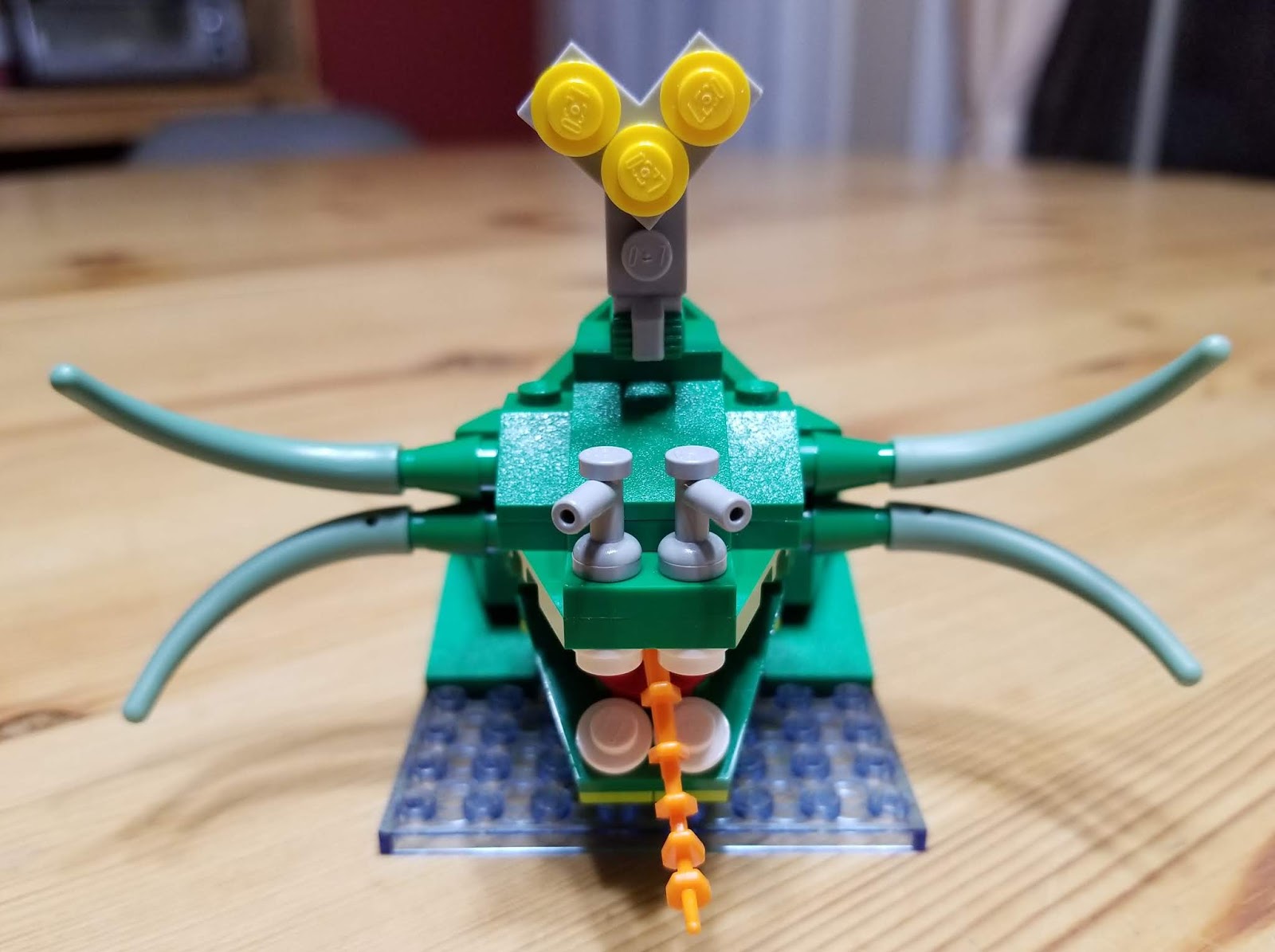
The froghemoth is a giant alien amphibian that first appeared in Expedition to the Barrier Peaks. Due to my interest in that module, I've followed Erol Otus's original design rather than the more recent art used in Pathfinder and D&D 5E. (The snorkel-like nostrils, built with faucet bricks, are one of these original details that I kept.) The body is built out of sloped bricks to create a hulking frog shape, with lighter colored bricks on the belly. The model is mounted on a 8x8 plate to mark the Huge space it occupies; I chose a transparent blue plate because of its watery home.

The four tentacles are attached to 1x1 cones and then to SNOT bricks; mini-slopes beside their bases help bulk up the "shoulders" a little.

The eyestalk is attached to a hinge mounted on jumper plates. (If the GM desires, this subassembly could be removed and placed on a smaller base, for when the froghemoth hides underwater with only its periscope-like eyestalk showing.)


The mouth's upper jaw is built as an extension of the main body piece, but the lower jaw is mounted on a 1x2 hinge brick so that it can open wide enough for the tongue (built from a 2x2 round plate and an orange vine piece) to shoot out to menace the froghemoth's prey.


Appendix: Past "Building the Bestiary" Columns

[#0]: How to Cheat (at Building) a Dragon
#1: Humanoids
#2: Underwater Races
#3: Giants
#4: Undead
#5: Tiny Creatures
#6: Four-Legged Friends
#7: Oozes
#8: Spell Effects
#9: Elementals
#10: Devils
#11: Aquatic Animals
#12: Vermin
#13: Non-OGL Monsters
#14: Plants
#15: For the Birds
#16: Serpentine Creatures
#17: Demons
Index

Tuesday, January 2, 2018

2017 in Review: The Blog


2017 has been a momentous year, for myself, for my blog, and for our country. However, I try to avoid discussing politics here, so I'll keep the focus of my review of the past year on my own work. I started this blog in late 2014, and have managed to keep it going on a weekly basis for most of the time since then, which is an accomplishment I'm quite proud of.

For those new to this blog, I write about roleplaying games, LEGO toys, and how I combine the two, with occasional forays into my other hobbies. I have a number of ongoing series that I add to as I find the time and inspiration. These include session summaries for the campaigns that I Game Master, reviews of RPG and LEGO products, and other subjects. Each item below includes a link to the most recent installment; most of those pages include links to previous columns in that series.

"Building the Bestiary" is my series on how I build LEGO miniatures for my tabletop role-playing games. It focuses on the first Pathfinder RPG Bestiary and the D&D 5E Monster Manual. It's my longest-running series here, with 17 installments, and I added an Index this year to help readers quickly find specific monsters I've covered.

I also post reviews of the collectible LEGO Minifigures Series once I acquire enough of each new set. I only wrote one such column in 2017 (The LEGO Batman Movie Minifigures), but I anticipate doing one of The Ninjago Movie Minifigures series sometime soon, as well as the upcoming second The LEGO Batman Movie series.

"Time of the Tarrasque" is a homebrew Pathfinder campaign that I started in January 2017. This is a world that I've been tinkering with for years (decades, really), so was very pleased for it to see actual play. We are currently on hiatus due to many of our players having changes in jobs and/or residences this fall and winter, but we hope to resume again soon. The heroes have reached 3rd level and I hope to see them advance to 20th level (and possibly some mythic tiers) by the end of the campaign.

I also started running Tales from the Yawning Portal (D&D 5E) for my wife and children this past year. We have completed The Sunless Citadel, and started The Forge of Fury over the kids' winter break. I'll be posting summaries of our first two sessions of Forge over the next couple weeks. (We previously started Lost Mine of Phandelver with some friends, but had to put that game on hiatus. Yawning Portal has allowed us to move forward with a more regular game.)

I am a long-time fan of Green Ronin's Freeport setting. My long-running third Freeport campaign, which ended in 2016, used D&D v.3.5 and later Pathfinder, but I've been considering using D&D 5E for my next foray into that setting. My Freeport 5E articles include reviews of Wizards of the Coasts' "Unearthed Arcana" and Plane Shift articles, Green Ronin's Book of the Righteous, and other 5E titles with an eye to using them with Freeport. I recently acquired Volo's Guide to Monsters and Xanathar's Guide to Everything, so expect columns about them within the next month or two.

I am also making an effort to get more experience with Green Ronin's Fantasy AGE system, and have started posting my thoughts on that game. 

Tuesday, December 5, 2017

Building the Bestiary #17: Demons

The original Types I-VI demons: (Back, L-R): II hezrou, III glabrezu, IV nalfeshnee;
(Front, L-R): I vrock, VI balor, V marilith.
Almost a year ago, I wrote a column on building the devils from the first Pathfinder Bestiary, and I included the marilith demon in my last installment (Serpentine Creatures). Now seems like the perfect time to take a look at the other demons in the Bestiary.

Dretch: cannibal (Pirates of the Caribbean); rock
monster (Rock Raiders); Gundabad orc (Hobbit)
Much of what I said about building devils will apply here. For example, Nexo Knights, Legends of Chima, and the collectible Minifigures Series are excellent sources of fiendish-looking minifigure and brick-built monsters. I'll also be referring to other past columns for details such as creature size (Giants) and building wings (For the Birds).

Dretch are the weakest of all demonkind. They are small humanoids with claws, fangs, and other bestial features. Build a savage-looking minifigure with short legs, or use short monster figures such as rock monsters (Rock Raiders) or scurriers (Nexo Knights).

Quasits are Tiny horned demons, the Abyss's counterpart to imps. In Pathfinder, they even have wings like an imp, but D&D quasits do not. For a winged quasit, use the Gargoyle or Cute Little Devil (Minifigures Series 14 and 16, respectively; see Imp in Devils). Alternately, a bat would be closer to the right scale (and makes a good imp as well). For a D&D quasit, simply omit the minifigure's wings. Salacious Crumb  (Star Wars) also makes an excellent wingless quasit, but he will need a brick to sit upon. You can also use a microfigure, such as one of the golems of Nathuz (LEGO Games: Heroica).

Babau are distinctive for the single curved horn on their head. As with the barbed devil, Bionicle Barraki make decent babau. You can also build one by sticking a 1x1 plate with a clip to the top of a minifigure's head, and attaching a rubber fang to the clip. The model shown uses the same tail assembly as the bearded devil.


The shadow demon can be based on any all-black minifigure, much like a shadow or wraith (see Undead), but it also has wings and horns. Use the Legends of Chima bat wings shown on the succubus and nabasu (below), or substitute a black cloak (as in the model shown here). The latter may be a better choice if the shadow demon appears in the same adventure with other winged fiends.

Shadow Demon: black skeleton, Ringwraith cloak (Lord of the Rings),
Maleficient's horns (Disney Minifigures)

A succubus always appears as a beautiful woman, and most fantasy art depicts them as scantily clad (if clad at all). The "Slave Leia" minifigure's body (Star Wars) is the best fit for the stereotype that I've found, but Lavaria (Nexo Knights) also works for a more obviously nonhuman demoness. The model shown here uses Lavaria's clear wing attachment piece and the Cute Little Devil's tail (Minifigures Series 16).

(D&D Fifth Edition lists succubi and incubi [the male form] separately from demons. For an incubus, simply add wings to a bare-chested male minifigure.)

Nabasu are bat-winged demons with somewhat bat-like heads. The most bat-like minifigures are the Vampire Bat (Monster Hunters and Minifigures Series 8) and Blista (of Legends of Chima's Bat Tribe). Alternatelty, any winged minifigure with a suitably demonic head will do in a pinch.

The remaining demons include the six varieties known as "type I" through "type VI" demons in first edition AD&D. Their current names first appeared as parenthetical alternate names, or names of individuals of their type.

A vrock (type I demon) is a Large vulture-headed and -winged demon. The simplest option is to use one of the Raven Tribe minifigures (Legends of Chima) on a Large base; I've added claws to make it more threatening. You can also start with a minifigure torso and legs and build the rest with bricks: 1x1 plates with clips to add claws to the hands and feet; some small bricks and plates to build a vulture's head; and a L-shaped neck bracket to attach wings and a tail. (See For the Birds about building bird heads and wings with bricks.)


A hezrou (type II demon) is a Large, muscular demon that looks vaguely toad- or lizard-like. See Giants for suggestions for building bipeds at this size (and the slaadi in Non-OGL Monsters for creatures with similar features). With some minor changes in color and head shape, the model shown here can also be used as a base for a dire ape or a barlgura demon (or a Pathfinder baregara [Bestiary 3]).


The glabrezu (type III demon) is one of the two Huge demons on this list. The model shown here uses many different connectors to join its various parts: click-hinges (legs and pincers), hinged plates (elbows), clip-and-bar hinges (neck), Technic pins (hips), and a 2x4 brick with pins at each end (shoulders). Because of the model's size and its free-swinging hip joints, I've used a Technic axle mounted in the base to keep it upright.


 The nalfeshnee (type IV demon) is also Huge. The first model shown here is a bit oversized, but I've included it as an example of a large monster built with the Hero Factory-style jointed chassis and plates. The brick-built boar's head is built around a Technic ball-socket connector.


Nalfeshnee head assembly

The Huge magma elemental in my Elementals column has an almost identical body design, as both were built to look ape-like. (The large buildable CHI Gorzan [set 70202] is simply too big for anything short of a Colossal ape, such as the humanoid gargantua from Oriental Adventures, or a giant version of the megaprimatus from Pathfinder Bestiary 5.) For a Gargantuan ape, remove the nalfeshnee's wings and tail, and give it a new head. A masked humanoid head from a Bionicle Toa or Hero Factory robot is probably best.

The second model modifies the Gorilla Legend Beast (set 70125) to create a properly Huge-sized nalfeshnee. These demons have significantly undersized wings for their body size, so minifigure-scale wings are not out of place on this demon. The boar's head has been scaled down to fit the Legend Beast's smaller ball-and-socket neck joint.

The marilith (type V demon) was covered in detail in the last installment, Serpentine Creatures.

The type VI demon was originally a balrog, based on Tolkien's monster, but the name was soon changed to "balor" to avoid copyright infringement. This Large winged demon has a fiery aura and fights with a sword and a flaming whip. The first model shown here uses the body of Jun-Chi, a "big figure" from the old Adventurers: Orient Expedition theme. (The same base was used for two other monsters in that subtheme: Tygurah and the Yeti. All three can be found on Bricklink for $5 and up each.) The horned mask is from the Islanders series (a subtheme of Pirates), the sword from Pharoah's Quest, and the wings and flame from Legends of Chima. Use a jumper plate to attach the minifigure head, and a SNOT plate and 1x1 clip plates to attach the wings.

The second balor model is brick-built. The basic shoulder and arm assembly is based on the ogre in LEGO GM's "LEGO Monster Manual": a 1x1 round plate connects each arm to a hole in a 1x2 brick in the torso, and a 2x4 car fender piece gives the shoulders some added bulk. Two 1x2 hinge bricks are used to attach the head and wings at an angle. SNOT bricks connect the torso to the legs, which are built of plates and slopes, with 1x1 "cheese-slopes" used for the cloven hooves. The balor is attached to the base with a single 1x1 brick, the hole of which fits over a single stud (1x1 plate) on the base. (This connection and the single-stud connections at the shoulders make mean this model does require some careful handling.)


Appendix: Past "Building the Bestiary" Columns

#1: Humanoids
#2: Underwater Races
#3: Giants
#4: Undead
#5: Tiny Creatures
#6: Four-Legged Friends
#7: Oozes
#8: Spell Effects
#9: Elementals
#10: Devils
#11: Aquatic Animals
#12: Vermin
#13: Non-OGL Monsters
#14: Plants
#15: For the Birds
#16: Serpentine Creatures
Index