Showing posts with label besm. Show all posts

Thursday, March 3, 2022

TBT: Misuhiro Yoko, a character for BESM

The following Big Eyes Small Mouth character was based on a minor background character from Revolutionary Girl Utena. She was originally posted to a RPG-related LiveJournal group (that I have since lost the name of) back in 2004. 

----------

Possible Utena Character: Misuhiro Yoko


This character was inspired by the shadow-puppet girls in Revolutionary Girl Utena, with the UFO/alien theme being played up in the latest episodes I've seen (I'm up to #29). I don't know how well she would fit into an Utena game, but if I end up playing in the game a friend of mine plans to run, this is the character I'll propose first.

Note: Because I don't own the BESM Utena book, Yoko was built with BESM 2E Revised, using Teen Romance costs for skills.

Misuhiro Yoko, Ohtomi Academy student, Grade 8 (25 CP)


Stats: Body 4, Mind 7, Soul 4 (15 CP)
Derived Values: ACV 5, DCV 3, HP 40, EP 55, SV 8

Attributes: Appearance 1 (1 CP), Art of Distraction 2 (2 CP), Highly Skilled 1 (1 CP), Own a Big Mecha 2 (Flying Saucer, 25 MP) (5 CP), Personal Gear 1 (1 CP), Shape Change 2 (Change gender only) (3 CP).

Defects: Nemesis (Kiryuu Nanami) (1 BP), Skeleton in the Closet (Alien posing as human) (1 BP), Special Requirement (Lay an egg once a month) (1 BP).

Skills: Biological Sciences 1 (Botany) (2 SP), Disguise 1 (Make-up) (2 SP), Linguistics 2 (Alien [native], English, Japanese) (4 SP), Mechanics 1 (Aeronautics) (3 SP), Melee Attack 1 (Sword) (5 SP), Melee Defend 1 (Sword) (5 SP), Performing Arts 1 (Comedy; Dance) (5 SP), Physical Sciences 1 (Astronomy) (2 SP), Piloting 1 (Spacecraft) (2 SP).

OBM: Flying Saucer (25 MP): HP 60.
Attributes: A.I. 1 (Basic Remote Control: Egg) (1 MP), Extra Capacity 1 (1 MP), Flight 4 (16 MP), Heavy Armor 1 (4 MP), Space Flight 1 (2 MP), Summonable 1 (4 MP), Toughness 1 (4 MP).
Defects: Awkward Size 1 (1 MBP), No Arms (2 MBP), Poor Maneuverability 2 (2 MBP), Restricted Ground Movement (None) (2 MBP), Summoning Object (Egg) (1 MBP).

Personal Gear: fencing sword and protective gear; alien "egg" amulet (summons and controls OBM).

Yoko is a human-like alien who came to Earth about a year ago. She has no training at navigation, and her old, hand-me-down saucer is notoriously clumsy, so she soon crash-landed. She decided that enrolling in the school would be the perfect cover while she repaired her spaceship. She has managed to be assigned to a mostly abandoned building, with space to summon and work on her saucer; she has fixed the crash damage, but has not solved the ship's shaky handling, so dares not leave the relative safety of her new home.

Yoko is an excellent student, who has joined the theater and fencing clubs. She is fairly well-liked, in spike of Nanami-san tormenting her for being "weird"--but Nanami has yet to guess just how weird she really is! As an adolescent member of her alien race, Yoko lays a boldly patterned egg once a month; she can usually hide this process (and the resulting day or two of reduced energy) under the cover of "the monthly miracle." In Episode #27: "Nanami's Egg," Yoko may be responsible for the egg Nanami found; she hoped it would mess with her rival's gullible mind. The eggs are not fertile unless Yoko mates with one of her own kind, and she is not aware of any others currently living on Earth. Her saucer's remote is modeled after one of her eggs, but is far less delicate.

Yoko has one other alien power that she rarely uses, and never where she could be seen: Her species is able to switch gender at will (except when laying eggs). Her male form looks like a nearly identical twin, and she will claim to be her brother "Ryo" if seen in that form. (However, no "Misuhiro Ryo" is enrolled at Ohtori Academy, so "he" must vanish quickly if questioned.) She usually carries a boy's uniform in her duffel if she foresees any need to use this ability.

----------

I never did get an opportunity to play Yoko in BESM. However, she did form the starting point for a NPC I created for "Grey Angels," the long-running Buffy/Angel series that I joined soon after that original post. In that game, she was an international student from Japan, who was shy and awkward but a genius with math and science. Her secret was that she was a half-Byblos demon (a knowledge-seeking race from the Angel RPG) who had been stranded in this dimension and was trying to reestablish contact with her people. At one point, she managed to rope the superscientist player character into helping her traipse all over campus (and beyond), taking readings with some weird sensory apparatus of her own design, but I don't recall her story ever getting much further than that. 

Since that game, I've read Neil Gaiman's surreal short story "How to Talk to Girls at Parties" (and more recently, the Dark Horse comic adaptation). If I ever use Yoko in another game, I expect that story to exert some influence on her, too.

The current "reunion arc" of "Grey Angels" has allowed me to revisit Yoko's story indirectly: I have introduced an NPC who is the daughter that Yoko left behind when she left for parts unknown 13 years ago. Sakura Masterson has been fun to play so far, and will likely be one of my main PCs for the "next gen" game we've been bantering about as a way to continue using the setting after the current crises are resolved.

And yes, I did finish watching Revolutionary Girl Utena not long after I finished that original post above. It's a bizarre series that gradually builds up to one of the weirdest climaxes of any anime I've ever seen, but I recall enjoying it, even the inexplicable nonsense parts of it. My "Grey Angels" character Trick Tillinghast, a fencer with a pronounced romantic streak, was very much a fan, and even dressed up as Utena for her masquerade-themed high school prom. In retrospect, her strong affinity with that character should have been a clue--one of many!--that she was not quite as straight as both she and I originally thought. But, hey, it took Utena a while to get there, too, and both were happier once they did.

Tuesday, October 2, 2018

The Kynthiad: Sources for reference and inspiration

Artemis, goddess of the hunt
For the past 11 years, I have been running a solo RPG campaign for my wife Erika, using the Big Eyes Small Mouth rules. "The Nine Journeys of Kynthia," AKA "The Kynthiad," is set in the world of ancient Greek mythology, with a certain amount of real-world Bronze Age history mixed in with the purely fantasy elements. Over the course of the game, I have drawn details and inspiration from a great many sources, the most important ones of which I'll briefly touch on here.

A more complete bibliography of the game's sources can be found here, but that page lacks the commentary I'm giving in this column.

The Game System

The campaign uses BESM Third Edition. The Second Edition BESM Fantasy Bestiary includes a large number of creatures based on Greek mythology, many of which I have converted to Third Edition or used as a benchmark for my own versions. Big Ears, Small Mouse has also been invaluable in designing smaller creatures, and animals in general.

Other RPG Sourcebooks

My lifelong interest in history and mythology has resulted in a good-sized collection of sourcebooks for other game systems that I've been able to use as reference for The Kynthiad. To start with, I have a large GURPS library of over 40 titles. The research put into that game's historical and genre sourcebooks is pretty solid, and most of the subject matter is system-neutral. Unsurprisingly, GURPS Greece and Egypt have seen the most use, but Bestiary, Fantasy Bestiary, Monsters, Places of MysteryTimeline, and even Celtic Myth have all been very useful, too. In GURPS Greece, author Jon Ziegler even provides a timeline that tries to make sense of the often-contradictory sequencing of the major myths, which I've adopted mostly intact as a framework for the recent history and current events of The Kynthiad.

Green Ronin Publishing's "Mythic Vistas" product line includes a couple titles that are great references for this game: Trojan War covers the most famous conflict of the period, and Testament provides information on the ancient Hebrews, Canaanites, Egyptians, and Mesopotamians.

There are also a few older D&D sources that I've used in my research for the game. I own the Dragon Magazine CD Archive--which includes occasional mythology-themed gems such as Michael Parkinson's "The Blood of Medusa"--and the Age of Heroes Historical Reference sourcebook. (I also own the deities sourcebooks for 1st, 2nd, and 3rd edition, but I find the treatments of the Greek gods in books such as Trojan War to be far preferable to these versions, all of which devote far more space to game mechanics than to divine lore.)

History

I have used a combination of ancient and modern texts to research the ancient Near East. Herodotus's Histories provide a wealth of detail about the world of his time (circa 440 BC), and he isn't stingy about relating myths tied to the events, people, and places he'd writing about. Even though he's writing several centuries after the "Heroic Age," the Histories have provided me with a wealth of details to flesh out obscure parts of the world such as the Scythians, Amazons, Medes, and Hyperboreans.

Probably the most important scholarly text that I've read in preparing this game has been The End of the Bronze Age: Changes in Warfare and the Catastrophe ca. 1200 B.C., by Robert Drews (Princeton University Press, 1993). This book takes a detailed look at the widespread sacking of Mediterranean cities contemporary with historical Troy, and the technology and tactics that contributed to it. The section on chariot design and tactics alone is worth the read, just to dispel a lot of common misunderstandings about how war was conducted at that time.

Mythology

My collection of translations and retellings of Greek mythology is far too large to catalog briefly, but a few items stand out as most useful to a GM trying to run a roleplaying campaign in this setting.

Robert Graves' Greek Myths is one of my primary reference works for quickly finding summaries of many stories, and following connections between them. My copy (The Folio Society, 1966) has an index of names which includes the meanings of many of them. Each section of the main text is followed by Graves' notes on sources, and his theories about the origins and meaning of the myths. Many of these notes are typical scholarly glosses, but in some passages, Graves expounds on his own bizarre pet theories about the subject at hand (however tenuously linked that subject and his theory might be). To give just a couple examples, he shares Frazer's obsession with attributing everything to sacred kings and fertility cults, and he has some very radical (many would say crazypants) ideas about the secret tree lore of the Druids. However, I have managed to distill a number of very useful ideas for use in my RPG campaign from his weirder ramblings.

My other favorite reference is Carlos Parada's Greek Mythology Link website, which is a massively hyperlinked database of people and places in Greek myths, including footnotes giving the original period sources for each page's topic. Special features of the site include genealogical charts, contextual charts (e.g., events before, during, and after the Trojan War), and detailed maps. These graphics are often limited in resolution on the website, but can be purchased as high-resolution PDFs. I acquired my copies several years ago, back when a handy and inexpensive archive of the complete database was available for purchase on CD.


Film

Naturally, movies and television have provided a great deal of inspiration for The Kynthiad. Series like Hercules and Xena play much more "fast and loose" with historical periods than I'm ever going to in this campaign, but they're still good for mining for story ideas. Movies like Clash of the Titans, Jason and the Argonauts, Troy, and Gods of Egypt provide great over-the-top battle scenes to use as models for RPGs involving gods and monsters, despite their many deviations from the classical versions of those stories. (I used to get much more bent out of shape over the liberties the screenwriters take with the source material, until I realized that the ancients were just as guilty of it.)

As I mentioned in an earlier column, I cast most characters in The Kynthiad using real-world actors so that my wife and I have a common frame of reference for them. The movie Troy was released just a few years before we started the campaign, and I knew that many of those characters would appear in the game, so it was easy to just keep the same casting for most of them. To cast other roles, I've drawn from a wide variety of other movies and TV shows--many but far from all of them being period pieces or fantasy films--to find suitable actors. In most cases, I limited myself to living actors whose current ages fit the parts I choose for them, but I have made a few exceptions. For example, Jolene Blalock played Medea in a TV movie of Jason and the Argonauts in 2000. My game is set a generation later, but Medea is a demigoddess who doesn't age as quickly as mortals do, so my reference photos for her include that costume as well as more recent headshots. Similarly, a handful of actors have died since I started the campaign (most notably Alan Rickman and Peter O'Toole), but I continue to use them in the game.


If you have a favorite source for information on the ancient Near East and its history and mythology, please share a link in the comments!


Past posts about "The Kynthiad"

Thursday, August 16, 2018

#RPGaDay2018: Days 4-5, 11-12

As I mentioned in my post earlier today, I participated in #RPGaDay in 2015, 2016, and 2017, but this year, I wasn't reminded of it until the middle of the month. So, to start with, I'm going to choose a handful of questions from the first two weeks. I may or not return to the skipped ones later in the month.


WEEK ONE: WHAT...
1) ...do you love about RPGs?
2) ...do you look for in an RPG?
3) ...gives a game "staying power"?
I'm going to skip these three, at least for now.

4) Most memorable NPC?
That would have to be one of the witches from my "Kynthiad" BESM campaign who I've talked about here. Medea, Archemora, or Luscina all made a lasting impression on Kynthia, and she's had to deal with each of them on multiple occasions by now.

5) Favorite recurring NPC?
In the distant past, that would definitely be Thastygliax, an NPC from my "Arcadayn" campaign (GURPS 3E). He was a young dragon who was curious enough about humans that he had learned a spell to adopt human form at will. It was in this form, using the name "Al-Zaki," that he met the party and started traveling with them.

More recently, it would be one of many of the recurring NPCs in the "Kynthiad," but I would have trouble choosing a favorite. One of the more interesting from an overall story arc perspective is  Thaleia. This beautiful Hyperborean princess had been romantically involved with Kynthia's beloved Anahodios some years before the campaign started. Thaleia started as a jealous bitch who enjoyed making Kynthia feel drab and unworthy. She eventually went too far and was exiled after Anahodios's sister consumed a nasty drug concealed in a gift meant for Kynthia. The next time Kynthia encountered her, Thaleia had taken over part of a distant tribe, and was using them to carve out a kingdom for herself in the Tin Isles. They made an uneasy truce, because they had a common enemy: the witch Luscina. Years later, Kynthia returned to the Tin Isles because a vision warned her that Thaleia's life was in danger. She saved her old rival (and her newborn daughter), and in the process, the two earned each other's grudging respect. Thalaia's exile had been revoked by then, but the princess refused to return home: she was a queen in her own right now, and felt responsible to the people she ruled.

WEEK TWO: HOW...
6) ...can players make a world seem real?
7) ...can a GM make the stakes important?
8) ...can we get more people playing?
9) ...has a game surprised you?
10) ...has gaming changed you?
I may get back to these later.

11) Wildest character name?
Finnilish Tremolile Boggarty Quince. He was an ugly, dwarfish half-elf mage who I played briefly in my friend Rich Feitelberg's GURPS 3E fantasy campaign. He was physically quite weak, and his spells were more trickery-oriented than battle magic, so he was rarely effective at anything. He was not nearly as much fun as my previous character, Sura El-Khadijah, a Muslim weapon master, had been.

12) Wildest character concept?
For a one-shot BESM (1E) game, I created Aldebaran Alamut, an genetically-engineered anthropomorphic albino alligator who worked as a plumber in the sewers. (Considering that one of the other PCs' concept was a retired "last year's model" sex droid, "Al's" origin was not that outre, in context.)

Wednesday, August 8, 2018

Big Ears, Small Magician

Mr. Snark is a magical talking white rabbit who used to be the pet bunny of a famous stage magician. Through some combination of genetic mutation and exposure to real magical power, he now possesses the ability to speak, stand on his back legs, and use his forepaws as hands. He has also acquired more magical talent than his master ever possessed, so now he has his own solo career as a stage magician. He is, however, still the size of a rabbit. He is always dressed in a top hat and cape.

Mr. Snark was created as a character for the Big Eyes, Small Mouth RPG. The Revised Second Edition stat block below uses the Teenage Romance genre costs for Skills, while the Third Edition version uses the Multigenre costs. In both editions, he has the ability to enter a tiny pocket dimension that he uses to vanish during magic acts--and when he needs to disappear for any other reason. (Mr. Snark knows he's no good in a fight; he employs trickery instead.) He needs to cover himself with a cape in order to enter this pocket dimension, but not to leave it.

Finally, in the Third Edition stat block, the reduced running speed for the Tiny template has been removed, and he has been given Fast instead.

Mr. Snark, The Magician Rabbit (BESM Revised Second Edition; 25 Points)

Stats: Body 4, Mind 5, Soul 7 (16 CP)

Attributes: Dimensional Portal 1 (Any capes, two apertures) (5 CP), Features 1 (Night Vision) (1 CP), Highly Skilled 1 (1 CP), Illusion 1 (Sight, hearing, and smell) (4 CP), Jumping 1 (1 CP), Personal Gear 1 (Magic props and costume) (1 CP), Sixth Sense 1 (Detect Magic) (1 CP), Speed 1 (1 CP)

Defects: Diminutive (3 BP), Easily Distracted (Carrots) (1 BP), Marked (Talking white rabbit) (2 BP)

Skills: Acrobatics 2 (Jumps) (6 SP), Sleight of Hand 5 (Stage Magic) (15 CP), Stealth 3 (Silent Movement) (9 SP)

Derived Values: Attack Combat Value 5, Defense Combat Value 3 (5 vs. ranged attacks), Health Points 11, Energy Points 60, Shock Value 2


Mr. Snark, The Magician Rabbit (BESM Third Edition; 200 Points)

Size: Tiny (-2)

Derived Values: 
Attack Combat Value 5 (Ranged 7)
Defense Combat Mastery 5 (Ranged 7)
Damage Multiplier 5
Health Points 55, Shock Value 16, Energy Points 60

Value/Points/Stat
4  / 40 / Body Stat
5  / 50 / Mind Stat
7  / 70 / Soul Stat

Rank/Points/Attributes
2 / 10 / Attack Combat Mastery (Ranged Attacks)
2 / 10 / Defense Combat Mastery (Ranged Attacks)
2 / 15 / Dimensional Portal (Earth to his Pocket Dimension, and back; Unique Variable -1: Requires a cape to reach Pocket Dimension)
3 / 3 / Features (Appearance 1, Increased Shock Value +5, Fur)
1 / 2 / Heightened Awareness
1 / 2 / Heightened Senses (Smell)
2 / 6 / Illusion (1 m radius; Extra Senses: Smell, Sound)
-- / 1 / Item (Magician's hat, cape, wand, and other props)
1 / 2 / Jumping
2 / 8 / Pocket Dimension (1 m)
1 / 2 / Sixth Sense (Magic)
3 / 9 / Skill: Acrobatics (Jumps)
3 / 6 / Skill: Burglary (Breaking and Entering)
2 / 2 / Performing Arts (Fast Talking)
5 / 10 / Sleight of Hand (Stage Magic)
3 / 9 / Stealth (Silent Movement)
1 / 2 / Special Movement (Fast)
2 / 2 / Unique Attribute (Small and Light)

Points/Defects
-1 / Easily Distracted (Carrots)
-3 / Marked (Talking white rabbit)
-24 / Unique Defect (Lifting Capacity x1/100)
-20 / Unique Defect (-8 Attack Damage)
-6 / Unique Defect (x1/4 Thrown Weapon Distance)
-8 / Unique Defect (Suffers +8 Extra Damage Each Attack)

Total: 200 Points

Friday, August 25, 2017

#RPGaDay 2017: Day 26


26th) Which RPG provides the most useful resources?

GURPS. I haven't played GURPS in about 15 years, but I still own a shelf full of GURPS historical sourcebooks, and have used them as references for games using very different rules systems. For example. I've used GURPS Greece, Egypt, Celtic Myth, Places of Mystery, and Fantasy Bestiary, among others, for my BESM Greek myth campaign; and GURPS China, Places of Mystery (again), and Arabian Nights when working on a Silk Road caravansarai LARP.

I also tend to reread sourcebooks that contain conspiracy/secret history/alternate history/occult content (GURPS Illuminati, Atlantis, Cabal, Atomic Horror, Warehouse 23, Monsters, etc.) every few years, because I've long wanted to try running a game of that sort. If I ever do, it probably won't be in GURPS, but I would be constantly using those sourcebooks throughout the game.

Wednesday, August 23, 2017

#RPGaDay 2017: Day 23


23rd) Which RPG has the most jaw-dropping layout?

This is a difficult question for me to answer, partly because "jaw-dropping" is not a word that often occurs to me when considering RPG books, and partly because I own a number of quite lovely RPG products.

I've already mentioned the full-color interior art of Blue Rose, Second Edition (see Day 12). The book's art director and graphic designer, Hal Mangold, has been making Green Ronin books look amazing for quite some time now, and he keeps finding ways to outdo himself time and time again. Other titles that Hal has designed in the past 2-3 years include Freeport: The City of Adventure, the Freeport Bestiary, and The Book of the Righteous--and those are just the gems that I personally own.

Apart from Hal's work, the first book that occurs to me is Big Eyes Small Mouth, Second Edition. The rulebook was in full color, with a bright, bold layout and lots of lots of colorful anime-style art throughout. (Sadly, I lost my copy in a flood. My Second Edition Revised book survived; it reproduced most of the art, but often at a smaller size and only in black and white.) The BESM Third Edition rulebook was full color and quite pretty as well, but it just wasn't as lush in presentation as the Second Edition.

And finally, I composed most of this post ahead of time, before I bought the Starfinder Core Rulebook last week, but that book deserves at least an honorable mention here.

Friday, August 18, 2017

#RPGaDay 2017: Days 18-22 (Eclipse Edition)


My family and I will be traveling the next few days to see the total eclipse and do general sightseeing in Nashville, so I've decided to post my answers to the next few days' questions now.

18th) Which RPG have you played the most in your life?
19th) Which RPG features the best writing?
20th) What is the best source for out-of-print RPGs?
21st) Which RPG does the most with the least words?
22nd) Which RPGs are the easiest for you to run?


18th) Which RPG have you played the most in your life?

This is an easy one: Dungeons & Dragons. I've been playing and DMing one edition or another of that game ever since I was first introduced to RPGs in middle school around 35 years ago. I played Basic and Expert in middle school, Advanced in high school, and 2nd Edition in college. I promptly adopted v.3.0 and v3.5 when they were released, but didn't care for 4th Edition much, so continued running and playing v.3.5 until my group decided to switch to Pathfinder a few years ago. Fifth Edition has won me back, and I'm running it for my kids so we can all learn the new rules.

19th) Which RPG features the best writing?

I'm not sure how to judge the "best" writing, but I would have to say that the Buffy and Angel RPGs are the two rulebooks that have been the most entertaining to read. Most RPG rulebooks tend to get pretty dry reading after a while, but very little of the Buffy core rulebook is. The prose is very conversational, and peppered with witticisms in the style of the TV series--but that casual, snarky style never gets in the way of explaining the rules clearly.

20th) What is the best source for out-of-print RPGs?

Given my shopping habits, I'd have to say RPG hobby shops and used book stores.

Many game stores will have a used game section, where items are greatly discounted. When I lived in Boston, my FLGS (Pandemonium Books and Games) had a rather extensive used game section, with most items marked at half the cover price. Some games languish on the used shelves because they just aren't good enough to sell even at a discount, but you can occasionally find a real gem among the dross. Pandemonium also had a "Black Hole" clearance shelf for items (both used and new) that hadn't moved in far too long; as time passed, those items moved to gradually more discounted shelves, ending at 90% off if still not sold.

Used bookstores will sometimes have role-playing games sections. Both Half Price Books stores in my area (Lexington, KY) have a full bay of RPG books, from a wide variety of games, both recent and venerable. Though none of the following were out of print, I scored a huge pile of Pathfinder hardcovers at HBP last year, and discovered the OneDice system there, which I bought for my kids.

21st) Which RPG does the most with the least words?

Fate Accelerated Edition. This 48-page book distills all the essential elements of the Fate system into a compact, streamlined game that can be used for almost any adventure genre.

This system is used in many of Evil Hat Production's recent games, like the new edition of Dresden Files. My one opportunity to play it so far was a short campaign using Do: Fate of the Flying Temple.

Best of all, the rulebook is available as a pay-what-you-like PDF from the Evil Hat website, or for only $5 in print.

22nd) Which RPGs are the easiest for you to run?

BESM Third Edition and D&D Fifth Edition. I'm sure that I would find BESM a lot more work to run for any campaign that was not a solo game, but for that, it's served us extremely well.

I'm still learning D&D 5E, but the rules are far, far simpler than any edition since 2nd, and it still captures the classic feel of the game. Running published adventures for my kids (Lost Mine of Phandelver and The Sunless Citadel) has been pretty easy so far. And it's the first edition in a while that I would not feel completely overwhelmed using to run the massive and dangerous Expedition to the Barrier Peaks (which, as I've discussed here before, is a goal of mine).

Monday, August 14, 2017

#RPGaDay 2017: Day 14


14th) Which RPG do you prefer for open-ended campaign play?

Pathfinder and BESM Third Edition.

My current gaming group's game of choice is Pathfinder. I've used that system for my most recent Freeport campaign, and for my current "Time of the Tarrasque" game (which technically has a planned end point around 20th level or so, but it's going to take us a few years of game play to get there, and I have very little planned out between now and then).

I use BESM 3E for the solo Greek myth campaign that I run for my wife. That game is extremely open-ended, though after 10 years of play, I'm actively trying to work out a suitable climactic stopping place for us in the near(ish) future.

D&D 5E will probably end up taking BESM's place as one of my go-to games once I master the system a bit more. I'm currently running published 5E modules for my kids, since Tarrasque takes up so much of my "create new stuff" headspace.

Friday, August 11, 2017

#RPGaDay 2017: Day 11


11th) Which 'dead game' would you like to see reborn?

Big Eyes Small Mouth. When Guardians of Order folded due to financial troubles, the Third Edition of the game had not yet been printed. White Wolf finally published the book under their Arthaus imprint, but no support for the new edition was ever produced.

For the past decade, I've been using BESM 3E for "The Kynthiad," a solo Greek myth campaign that I run for my wife Erika. I would like to try it out in the context of another campaign (either as player or GM), but haven't had the opportunity yet. I considered BESM for my "Winds of Freeport" campaign before settling on D&D v.3.5. (You can see my preliminary conversion notes for that here.) If I ever return to my "Adventures of Arcadayn" setting, BESM is one of the systems that I would consider using instead of GURPS (and the wiki already has some partial conversion notes for BESM 3E).

Wednesday, August 9, 2017

#RPGaDay 2017: Days 9-10


(My answer for Day 10 is very short, so I've added it to this post instead of doing it separately tomorrow.)

9th) What is a good RPG to play for about 10 sessions?

Most RPGs are well suited to a story arc that takes about 10 sessions. For a Buffy or Angel game, 10 episodes is just about right for a first season, or a stand-alone "mini-series." A longish published d20 adventure can often take about 10 sessions, and can allow the party to level a couple of times, depending on the scenario.

BESM (any edition) and Fate Accelerated Edition are good choices for more rule-light games in this time-frame. My first experience running BESM was a fantasy mini-campaign using Second Edition. I could have easily stretched that game to 10 sessions, but we reached a perfectly satisfactory resolution after five somewhat-longer-than-usual sessions.

The FAE game that I mentioned yesterday made it to 8 sessions before scheduling issues sidelined it; just a couple more sessions could have given it the proper closure it needed.

10th) Where do you go for RPG reviews?

My answers to this are pretty much the same as to Day 3's question (How do you find out about new RPGs?).

Thursday, August 3, 2017

#RPGaDay 2017: Day 4


4th) Which RPG have you played the most since August 2016?

Pathfinder. In August 2016, I wrapped up my most recent Freeport campaign (which started in v.3.5 and was converted to Pathfinder halfway through) and started trying out Pathfinder Society (Paizo's organized play program). I also started my new Pathfinder campaign, "Time of the Tarrasque," in January 2017.

The runner-ups would be D&D Fifth Edition (which I've been running for my kids) and BESM Third Edition (which I use for "The Kynthiad," the solo Greek myth campaign that I run for my wife).

Wednesday, June 21, 2017

Some Big Anniversaries as a Game Master

2017 brings three significant anniversaries for me as a Game Master.

First, I have been running RPGs for my kids (now 13 and 11) since sometime in 2012--five years! It's been very on and off again over that time, but now that I'm running some D&D 5E modules for them, it should be a much more regular part of our lives.

Second, the end of July will mark 10 years since I started "The Kynthiad," the solo Greek myth BESM game that I run for my wife Erika. I wrote about this game at some length around its anniversary two years ago, and a few times since.

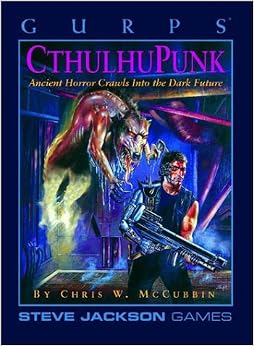
Image result for gurps cthulhupunkThird, 20 years ago this May, I GMed my first game for Erika and her best friend, Seanna Lea--both of whom still plays in most of my games to this day. That "Cthulhu 2000 AD" campaign was a modern-day Lovecraftian game using GURPS CthulhuPunk, and was my second attempt at running GURPS. I had first tried the system--briefly--in college, and it was the system of choice for the first regular gaming group that I joined after moving to Boston. I decided to use GURPS rather than Call of Cthulhu because I was more familiar with that system, and because I preferred to have more fully developed characters then was possible with CoC's very simple character generation. I made a number of mistakes, mostly in ensuring party cohesion, and in balancing "waking world" vs. Dreamlands adventures, but we all had fun over those 15 months. A couple of years later, I ran a one-shot for Erika and Seanna Lea's characters in order to provide them better closure than I had able to do before the campaign's end. (By then, I had also been running a GURPS fantasy campaign--"Adventures in Arcadayn"--for Erika, Seanna Lea, and another friend for a couple years, but that is, as they say, another story.)

Shortly after that final one-shot, I posted some of my notes on this campaign (and the previous one, which was also a Cthulhu game) to my gaming website. That was on Yahoo! Geocities at the time, and I migrated those notes to Wikispaces when I had to switch hosts some years later. By the time I migrated Thastygliax's Vault to Google Sites in 2014, I had so many different campaign archives to move that the GURPS Cthulhu games were among the lowest in priority, so they did not get moved at that time. While working on that migration, I discovered that many (but not all) of those pages could be found on the Internet Archive Wayback Machine*. That meant that I could still post a link to that content until I got around to posting it on my new site. I did so, but included a caveat about the Wayback Machine's archive not being 100% complete.

Then I didn't think about those pages again for a couple years, expect for the briefest of moments every time I opened the Vault's homepage. Those Cthulhu games are the oldest campaigns that I have listed there, so are at the top of the list of links. This past week, I finally took the time to add My GURPS Cthulhu Campaigns to the Vault, so that I could delete that annoying little caveat. It was while I was preparing those pages for their new home that I realized that I had started my "Cthulhu 2000 AD" campaign 20 years (and a few weeks) ago.

Erika and Seanna Lea are certainly open to me running more Lovecraftian games, evidenced by the fact that they've played in all three of my campaigns set in Green Ronin Publishing's Mythos-tainted Freeport: The City of Adventure. There is a chance, albeit a very slim one, that we may revisit their "Cthulhu 2000 AD" characters someday, for nostalgia's sake. But it would almost certainly be in a different game system, and might not have much continuity with the original campaign. The most obvious choice of system is GURPS Fourth Edition (which I own but have never had a chance to try out) but their characters would work just as well (if not better?) in the Buffy/Angel version of Unisystem.

Happy anniversaries, Erika and Seanna Lea!


* Another old project of mine that I found on the Wayback Machine was GURPS Sluggy Freelance, which I briefly posted about this past weekend after copying it to the Vault.


Thursday, October 27, 2016

The Kynthiad: The Witches

Hecate, the witch goddess
With Halloween just around the corner, I thought I'd devote this week's column to that theme and talk about witches. Not just any witches, mind you, but the witches featured in "The Kynthiad," the Greek mythology solo campaign that I run for my wife Erika. Her character, Kynthia, is a champion of the goddess Artemis, who travels about the world on quests given to her through visions or other messages from the gods. The witches who Kynthia has encountered have proven to be some of the most memorable recurring characters in this campaign.

The witches of Greek myth were always powerful and terrifying. The ability to wield magic was rare, but was dangerous because it was capable of nearly anything, though each witch had her own particular area of expertise. A strong will was necessary to wield such power, and in the ancient world, such independent women were almost universally feared and hated. They were typically described as beautiful enchantresses, who wielded their sex appeal as proficiently--and as wantonly--as their spells. Unsurprisingly, the most powerful witches were demigoddesses in their own right: Circe and Medea were descendants of Helios, Titan of the Sun, and received their first instruction in magic from that god.

Medea (Jolene Blalock)
The first witch that Kynthia ever met was Medea herself. By that time, Kynthia had met and fallen in love with Anahodios, the handsome winged grandson of Boreas, the North Wind, who accompanied her on her quests ever since their first meeting. While seeking out Prometheus in the Causasus, the two took shelter in a cave. Kynthia woke during the night to find a mysterious woman sitting by their fire, while Anahodios had fallen into an abnormally deep sleep. Medea quizzed her about her business in this part of the world, then departed. Kynthia was left shaken by the encounter, knowing Medea's reputation all too well--Anahodios was, after all, the son of an Argonaut (Zetes).

Later, when traveling across northern Africa, Kynthia and Anahodios were captured by a band of women warriors who took them to the camp of their mistress, Archemora. This witch attempted to seduce Anahodios and nearly succeeded. Kynthia managed to break free and rescue her beloved, then they (literally) took flight before the witch had another chance to weave any more spells. After this encounter, Kynthia was justifiably paranoid about witches stealing her man!

While traveling near Sicily and the Strait of Messina, Kynthia learned the story of the nymph Scylla, who had been cursed into monster form by Circe. Of her own initiative--and encouraged by Scylla's mother, the goddess Hecate--Kynthia set herself the task of restoring the nymph to her proper form. This required visiting Circe to ask the witch to lift her curse. Kynthia's knowledge of the voyage of the Argo allowed her to approach the witch as a suppliant who could not be harmed without angering the gods. Naturally, Circe was loathe to release her victim, so she set Kynthia three impossible tasks in order to get the necessary ingredients for the antidote: an Erinyes's tears, a kiss from the nymph of the pool of Lethe, and the caul from a virgin birth. This required Kynthia to enter the underworld, a harrowing journey that still haunts her. But to Circe's surprise, she succeeded--returning with Lethe's newborn son Scotius, marked by the kiss and tears, and his caul. Because Kynthia was woefully unprepared to care for a chthonic goddess's ill-omened child, she left him with Circe and took the cure to Scylla.

Kynthia met even more witches in the Tin Isles (modern Britain). She discovered that the Hyperborean princess Thaleia (an old rival for Anahodios's affections) had led an invasion of the island and taken control of the Atrebates, one of the Celtic tribes there. This led to a clash with two other tribes, the Silures (who Kynthia made peaceful contact with) and the Dumnonii, that was decided by a contest of seers at the Giant's Dance (Stonehenge). This contest was orchestrated by Luscina, a Dumnonii sorceress, whose plans failed when Kynthia took the place of the Silures tribe's witch and divined the answers to the tests she posed.

Archemora (Kelly Hu)
Both Archemora and Luscina became recurring villains who Kynthia grew to hate more passionately with each encounter. Archemora next showed up in the mountains near Hyperborea (Kynthia's new home after marrying Anahodios), but was left stranded there after Kynthia shot down her pet griffin. The witch later appeared in Cimmeria, where Kynthia's distant cousin Ophiophane was waging war to claim her late father's throne. Archemora had insinuated herself into the usurper's court (and his son's bed), so while Ophiophane faced off against the king in the final battle, Kynthia and Anahodios took on their old enemy. The witch escaped thanks to her magic cloak, which allowed her to take the form of a flock of crows--which made it impossible for a single arrow to kill her. Years later, Kynthia encountered her one last time, near the witch's original home in Scythia. This time, her target was the king of the Medes (and Medea's grandson). When Kynthia and Anahodios discovered her there, they pursued her doggedly until they had shot every crow in the cloak's swarm, which finally killed the sorceress. At this point, Medea arrived on the scene and thanked Kynthia for disposing of the other witch, as she had other plans for who her grandson should marry to carry on the Heliad dynasty.

Luscina (Christina Hendricks)
Unlike Archemora, Luscina still lives, and Kynthia has yet to engage in actual combat with her. A vision of Thaleia in childbirth dying sent Kynthia back to the Tin Isles. The people of Thaleia's consort's tribe spend a few days of each year as wolves, but this "gift" normally doesn't manifest until puberty. Thaleia's child had been cursed to be born in wolf form, and only Kynthia's miraculous healing powers allowed her old rival to survive the bloody birth. They determined that Luscina was responsible, so Kynthia went in search of the witch in order to force her to lift the curse. Along the way, Anahodios fell prey to a wasting curse, which also proved to be the Dumnonii woman's fault. It was also the only reason that Kynthia didn't shoot her on sight, because (as with Circe's work) only the witch who bestowed the curse could lift it. Luscina demanded a terrible price for Anahodios's cure: a night alone with him, and he would have to do his best to please her. This ordeal left both Anahodios and Kynthia traumatized...but he lived. If Kynthia and Luscina ever cross paths again, the witch will not.

More recently, the campaign has taken a new turn, with Kynthia trying to find allies against the danger posed by the impending return of the monstrous god Typhon. Most of the Olympian gods are currently distracted by an unfortunate little squabble known as the Trojan War, so Kynthia has had to seek help elsewhere. An Egyptian sorcerer revealed to Kynthia much of the secret history behind Typhon's first war against the gods, and suggested that she help him seek out other magicians for help in determining how to avoid (or if necessary, fight) a second one. As a result, Kynthia has introduced Hori to Medea--a very momentous occasion, given how little trust there is between practitioners of magic. But even with Medea as an apparent ally, Kynthia was grateful to part ways with the witch again--the woman still unnerves her like no other, except maybe her aunt Circe.

Meanwhile, Kynthia has learned that the baby she helped deliver in the underworld is actually Typhon's son. Scotius has grown to adult size in just a few years, and has developed powerful magical abilities of his own. Kynthia now has to determine what part Scotius is destined to play in his father's return--and what to do about it when she does...

Wednesday, January 6, 2016

Adventures in Arcadayn

Like most gamers my age, I was introduced to role-playing games through Dungeons & Dragons. (My first experience was in middle school in the early '80s.) I played D&D almost exclusively through middle school, high school, and most of college. I did find opportunities to briefly try a few other systems, including Star Frontiers, Tunnels & Trolls, Marvel Superheroes, and GURPS, but I never played or ran any long-term campaigns outside D&D until I moved to Boston as a graduate student. The first gaming group I joined there played GURPS, which I played regularly for the next few years. I also discovered LARPing and, mostly through friends I made through that community (and the S.C.A.), I was exposed to a much wider variety of tabletop systems as well (most notably Earthdawn and Unisystem).

The first truly long-term campaign that I ever GM-ed was an AD&D 2nd Edition game that ran from my sophomore through senior years of college. For this game, I used Arcadayn, a homebrewed setting based on an idea from a high school friend. After college, I kept tinkering with the setting, and once I got hooked on GURPS, I started converting the setting to that system. My GURPS GM had done just that with his old D&D world. One advantage of this system change was that GURPS was easier to customize, allowing me to overhaul the setting in ways that removed or reduced some of the most obvious D&D-isms, making Arcadayn into even more my own original creation.

After a few short-lived attempts at running Cthulhu Mythos adventures using GURPS, some of those players expressed interest in playing a "pure" fantasy campaign in that system. I took some time to develop my new version of Arcadayn to the point where I was ready to run something in it, and created a website in order to share background information with my players. That game was very successful, running for over 50 sessions over three years of regular play (from 1999 to 2002). During that time, our three young heroines forged a deep friendship that transcended their very different cultural and religious backgrounds. Their accomplishments included defeating a vile necromancer, befriending a dragon, and rediscovering a long-lost divine artifact that had been broken and corrupted by evil deeds. When one of my three core players could no longer make the time commitment due to her demanding schedule, we found a stopping point to the campaign that provided definite closure (purifying the artifact, and facing down its defiler's revenant) but left open the possibility of returning to those characters at some future date. (Sadly, that sequel never came to pass, and we no longer all live in the same state.)

A couple years later, I resurrected part of the original Arcadayn setting from my college days for a D&D Third Edition campaign, but I put brand new twists on this version (which I dubbed "Ursk"). This game was soon put on indefinite hold when my wife and I became parents for the first time. When we were finally able to resume gaming later that year, we chose to return to one of my other campaigns (Freeport) instead.

Since then, I have continued to putter with Arcadayn. When I had to move the campaign website to a new home in 2007 (due to GeoCities ceasing to be), I borrowed an idea from Green Ronin's Freeport setting. The company had relaunched that line as a series of systemless setting books with separate companion volumes for playing Freeport in different systems. I organized my new wiki to present the background information in systemless form, with the GURPS material on separate pages. I had acquired GURPS Fourth Edition by that point, but had not had an opportunity to play it, so I added some Fourth Edition conversions. I had also toyed with the idea of converting the setting to BESM Third Edition, so shared that new information there as well.

When I had to migrate my various gaming websites to a new home about a year ago, Arcadayn's was unaffected because it was at a different host. However, I've decided I prefer Google Sites over PBwiki, so I've just finished copying Adventures in Arcadayn to a new wiki there. I had not looked at any of this material in a very long time (since shortly after the last migration), so this task set me to thinking again about what system I might use if I ever run another Arcadayn campaign. I haven't played GURPS since we wrapped that first campaign. While I would love the opportunity to finally try out GURPS Fourth Edition, my group--which still includes two of my Third Edition players--prefers very different systems these days. Our current default system is Pathfinder, after a decade of D&D v.3.5 holding the top spot. Arcadayn has changed too much from its D&D roots to be easy to convert back to any edition of that system, but I might be able to use Pathfinder to find a playable middle ground. A more generic system would allow more flexibility in character creation, which was one of the main reasons I used GURPS last time. Of the multi-genre games I've played, BESM Third Edition seems the best choice. It has the wide variety of character options I'd need, the rules are simpler than GURPS, and it's geared toward a more "cinematic" style because it was designed to model anime, not gritty realism.

Of course, I'm unlikely to start a new Arcadayn campaign any time soon--I simply have too many other games demanding my attention. I will, however, continue to tinker with the setting, as I try to model some of the setting's races, magical traditions, and character archetypes in different systems. (For starters, those BESM conversion notes are far from complete. And my Kynthiad campaign has generated a lot of new BESM material that I could adapt.) I'll post the more interesting experiments to the new wiki, and discuss some of them here.

-----

(An older version of the history of how Arcadayn came to be can be found here.)

Tuesday, August 11, 2015

#RPGaDay2015: Days 1-11

I've been introduced to Dave Chapman's #RPGaDay2015 prompts through Timothy Brannon (of Buffy/Ghosts of Albion fame) and decided I'd join in, even though the month is a third over already.


1st) Forthcoming game you're most looking forward to
Blue Rose AGE Edition, by Green Ronin Publishing. I loved the original Blue Rose game, though I never did actually play it much beyond a few brief one-shots. The True20 System was an intriguing variant of d20, the setting provided a refreshing difference from typical D&D fare, and the artwork (particularly that of Stephanie Pui-Mun Law) was simply gorgeous. The new game will use the AGE system first created for the Dragon Age RPG, and will expand the amount of setting material and artwork.

2nd) Kickstarted game most pleased you backed
To limit the answer to products I've already received, that would have to be either Fate Core or Earthdawn Fourth Edition. I'm going to give it to the latter because I know that I'll get to play that one when my wife is finally able to resume running her Earthdawn campaign.

3rd) Favorite New Game of the last 12 months
Dungeons & Dragons 5th Edition. I've been playing D&D since 1981 or '82, and 4th edition was the first new edition that I didn't like better than the previous one. I've only played in one short 5E campaign so far, but it is a welcome return to D&D that actually feels like D&D.

In addition, 5E provided an excellent opportunity for one of my younger gaming buddies to run his first RPG campaign. I played a big part in getting him hooked on tabletop RPGs in the first place, so it's been rather gratifying seeing him embrace the role of GM, too.

4th) Most Surprising Game
I'm going to say BESM Third Edition. Not because the game itself is overly surprisingly--though it is a lovely system--but because it's a miracle that it ever got published at all. Guardians of Order ceased to exist as a business before this much-anticipated book saw press, but fortunately a deal was struck to have it published by Arthaus, Inc,, an imprint of White Wolf. Sadly, Arthaus never offered any further support for the game (but at least you can still buy it through DriveThruRPG).

5th) Most recent RPG purchase
Not counting Kickstarters (which lack the instant gratification of having a new toy in your hands as soon as you pay for it), my most recent purchase was Monster Codex, for Pathfinder.

6th) Most recent RPG played
Pathfinder RPG. I ran a session of my Freeport campaign the previous weekend.

7th) Favorite Free RPG
GURPS Lite. A brilliant piece of marketing, and a surprisingly good distillation of the game's core mechanics and character creation options into an easily digestible size for new players. This is what quick-start rules should be, but with pretty much just this one exception, never are.

8th) Favorite appearance of RPGs in the Media
Somewhere I still have clippings of the Indianapolis Star's coverage of GenCon from the year that I attended (2011). I was visiting my mother (who lives in the next county) at the same time, and she saved them for me.

9th) Favorite media you wish was an RPG
Harry Potter. My kids would eat this up in a heartbeat.

10th) Favorite RPG Publisher
Green Ronin Publishing. Their Freeport Trilogy is the reason I started my fan errata pages, which directly led to a number of writing and editing gigs for the Ronins. This small company knows how to make make consistently good games, which is why they're still around--and thriving--after 15 years.

11th) Favorite RPG Writer
Since I just gushed over Green Ronin, I'm going to go elsewhere and choose Kenneth Hite for this one. I was introduced to his work primarily through his Suppressed Transmission columns and his GURPS sourcebooks. "Uncle Ken" is a wonderful resource for anyone interested in Lovecraft, alternate history, high weirdness, and making your players squirm in combined horror and glee.

Thursday, July 23, 2015

The Kynthiad: Solo adventures in the world of ancient Greek mythology

I have been a fan of Greek mythology since early childhood. I read Edith Hamilton's Mythology before the end of elementary school and Bulfinch's Age of Fable during high school, and took a Classical Mythology class early in my college career. Between that and my passion for game mastering RPGs, it was inevitable that I would eventually run a campaign based on these myths. The surprising part is that I didn't start planning such a game in earnest until my 30s.

In the early 2000s, I mentioned to some of my gaming buddies that I wanted to run a mythology-based game. At the time, GURPS was my system of choice for anything that wasn't D&D, so I started working on ideas using those rules, and my wife Erika and another friend even started working out character concepts. However, that campaign never happened, in part because I couldn't settle on a coherent focus or frame for the story. (Classical mythology covers a vast body of texts, many of them blatantly contradictory!) 

A few years later, Erika and I became parents, and having two small children greatly curtailed our gaming schedule. Erika requested that I run some kind of solo game for her, so that she could get her RPG fix more often. I realized that this would be an excellent opportunity for me to finally run a Greek myth game, without any of the potential headaches of scheduling a full-sized group and balancing spotlight time for multiple PCs. 

We decided against GURPS as being too crunchy, and chose Big Eyes Small Mouth instead. BESM was designed as a rules-light system allowing play in any genre of anime, which means that it also works well for most genres of non-anime gaming, too. A few years before, I had run a successful medieval fantasy mini-campaign using BESM Second Edition, and now (in 2007) wanted to try out the newly-released Third Edition. 

The campaign was set in the Bronze Age Greek world, circa 1200 BC, during the first couple years of the Trojan War. Kynthia began play as an acolyte in a temple of Artemis in Colophon, one of the many smaller cities along the Aegean coast of Asia Minor. This city appears in the Iliad as one of many cities sacked by the Achilles to collect supplies for the siege of Troy and weaken any potential allies to that city. During the first session, a group of Greek ships attacked the city, and Kynthia joined the defense of the goddess's temple. She experienced intense headaches just before the raid, which only grew as the Greeks broke into the sanctuary itself. Kynthia prayed to the goddess for protection--and the ground shook, dropping pieces of the roof upon the intruders and frightening away any Greeks who were not instantly killed. The priestesses were saved, and the city was spared a full sacking. 

Up to now, Kynthia had been an indifferent acolyte--one of many who assumed their parents would find them a wealthy husband before taking their final vows--but this miracle demonstrated that Artemis had other ideas for her life. And so began "The Nine Journeys of Kynthia," AKA The Kynthiad. Our heroine would go on to become a world-traveling seeress and champion for the goddess, and--after performing her first few quests--formally becoming Her priestess. 

We've had a few hiatuses along the way--the longest being prompted by our cross-country move a couple years ago--but the game is still going strong many years later. In fact, one week from today will be the 8th anniversary of our very first session--and we've just recently passed the 200 mark. 

Emmy Rossum, cast as our heroine, Kynthia of Colophon
Now that I've posted this introduction, I intend to write more about this campaign in future columns. This campaign has far too much history to try to chronicle it all here, but it does provide plenty of material for discussing various challenges and decisions I faced in preparing and running the game. Some of the topics I plan to touch on include:
  • Combining mythology with real-world history to create a consistent and authentic-feeling fantasy world.
  • Portraying the gods, who interfere constantly in the myths--and deciding how many of them to use, in a world with many different cultures and pantheons.
  • Reference works and other inspiration for background, characters, and plots.
  • Casting characters using real actors, to provide a convenient photo reference. 

Monday, March 23, 2015

What I've been playing

When my wife Erika and I moved from Boston to Kentucky a year and a half ago, I had to put my v.3.5 Freeport game on hiatus. Fortunately, two of the other three players in our group--my wife's co-worker and best friend, and her husband--were making the move with us due to the job relocation. This meant that the four long-term members of the group would still be able to play together (as we have for over 10 years), and we could continue the same campaign in some form or other.

I delayed restarting Freeport for a while, in large part because Green Ronin had announced a Kickstarter for a new Pathfinder edition of Freeport: The City of Adventure. I had started to look at that system shortly before then, and liked what I saw, so I pitched the idea to my players of converting our game to Pathfinder when we resumed play. The book was delayed for some time, so I eventually decided to go ahead and convert things as best I could with the core rules and a couple supplements, and wait for the Freeport book's release to do some revamping as needed. Early, backer-only drafts of the book became available as we worked on those conversions, which saved us a great deal of work with setting-specific things like my wife's azhari corsair. 

We continued to game in other ways during that long hiatus (which ended up lasting almost exactly a year). Erika continued the Earthdawn game she had been running for us on and off before the move. We used Google Hangouts to include our fifth member, who remained in Massachusetts. We also introduced our children (ages 9 and 10) to Earthdawn, though it quickly became clear that they lacked the attention span for the level of commitment we adults regularly put into our games.

Chris, one of my other players, ran some Pathfinder for us--specifically, "The Shadow's Dungeon," from the Kickstarter for The Gamers: The Hands of Fate--so that we could all get more practice with the system. We also introduced the kids to this system, though they dropped out of the module after the first session or two.

We started looking for new recruits to make up for the loss of our fifth player (who would not be continuing in the Freeport game for a number of reasons). By the time we finally restarted Freeport this past fall, we had made some new local friends who were looking for a game to join. One had been gaming for some years, while her fiance was new to tabletop but had a lot of experience with D&D-based CRPGs. With the group's consent, I invited them to play a one-shot adventure with us: the short, low-level Pathfinder adventure Risen from the Sands, which I had acquired through Free RPG Day earlier that year. This would give them a gaming fix and give us a change of pace, and we could see how well they fit in with our playing style. That session was an unqualified success, and we warmly welcomed them into the group. They created characters for my Freeport game, which we had resumed playing a session or two before this. 

As the holidays approached, my job entered its annual crunch-time. One of our new players (the tabletop newbie) offered to run some D&D 5th Edition during this time to give me some time off while work was crazy. That game wrapped up last month, but Tim, the DM (AKA "Tim the Younger," to distinguish him from me), promised to run more for us someday. At the moment, though, our new players are buried under wedding planning and writing their dissertations. We will be resuming Freeport when their schedule settles down a bit, hopefully within the next month or two. Before we dive back into the City of Adventure, however, Chris will be running a high-level tower defense-style Pathfinder one-shot, just to give us all a chance to play with 20th-level characters for a change.

Next up in Freeport will be one last, lengthy adventure to give us a spectacular finale before we shelve the Freeport game again (indefinitely this time). After that, we will finally start the "Time of the Tarrasque" campaign that I've been tinkering with for ages (in various editions, but we've settled on Pathfinder). I'll be posting a great deal more about that game as we gear up for it and start play. I've already started a separate game for my children set in that world, but far from where the adult group will be starting. I'll post more about that later, too, but we've only played a couple sessions so far.

Erika plans to run more Earthdawn again sometime this year, too, without our original fifth player but including our two new recruits. That system just had a Kickstarter for a 4th edition, so we'll be converting to that when we start again. (We continuing players are already doing so for our characters.) Thankfully, that transition will involve far, far fewer changes than a new D&D edition does!

And through all this time, I've continued running "The Kynthiad," the solo BESM Third Edition game for Erika that we started years ago. It's set in the Bronze Age, and based on the myths and history of Greece and its neighbors in the Mediterranean and Near East. I'll blog more about that in time, too.

Wednesday, December 31, 2014

Throwback Thursday: A Lewis Carroll Bestiary, Part 2

See Part 1 for my original "Lewis Carroll Bestiary," for Big Eyes Small Mouth, Second Edition Revised. This installment gives BESM Third Edition stat block for these creatures.

Notes: All three species are rare enough that all individuals qualify for the Marked defect.

Bandersnatch

The Bandersnatch resembles a gigantic centipede. Its speed is legendary, and "Might as well try to catch a Bandersnatch" is a popular saying in the lands near its home, used in response to a proposed action that the speaker believes impossible.

A Bandersnatch attacks from ambush, rushing forward with incredible speed. Its favorite tactic is grabbing its prey with its many multi-jointed legs and then swiftly wrapping silk-like cords around it. (In game terms, this is a "Snatch" grappling attack followed by a "Banding" tangle attack.) If outnumbered, it will flee at high speed, then continue stalking the group until it sees an opportunity to grab a straggler.

Size: Large
ValuePointsStat
9+90Body Stat
3+30Mind Stat
4+40Soul Stat
LevelPointsAttribute
+3+6Armor (Armor Rating 6)
+2+4Combat Technique (Leap Attack, Lightning Reflexes)
+1+9Defense Combat Mastery (Dependent -1: Superspeed)
+2+4Energy Bonus
+1+14Extra Actions (Dependent -1: Superspeed)
+1+2Heightened Awareness
+2+6Melee Attack (Grappling)
+2+6Melee Defense (Grappling)
+1+3Skill: Acrobatics (Jumps)
+1+3Skill: Stealth (Concealment)
+1+1Skill: Wilderness Tracking (Desert)
+5+10Special Movement (Balance, Light-Footed, Slithering, Wall-Crawling 2)
+3+12Superstrength (No Damage Multiplier Increase)
+1+12Superspeed
+1+10Unique Attribute (+4 Attack Damage)
+1+3Unique Attribute (x2 Thrown Weapon Distance)
+0+7Weapon "Banding" (Enervating 3, Tangle 2, Unique Variable 2: Victim suffers Impaired Speech -6 while entangled)
+1+1Weapon--Alternate Attack "Mandibles"
+0+1Weapon--Alternate Attack "Snatch" (Flexible 2)

PointsDefects

-6Impaired Speech (No Language)

-5Inept Attack (Ranged Attacks)

-5Inept Defense (Ranged Attacks)

-3Marked (Gigantic Centipede)

-1Unique Defense (Big and Heavy)
Total:+262 Points
Derived Values:
Attack Combat Value: 5 (Ranged 4, Grappling 7)
Defense Combat Value: 5 (Superspeed 6, Ranged 4 [5 with Superspeed], Grappling 7 [8 with Superspeed])
Damage Multiplier: x5 (x6 Leaping)
Health Points: 65
Shock Value: 13
Energy Points: 45

Notes: Damage: Fangs 14 (Leap 19); Initiative: +10 [+5 Attack Combat Value, +3 Lightning Reflexes, +2 Superspeed]; Speed: Superspeed 100 meters/round.
(Skills were bought using Multi-genre costs. In almost all genres, these three skills total 7 Points or less; apply any leftover points to Wilderness Tracking.)

Jabberwock

The Jabberwock is a four-legged, semi-upright, winged, dragon-like creature (see Tenniel's illustration in Through the Looking-glass). The breath and wings of this horrible monster make a great deal of noise, so it eschews stealth and cunning in favor of brute force and speed in hunting its prey. It attacks by biting and clawing, often attempting to carry half-subdued prey back to its lair to eat at its leisure. Only a hero wielding a "vorpal sword" (a weapon of ill-defined properties) stands a chance of killing it quickly.

Size: Huge
ValuePointsStat
8+80Body Stat
2+20Mind Stat
5+50Soul Stat
LevelPointsAttribute
+6+12Armor (Armor Rating 12)
+2+20Attack Combat Mastery
+1+2Combat Technique (Hardboiled 1)
+2+20Defense Combat Mastery
+1+2Energy Bonus
+1+15Extra Actions
+1+8Flight
+1+7Massive Damage (Melee)
+2+6Melee Attack (Claws and Fangs)
+2+4Special Movement (Fast 2)
+1+8Superstrength
+5+20Superstrength (No Damage Multiplier Increase)
+3+6Tough
+2+20Unique Attribute (+4 Attack Damage)
+2+6Unique Attribute (x2 Thrown Weapon Distance)
+2+4Weapon "Claws"
+1+1Weapon--Alternate Attack "Fangs"

PointsDefects

-2Achilles Heel (Vorpal Swords)

-4Blind Fury (Taking Damage)

-6Impaired Manipulation (Talons)

-6Impaired Speech (No Language)

-10Inept Attack -2 (Ranged Attacks)

-10Inept Defense -2 (Ranged Attacks)

-2Less Capable (Stealth: -4 Penalty)

-3Marked (Huge Draconian Beast)

-3Unappealing

-2Unique Defense (Big and Heavy 2)
Total:+269 Points
Derived Values:
Attack Combat Value: 7 (Claws or Fang 9, Ranged 5)
Defense Combat Value: 7 (Claws or Fang 9, Ranged 5)
Damage Multiplier: x6 (Melee x7)
Health Points: 80
Shock Value: 26
Energy Points: 40

Notes: Damage: Claws 31, Fangs 24; Initiative: +7; Speed: walk 32 meters/round, fly 10 meters/round.

Jubjub

The Jubjub is a gigantic, long-legged bird resembling both a parrot and a crow, with feathers of many different colors. It is a king of birds, commanding most avians it encounters, and is usually accompanied by a flock of normal birds of mixed species. It is most renowned for its panic-inspiring scream; most hear the Jubjub long before they see it.

Size: Large
ValuePointsStat
7+70Body Stat
3+30Mind Stat
6+60Soul Stat
LevelPointsAttribute
+4+8Armor (Armor Rating 8)
+2+2Features (Appearance: Impressive, Mimic Sound)
+2+14Flight (Maintain -1, Spread 1)
+2+6Melee Attack (Beak and Talons)
+5+30Mind Control (Any Bird)
+1+2Skill: Animal Training (Birds)
+1+2Special Movement (Fast)
+3+12Superstrength (No Damage Multiplier Increase)
+1+10Unique Attribute (+4 Attack Damage)
+1+3Unique Attribute (x2 Thrown Weapon Distance)
+0+11Weapon "Song of Despair" (Area 3, Drain 4: Soul, Psychic 6; Toxic -2: Sound-Based)
+1+1Weapon--Alternate Attack "Beak"
+1+1Weapon--Alternate Attack "Talons"

PointsDefects

-2Easily Distracted (Shiny Objects)

-6Impaired Manipulation (Talons)

-6Impaired Speech (No Language)

-5Inept Attack (Ranged Attacks)

-5Inept Defense (Ranged Attacks)

-3Marked (Gigantic Multicolored Bird)

-1Unique Defense (Big and Heavy)
Total:+234 Points
Derived Values:
Attack Combat Value: 5 (Melee 7, Ranged 4)
Defense Combat Value: 5 (Ranged 4)
Damage Multiplier: x5
Health Points: 65
Shock Value: 13
Energy Points: 45

Notes: Damage: Beak or Talons 16; Initiative: +5; Speed: walk 14 meters/round, fly 30 meters/round.
(Its Skill was bought using Multi-Genre costs. In genres or settings where Animal Training is only 1 Point per Level, raise this Skill to Level 2.)


The material presented here is my original creation, intended for use with the Big Eyes, Small Mouth system from Guardians of Order. This material is not official and is not endorsed by Guardians of Order. BESM is copyright Guardians of Order, Inc.; all rights reserved.

Throwback Thursday: A Lewis Carroll Bestiary, Part 1

While migrating some of my old wiki pages to new homes, I came across this page from several years back (circa 2003-2005?) and decided to share it here. Part 1 gives my original BESM Second Edition stats; Part 2 will provide conversions to BESM Third Edition.


A Lewis Carroll Bestiary
Monsters for Big Eyes, Small Mouth, Second Edition Revised.

The following creatures are based on the works of Lewis Carroll (specifically, Through the Looking-glass and "The Hunting of the Snark"), with some ideas inspired by Gary Gygax's versions of these monsters (in the AD&D adventure The Land Beyond the Magic Mirror).

Each species described here is rare enough to qualify for the Marked defect. Skills were bought using Medieval Fantasy costs.

Bandersnatch (35 CP)

The Bandersnatch resembles a gigantic centipede. It attacks from ambush, rushing forward with incredible speed. Its favorite tactic is "snatching and banding": grabbing its prey and then swiftly wrapping silk-like cords around it. (In game terms, this is a wrestling attack followed by its Special Attack.) If outnumbered, it will flee at high speed, then continue stalking the group until it sees an opportunity to grab a straggler.

Body 9, Mind 3, Soul 4 (16 CP)

Attributes: Elasticity 1 (1 CP), Energy Bonus 1 (1 CP), Extra Attacks 1 (4 CP), Heightened Awareness 1 (1 CP), Highly Skilled 1 (1 CP), Kensei 1 (Chanbara Master) (1 CP), Light Armour 2 (5 armour) (2 CP), Natural Weapons 3 (Claws, Fangs, Tentacles) (3 CP), Special Attack 1 ("Banding": damage 15; Drain Energy, Tangle: 10 HP, Unique Ability: victim suffers Cannot Talk 1 while entangled; Melee, No Damage) (4 CP), Special Movement 3 (Balance, Light-footed, Wall-crawling) (3 CP), Speed 4 (2 CP)

Defects: Awkward Size (1 BP), Cannot Talk (1 BP), Marked (gigantic centipede) (2 BP)

Skills: Acrobatics 1 (Jumps) (3 SP), Ranged Defense 1 (Personal) (4 SP), Stealth 1 (Concealment) (4 SP), Unarmed Attack 2 (Wrestling) (8 SP), Unarmed Defense 2 (Wrestling) (8 SP), Wilderness Tracking 1 (Desert) (3 SP)

Derived Values: Attack Combat Value 5, Defense Combat Value 3, Health Points 65, Energy Points 45, Shock Value 13

Notes: The bite does 7 damage, claws 10, including ACV; add 5 with a successful Chanbara attack. Its many extra legs give the benefits of Tentacles for wrestling attacks; with Elasticity added, it gains a total of +2 when attacking or defending while wrestling. Speed gives it +2 Initiative.

Jabberwock (35 CP)

The Jabberwock is a four-legged, semi-upright, winged, dragon-like creature (see Tenniel's illustration in Through the Looking-glass). The breath and wings of this horrible monster make a great deal of noise, so it eschews stealth and cunning in favor of brute force and speed in hunting its prey. It attacks by biting and clawing, often attempting to carry half-subdued prey back to its lair to eat at its leisure. Only a hero wielding a "vorpal sword" (a weapon of ill-defined properties) stands a chance of killing it quickly.

Body 8, Mind 2, Soul 5 (15 CP)

Attributes: Combat Mastery 2 (4 CP), Damn Healthy! 3 (3 CP), Energy Bonus 1 (1 CP), Extra Attacks 1 (4 CP), Flight 1 (4 CP), Heavy Armour 1 (10 armour) (4 CP), Massive Damage 1 (2 CP), Natural Weapons 2 (Claws, Fangs) (2 CP), Super Strength 1 (3 CP)

Defects: Awkward Size (2 BP), Cannot Talk (1 BP), Marked (hideous draconian beast) (2 BP), Unskilled (1 BP), Vulnerability (Vorpal Swords) (1 BP)

Skills: Unarmed Attack 2 (Strikes) (8 SP)

Derived Values: Attack Combat Value 7, Defense Combat Value 5, Health Points 80, Energy Points 45, Shock Value 16

Notes: Its bite does 24 damage, its claws 27, including ACV, Massive Damage, and Super Strength.

Jubjub (40 CP)

The Jubjub is a gigantic, long-legged bird resembling both a parrot and a crow, with feathers of many different colors. It is a king of birds, commanding most avians it encounters, and is usually accompanied by a flock of normal birds of mixed species. It is most renowned for its panic-inspiring scream; most hear the Jubjub long before they see it.

Body 7, Mind 3, Soul 6 (16 CP)

Attributes: Flight 1 (can't hover) (3 CP), Light Armour 3 (7 armour) (3 CP), Mind Control 5 (Birds only) (10 CP), Natural Weapons 2 (Beak, Claws) (2 CP), Special Attack 4 ("Song of Despair": damage 30; Area Effect: 10 m radius, Drain Soul, Soul Attack; No Damage, Toxic: sound-based) (16 CP)

Defects: Awkward Size (1 BP), Cannot Talk (1 BP), Easily Distracted (shiny objects) (1 CP), Marked (gigantic bird) (2 BP), No Arms (2 BP), Unskilled (1 BP)

Skills: Animal Training 1 (Birds) (2 SP), Unarmed Attack 2 (Strikes) (8 SP)

Derived Values: Attack Combat Value 5, Defense Combat Value 3, Health Points 65, Energy Points 45, Shock Value 13

Notes: Its beak does 7 damage, its claws 10, including ACV.


The material presented here is my original creation, intended for use with the Big Eyes, Small Mouth system from Guardians of Order. This material is not official and is not endorsed by Guardians of Order. BESM is copyright Guardians of Order, Inc.; all rights reserved.