Showing posts with label gurps. Show all posts

Tuesday, October 2, 2018

The Kynthiad: Sources for reference and inspiration

Artemis, goddess of the hunt
For the past 11 years, I have been running a solo RPG campaign for my wife Erika, using the Big Eyes Small Mouth rules. "The Nine Journeys of Kynthia," AKA "The Kynthiad," is set in the world of ancient Greek mythology, with a certain amount of real-world Bronze Age history mixed in with the purely fantasy elements. Over the course of the game, I have drawn details and inspiration from a great many sources, the most important ones of which I'll briefly touch on here.

A more complete bibliography of the game's sources can be found here, but that page lacks the commentary I'm giving in this column.

The Game System

The campaign uses BESM Third Edition. The Second Edition BESM Fantasy Bestiary includes a large number of creatures based on Greek mythology, many of which I have converted to Third Edition or used as a benchmark for my own versions. Big Ears, Small Mouse has also been invaluable in designing smaller creatures, and animals in general.

Other RPG Sourcebooks

My lifelong interest in history and mythology has resulted in a good-sized collection of sourcebooks for other game systems that I've been able to use as reference for The Kynthiad. To start with, I have a large GURPS library of over 40 titles. The research put into that game's historical and genre sourcebooks is pretty solid, and most of the subject matter is system-neutral. Unsurprisingly, GURPS Greece and Egypt have seen the most use, but Bestiary, Fantasy Bestiary, Monsters, Places of MysteryTimeline, and even Celtic Myth have all been very useful, too. In GURPS Greece, author Jon Ziegler even provides a timeline that tries to make sense of the often-contradictory sequencing of the major myths, which I've adopted mostly intact as a framework for the recent history and current events of The Kynthiad.

Green Ronin Publishing's "Mythic Vistas" product line includes a couple titles that are great references for this game: Trojan War covers the most famous conflict of the period, and Testament provides information on the ancient Hebrews, Canaanites, Egyptians, and Mesopotamians.

There are also a few older D&D sources that I've used in my research for the game. I own the Dragon Magazine CD Archive--which includes occasional mythology-themed gems such as Michael Parkinson's "The Blood of Medusa"--and the Age of Heroes Historical Reference sourcebook. (I also own the deities sourcebooks for 1st, 2nd, and 3rd edition, but I find the treatments of the Greek gods in books such as Trojan War to be far preferable to these versions, all of which devote far more space to game mechanics than to divine lore.)

History

I have used a combination of ancient and modern texts to research the ancient Near East. Herodotus's Histories provide a wealth of detail about the world of his time (circa 440 BC), and he isn't stingy about relating myths tied to the events, people, and places he'd writing about. Even though he's writing several centuries after the "Heroic Age," the Histories have provided me with a wealth of details to flesh out obscure parts of the world such as the Scythians, Amazons, Medes, and Hyperboreans.

Probably the most important scholarly text that I've read in preparing this game has been The End of the Bronze Age: Changes in Warfare and the Catastrophe ca. 1200 B.C., by Robert Drews (Princeton University Press, 1993). This book takes a detailed look at the widespread sacking of Mediterranean cities contemporary with historical Troy, and the technology and tactics that contributed to it. The section on chariot design and tactics alone is worth the read, just to dispel a lot of common misunderstandings about how war was conducted at that time.

Mythology

My collection of translations and retellings of Greek mythology is far too large to catalog briefly, but a few items stand out as most useful to a GM trying to run a roleplaying campaign in this setting.

Robert Graves' Greek Myths is one of my primary reference works for quickly finding summaries of many stories, and following connections between them. My copy (The Folio Society, 1966) has an index of names which includes the meanings of many of them. Each section of the main text is followed by Graves' notes on sources, and his theories about the origins and meaning of the myths. Many of these notes are typical scholarly glosses, but in some passages, Graves expounds on his own bizarre pet theories about the subject at hand (however tenuously linked that subject and his theory might be). To give just a couple examples, he shares Frazer's obsession with attributing everything to sacred kings and fertility cults, and he has some very radical (many would say crazypants) ideas about the secret tree lore of the Druids. However, I have managed to distill a number of very useful ideas for use in my RPG campaign from his weirder ramblings.

My other favorite reference is Carlos Parada's Greek Mythology Link website, which is a massively hyperlinked database of people and places in Greek myths, including footnotes giving the original period sources for each page's topic. Special features of the site include genealogical charts, contextual charts (e.g., events before, during, and after the Trojan War), and detailed maps. These graphics are often limited in resolution on the website, but can be purchased as high-resolution PDFs. I acquired my copies several years ago, back when a handy and inexpensive archive of the complete database was available for purchase on CD.


Film

Naturally, movies and television have provided a great deal of inspiration for The Kynthiad. Series like Hercules and Xena play much more "fast and loose" with historical periods than I'm ever going to in this campaign, but they're still good for mining for story ideas. Movies like Clash of the Titans, Jason and the Argonauts, Troy, and Gods of Egypt provide great over-the-top battle scenes to use as models for RPGs involving gods and monsters, despite their many deviations from the classical versions of those stories. (I used to get much more bent out of shape over the liberties the screenwriters take with the source material, until I realized that the ancients were just as guilty of it.)

As I mentioned in an earlier column, I cast most characters in The Kynthiad using real-world actors so that my wife and I have a common frame of reference for them. The movie Troy was released just a few years before we started the campaign, and I knew that many of those characters would appear in the game, so it was easy to just keep the same casting for most of them. To cast other roles, I've drawn from a wide variety of other movies and TV shows--many but far from all of them being period pieces or fantasy films--to find suitable actors. In most cases, I limited myself to living actors whose current ages fit the parts I choose for them, but I have made a few exceptions. For example, Jolene Blalock played Medea in a TV movie of Jason and the Argonauts in 2000. My game is set a generation later, but Medea is a demigoddess who doesn't age as quickly as mortals do, so my reference photos for her include that costume as well as more recent headshots. Similarly, a handful of actors have died since I started the campaign (most notably Alan Rickman and Peter O'Toole), but I continue to use them in the game.


If you have a favorite source for information on the ancient Near East and its history and mythology, please share a link in the comments!


Past posts about "The Kynthiad"

Thursday, August 30, 2018

How do you go about creating a character for play?

Nefereanu, my Osiriani oread brawler/living monolith (and his embiggened form)
I recently came across an old thread on the Paizo Messageboards titled "How do you go about creating a character for play?" The original poster wanted to know whether other players started with a optimized build, a purely character-driven concept, random rolls, GM assignment, or some other method. My own answer would have to be that I don't have a single method; I have created player characters using a wide variety of starting points. That's hardly a satisfying answer by itself, so I'll give several examples.

First, I should mention that during my 30+ years as a RPG player, I have GMed about as much as I've played as a PC, and that influences my choices as well. I get frequent opportunities to try out new character ideas as NPCs in games that I run, and I enjoy a wide diversity of character types, so I'm pretty flexible about what niche my PC will fill in a party. If some of the other players have strong preferences about what they want to play, I'm usually willing to take one of the unfilled roles as my starting point.

That goes double if I'm joining an established group with a campaign already in progress. I will almost always feel out what the party most wants or needs and try to oblige, while insuring my own fun:
  • When I joined a fantasy GURPS campaign many years ago, my first chat with the GM revealed that current party was rather light on combat skills, so I chose to build a weapons master. (This choice also allowed me to focus on learning the intricacies of the combat system without having to learn the magic rules at the same time.) Most of Sura's character points went towards making her a very effective warrior, but then I looked for ways to keep her interesting to play when she wasn't fighting. Shopping for disadvantages helped here: Secret intrigued me (I decided that she pretended to be a man in order to learn swordsmanship), as did Minority (she was a Muslim in a Christian-dominated region). As the game went on, Sura's faith and her sense of honor defined the character at least as much as her battle prowess.
  • Some years later, when I was recruited into a Buffy RPG game, the group had just lost two players who had played witches. I was willing to take over the spellcaster role, but I needed a hook that would get me invested in the character. I am a longtime Lovecraft fan, and the campaign was set in a fictional New England town, so I proposed a character based on the Deep One hybrids of Innsmouth. The GM turned out to be a Cthulhu Mythos junkie as well, so gleefully worked a "Triton" race into her game. Most of Baz's personality and interests were an exaggerated version of my own--if I had been born a half-demon sorcerer--which made him easy and fun to play.
These days, most of my new PCs are created for Pathfinder Society. Unlike most of my other RPG experiences, participating in organized play means that you rarely play the same character in the same party from session to session. There are special rules for home games and/or campaign games if you want that kind of continuity, but it's not the default assumption. Instead, there's a certain amount of randomness about party composition, though players who (like me) have several established characters can mitigate that somewhat by substituting in a different PC before the mission starts if the table desperately needs a certain role filled. But in general, this "luck of the draw" element is embraced; players are encouraged to play the character that they want to play for that event, rather than settling for a second or third choice simply because the party is full of, say, strikers instead of healers or diplomats. 

Ansari Zolta, human rogue
When I first started PFS, I played pregenerated characters for my first several scenarios before committing to building my own character. I started with the iconic rogue, because that class can contribute in almost all types of encounters, and because the table lacked one. That made me decide to build a rogue as my "dash one" character. Ansari was a fairly typical thief-style rogue, good at sneaking around, noticing things, and disarming traps. However, I made sure to include a few hooks to make him more interesting to play: He was Keleshite, but was a devotee of Cayden, the god of drink, because he had been apprenticed to a brewer. His master had been a dwarf, so he knew the language and enjoyed being around others of that race. As play continued, Ansari remained faithful to Cayden--even to the point of dipping a single level of cleric--and he was surprisingly honest and forthright for a thief, except when the mission demanded subterfuge. All of which was development from my very sketchy notes about his background at 1st level.

Rauadabjorn Kjallaksson,
dwarf stonelord paladin
My second character was a paladin, because I had also tried out that iconic for a couple scenarios. This time, however, my character was entirely built around a racial archetype, and I never really worked out much background apart from the minimum implied by his stat block. Bjorn was actually based on a fighter/paladin/stalwart defender that I created for a 20th-level one-shot that a friend of mine has yet to run. I had deliberately built the "dwarfiest dwarf that ever dwarfed" (in that friend's words), but when I decided to recycle the name and core concept for PFS, I discovered that a single-classed stonelord paladin was actually a better fit, especially at lower levels. (The archetype gains stalwart defender abilities, without multiclassing.) The details of his personality and motivations have arisen almost entirely out of play: He's a fairly straightforward crusader hero, but his open mind and genuine concern for the welfare of the people he's protecting have been known to put him at odds with more jaded soldiers.

Some of my other PFS characters have started out as finding an interesting combination of classes and abilities, then draping roleplaying hooks over that frame:
  • Neferanu came out of a desire to try out the Living Monolith prestige class when I acquired People of the Sand. I decided to aim for the more martial option, rather than a spellcaster, and settled on brawler because I hadn't played a hybrid class before and that class seemed the easiest of the lot (only four pages of text for the entire class!). The prestige class's requirements dictated most of his early feat and skill selections in order to qualify as early as possible, but I did find room for a few custom touches. To play up the stony theme from the beginning, I made him an oread, and chose a background trait that gave him Bluff as a class skill. (Sadly, I learned that the mask of stony demeanor was errataed well out of his price range, but I still gave him Combat Expertise so that he would have access to Improved Feint.)
  • Mariko Snowtop,
    undine white-haired witch
  • Similarly, I picked the White-Haired Witch archetype for my first character of that class because it sounded weird and intriguing. I chose a king crab for Mariko's familiar because it gave a bonus to grapple checks, which would help with her hair attacks. That choice suggested an aquatic origin, so I made her an undine. At this point in my PFS experience, I had characters from about half of the different Pathfinder Society factions, and I've tried to avoid duplicating any for as long as I could. I had had no interest in the Exchange before then, but decided to give it a try, and gave her the Diplomacy and Profession (merchant) skills to support that career path. That choice has worked out quite well for her, and she's very close to becoming my first PFS character to unlock the final reward (7+ goals) on a faction card.
My wife Erika joined PFS later than I did, but is now just as active in it as I am (and has actually GMed more PFS scenarios than I have). We play together often enough that we eventually decided to add some pairs of PCs to our stables who were designed to work as a team.
  • Our first attempt was designed to eventually make use of teamwork feats, which are difficult to use unless you can regularly play with a character who has the same feats, or have a class feature that gets around the normal restrictions on using them. I chose to go with an inquisitor, while Erika built a rogue. The fun (and somewhat silly) part came when we decided that the Greenbottles were half-siblings--a half-elf and a half-orc--who were raised by halflings. 
  • One of the GM boons that we've both earned allows us to create an aasimar or tiefling character, which are normally prohibited in PFS. Even before we received this boon, we had the idea of creating a pair of lawful neutral Chelaxian Asmodeus worshipers, each with Profession (barrister). This subskill shows up in a surprising number of PFS scenarios, and is a perfect day job skill for bureaucratic devil cultists. Erika settled on a cleric early on, though was undecided about race until recently (she chose aasimar, to mess with people's expectations). Before the race boon, I was considering an unchained summoner with a devil eidolon, but I've since settled on a tiefling investigator instead. I've also changed his Profession skill to scribe, though he'll likely pick up a rank in barrister within a level or two so that he can aid the cleric. We originally envisioned them as members of the Dark Archive, but we already had active characters in that faction. On the other hand, our original Grand Lodge PCs will reach Seeker level soon, so we made our Asmodeans members of that faction, with the idea that they promote inter-faction cooperation. (We've yet to play these characters, but hope to debut them soon, now that we've finished earning the necessary race boons.)
Nar-Lok, half-orc
heavens shaman
And then, sometimes, I just revel in being weird. I'm not sure anymore exactly how I came up with the idea for Nar-Lok, my half-orc heavens shaman. He is a combination of interesting mechanical combinations as well as some over-the-top personality elements. I gave him the sacred tattoo alternate racial trait, which gives a luck bonus to saves, and the Fate's Favored background trait, which increases any luck bonus he receives. This gives him very good saves for his level, which is critical in PFS--especially once I decided that he was Dark Archive, and thus would be making ill-advised experiments on a regular basis. His interest in the stars and weird magic suggested a day job as a fortune-teller, and to advertise this, he wears clothing covered in stars and other astrological symbols, and has a number of tattoos in the same theme. Despite his brazenly bizarre appearance, he's quite diplomatic, and with aid from his talking thrush familiar, regularly serves as the party's "face." (On the other hand, he will only get creepier as he advances and gains new hexes and spirit magic. He has also earned a very exotic improved familiar as soon as he's high enough level to claim it.)

I'd love to hear in the comments how you lovely readers come up with your own character ideas!

Thursday, August 16, 2018

#RPGaDay2018: Days 4-5, 11-12

As I mentioned in my post earlier today, I participated in #RPGaDay in 2015, 2016, and 2017, but this year, I wasn't reminded of it until the middle of the month. So, to start with, I'm going to choose a handful of questions from the first two weeks. I may or not return to the skipped ones later in the month.


WEEK ONE: WHAT...
1) ...do you love about RPGs?
2) ...do you look for in an RPG?
3) ...gives a game "staying power"?
I'm going to skip these three, at least for now.

4) Most memorable NPC?
That would have to be one of the witches from my "Kynthiad" BESM campaign who I've talked about here. Medea, Archemora, or Luscina all made a lasting impression on Kynthia, and she's had to deal with each of them on multiple occasions by now.

5) Favorite recurring NPC?
In the distant past, that would definitely be Thastygliax, an NPC from my "Arcadayn" campaign (GURPS 3E). He was a young dragon who was curious enough about humans that he had learned a spell to adopt human form at will. It was in this form, using the name "Al-Zaki," that he met the party and started traveling with them.

More recently, it would be one of many of the recurring NPCs in the "Kynthiad," but I would have trouble choosing a favorite. One of the more interesting from an overall story arc perspective is  Thaleia. This beautiful Hyperborean princess had been romantically involved with Kynthia's beloved Anahodios some years before the campaign started. Thaleia started as a jealous bitch who enjoyed making Kynthia feel drab and unworthy. She eventually went too far and was exiled after Anahodios's sister consumed a nasty drug concealed in a gift meant for Kynthia. The next time Kynthia encountered her, Thaleia had taken over part of a distant tribe, and was using them to carve out a kingdom for herself in the Tin Isles. They made an uneasy truce, because they had a common enemy: the witch Luscina. Years later, Kynthia returned to the Tin Isles because a vision warned her that Thaleia's life was in danger. She saved her old rival (and her newborn daughter), and in the process, the two earned each other's grudging respect. Thalaia's exile had been revoked by then, but the princess refused to return home: she was a queen in her own right now, and felt responsible to the people she ruled.

WEEK TWO: HOW...
6) ...can players make a world seem real?
7) ...can a GM make the stakes important?
8) ...can we get more people playing?
9) ...has a game surprised you?
10) ...has gaming changed you?
I may get back to these later.

11) Wildest character name?
Finnilish Tremolile Boggarty Quince. He was an ugly, dwarfish half-elf mage who I played briefly in my friend Rich Feitelberg's GURPS 3E fantasy campaign. He was physically quite weak, and his spells were more trickery-oriented than battle magic, so he was rarely effective at anything. He was not nearly as much fun as my previous character, Sura El-Khadijah, a Muslim weapon master, had been.

12) Wildest character concept?
For a one-shot BESM (1E) game, I created Aldebaran Alamut, an genetically-engineered anthropomorphic albino alligator who worked as a plumber in the sewers. (Considering that one of the other PCs' concept was a retired "last year's model" sex droid, "Al's" origin was not that outre, in context.)

Friday, August 25, 2017

#RPGaDay 2017: Day 26


26th) Which RPG provides the most useful resources?

GURPS. I haven't played GURPS in about 15 years, but I still own a shelf full of GURPS historical sourcebooks, and have used them as references for games using very different rules systems. For example. I've used GURPS Greece, Egypt, Celtic Myth, Places of Mystery, and Fantasy Bestiary, among others, for my BESM Greek myth campaign; and GURPS China, Places of Mystery (again), and Arabian Nights when working on a Silk Road caravansarai LARP.

I also tend to reread sourcebooks that contain conspiracy/secret history/alternate history/occult content (GURPS Illuminati, Atlantis, Cabal, Atomic Horror, Warehouse 23, Monsters, etc.) every few years, because I've long wanted to try running a game of that sort. If I ever do, it probably won't be in GURPS, but I would be constantly using those sourcebooks throughout the game.

Thursday, August 17, 2017

#RPGaDay 2017: Day 17


17th) Which RPG have you owned the longest but not played?

Spaceship Zero, from Green Ronin. It was published in 2002, and I acquired a copy in early 2003. It's based on the album of the same name by The Darkest of the Hillside Thickets, and was designed (and partly illustrated) by members of the band. It's a quirky mix of '50s radio-serial SF tropes and Lovecraftian horror (the main villains, the Hydronauts, are clearly "Deep Ones in spaaaaaace"). I've compiled some unofficial errata for the game, but never played it.

GURPS Fourth Edition (Steve Jackson Games, 2004) is a close second. I played a lot of GURPS Third Edition back in the '90s, but my regular group had drifted off to other games (primarily D&D v.3.0/v.3.5) by the time 4E came out, so we never made the move to that rules set. Which is a shame, because I won a copy of the Basic Set through the 4E iconics lookalikes contest when SJ Games was first promoting the new edition. (I built the warbot C31R07 in LEGO. My strategy of appealing to Evil Stevie's other hobbies worked!) I also sold a single 4E article to Pyramid ("The Mirror Dance: Playing Twins in GURPS," June 24, 2005).

Tuesday, August 15, 2017

#RPGaDay 2017: Days 15-16

My kids start school tomorrow, so to give myself one less thing to worry about then, I've decided to post tomorrow's question along with today's. And as you'll see, they're closely related questions.

My regular weekly blog will still be posted Wednesday or Thursday. This week's installment will feature a new "Time of the Tarrasque" session.


15th) Which RPG do you enjoy adapting the most?

Call of Cthulhu. Apart from trying one of the brief solo adventures back in college (when my roommate owned a copy), I have never played Call of Cthulhu using Chaosium's original BRP rules. I have, however, acquired a sizable CoC library, and have adapted it for use in other game systems: I ran a couple short GURPS campaigns using the rules in GURPS CthulhuPunk; I've co-written a short, silly LARP titled "Miskatonic Regional Elementary School"; and I've run three campaigns in Green Ronin's Freeport setting, which is steeped in Lovecraftian horror. I'm also partly responsible for the volume of Cthulhu Mythos elements that appeared in the long-time Buffy campaign I played in; my first character pitch was a essentially a Deep One hybrid, and the GM gleefully ran with it.

16th) Which RPG do you enjoy using as-is?

That's a tough question, as I tend to make up my own material for almost every system that I play for any significant length of time. But at the moment, I'd have to say Dungeons & Dragons, Fifth Edition. Most of my homebrewing efforts are currently dedicated to my Pathfinder campaign, so for now, I just use what's in the 5E core rulebooks and the canned adventures that I'm running. That's plenty good enough for my kids as they learn the system and I get more comfortable with running it.

(Of course, anyone who follows my blog knows that I'm interested in trying a Freeport 5E game someday, and that will involve a lot of conversion from previous editions. But for now, my answer stands.)

Tuesday, July 4, 2017

Adventures in Arcadayn Revisited


Ruqayyah meets the dragon Thastygliax
In a past blog, I wrote about Adventures in Arcadayn, a homebrew fantasy GURPS campaign that I ran from 1998-2002. Arcadayn was the longest campaign that I had run at that time: three full years of playing 1-2 times a month with the same 3-4 people.

I used to have summaries of all 55 sessions of that campaign online, but that was a couple of site migrations ago. I've been wanting to correct that omission for some time, but no longer had the files in electronic form, only as a binder full of print-outs. I recently found a little over half of those summaries preserved in the Internet Archive Wayback Machine, which saved me enough work that transcribing the rest no longer seemed quite so Herculean a task. I completed that project at the end of June, so the complete history of The Maidens Who Serve the Gods can now be found on my Arcadayn site.

As I read these journals again for the first time in a decade or so, I was pleasantly surprised again and again by how much good stuff I came up with for this campaign! I just wish that more of the GM notes that I had never posted online had survived, so that I could share them now.


Wednesday, June 21, 2017

Some Big Anniversaries as a Game Master

2017 brings three significant anniversaries for me as a Game Master.

First, I have been running RPGs for my kids (now 13 and 11) since sometime in 2012--five years! It's been very on and off again over that time, but now that I'm running some D&D 5E modules for them, it should be a much more regular part of our lives.

Second, the end of July will mark 10 years since I started "The Kynthiad," the solo Greek myth BESM game that I run for my wife Erika. I wrote about this game at some length around its anniversary two years ago, and a few times since.

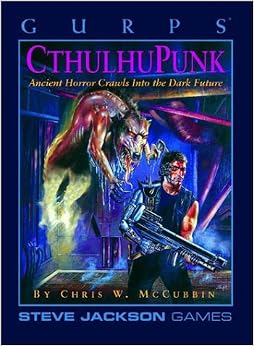
Image result for gurps cthulhupunkThird, 20 years ago this May, I GMed my first game for Erika and her best friend, Seanna Lea--both of whom still plays in most of my games to this day. That "Cthulhu 2000 AD" campaign was a modern-day Lovecraftian game using GURPS CthulhuPunk, and was my second attempt at running GURPS. I had first tried the system--briefly--in college, and it was the system of choice for the first regular gaming group that I joined after moving to Boston. I decided to use GURPS rather than Call of Cthulhu because I was more familiar with that system, and because I preferred to have more fully developed characters then was possible with CoC's very simple character generation. I made a number of mistakes, mostly in ensuring party cohesion, and in balancing "waking world" vs. Dreamlands adventures, but we all had fun over those 15 months. A couple of years later, I ran a one-shot for Erika and Seanna Lea's characters in order to provide them better closure than I had able to do before the campaign's end. (By then, I had also been running a GURPS fantasy campaign--"Adventures in Arcadayn"--for Erika, Seanna Lea, and another friend for a couple years, but that is, as they say, another story.)

Shortly after that final one-shot, I posted some of my notes on this campaign (and the previous one, which was also a Cthulhu game) to my gaming website. That was on Yahoo! Geocities at the time, and I migrated those notes to Wikispaces when I had to switch hosts some years later. By the time I migrated Thastygliax's Vault to Google Sites in 2014, I had so many different campaign archives to move that the GURPS Cthulhu games were among the lowest in priority, so they did not get moved at that time. While working on that migration, I discovered that many (but not all) of those pages could be found on the Internet Archive Wayback Machine*. That meant that I could still post a link to that content until I got around to posting it on my new site. I did so, but included a caveat about the Wayback Machine's archive not being 100% complete.

Then I didn't think about those pages again for a couple years, expect for the briefest of moments every time I opened the Vault's homepage. Those Cthulhu games are the oldest campaigns that I have listed there, so are at the top of the list of links. This past week, I finally took the time to add My GURPS Cthulhu Campaigns to the Vault, so that I could delete that annoying little caveat. It was while I was preparing those pages for their new home that I realized that I had started my "Cthulhu 2000 AD" campaign 20 years (and a few weeks) ago.

Erika and Seanna Lea are certainly open to me running more Lovecraftian games, evidenced by the fact that they've played in all three of my campaigns set in Green Ronin Publishing's Mythos-tainted Freeport: The City of Adventure. There is a chance, albeit a very slim one, that we may revisit their "Cthulhu 2000 AD" characters someday, for nostalgia's sake. But it would almost certainly be in a different game system, and might not have much continuity with the original campaign. The most obvious choice of system is GURPS Fourth Edition (which I own but have never had a chance to try out) but their characters would work just as well (if not better?) in the Buffy/Angel version of Unisystem.

Happy anniversaries, Erika and Seanna Lea!


* Another old project of mine that I found on the Wayback Machine was GURPS Sluggy Freelance, which I briefly posted about this past weekend after copying it to the Vault.


Saturday, June 17, 2017

GURPS Sluggy Freelance

Back in 2000, I wrote a GURPS adaptation for the webcomic Sluggy Freelance. It was well received by both Pete Abrams and Steve Jackson, even earning a mention in the Daily Illuminator. However, I eventually drifted away from reading Sluggy and playing GURPS, and I never got around to doing more with it.

I've changed website hosts a couple of times since then, and lost the original files somewhere along the way. But thanks to the magic of the Internet Archive Wayback Machine, I was able to recover that content and have now uploaded GURPS Sluggy Freelance to my current gaming site, Thastygliax's Vault.

Due to the time that's passed since I was up-to-date on either the comic or the system, I have no plans to update this project, but I wanted to be able to share this labor of love again.

Wednesday, January 6, 2016

Adventures in Arcadayn

Like most gamers my age, I was introduced to role-playing games through Dungeons & Dragons. (My first experience was in middle school in the early '80s.) I played D&D almost exclusively through middle school, high school, and most of college. I did find opportunities to briefly try a few other systems, including Star Frontiers, Tunnels & Trolls, Marvel Superheroes, and GURPS, but I never played or ran any long-term campaigns outside D&D until I moved to Boston as a graduate student. The first gaming group I joined there played GURPS, which I played regularly for the next few years. I also discovered LARPing and, mostly through friends I made through that community (and the S.C.A.), I was exposed to a much wider variety of tabletop systems as well (most notably Earthdawn and Unisystem).

The first truly long-term campaign that I ever GM-ed was an AD&D 2nd Edition game that ran from my sophomore through senior years of college. For this game, I used Arcadayn, a homebrewed setting based on an idea from a high school friend. After college, I kept tinkering with the setting, and once I got hooked on GURPS, I started converting the setting to that system. My GURPS GM had done just that with his old D&D world. One advantage of this system change was that GURPS was easier to customize, allowing me to overhaul the setting in ways that removed or reduced some of the most obvious D&D-isms, making Arcadayn into even more my own original creation.

After a few short-lived attempts at running Cthulhu Mythos adventures using GURPS, some of those players expressed interest in playing a "pure" fantasy campaign in that system. I took some time to develop my new version of Arcadayn to the point where I was ready to run something in it, and created a website in order to share background information with my players. That game was very successful, running for over 50 sessions over three years of regular play (from 1999 to 2002). During that time, our three young heroines forged a deep friendship that transcended their very different cultural and religious backgrounds. Their accomplishments included defeating a vile necromancer, befriending a dragon, and rediscovering a long-lost divine artifact that had been broken and corrupted by evil deeds. When one of my three core players could no longer make the time commitment due to her demanding schedule, we found a stopping point to the campaign that provided definite closure (purifying the artifact, and facing down its defiler's revenant) but left open the possibility of returning to those characters at some future date. (Sadly, that sequel never came to pass, and we no longer all live in the same state.)

A couple years later, I resurrected part of the original Arcadayn setting from my college days for a D&D Third Edition campaign, but I put brand new twists on this version (which I dubbed "Ursk"). This game was soon put on indefinite hold when my wife and I became parents for the first time. When we were finally able to resume gaming later that year, we chose to return to one of my other campaigns (Freeport) instead.

Since then, I have continued to putter with Arcadayn. When I had to move the campaign website to a new home in 2007 (due to GeoCities ceasing to be), I borrowed an idea from Green Ronin's Freeport setting. The company had relaunched that line as a series of systemless setting books with separate companion volumes for playing Freeport in different systems. I organized my new wiki to present the background information in systemless form, with the GURPS material on separate pages. I had acquired GURPS Fourth Edition by that point, but had not had an opportunity to play it, so I added some Fourth Edition conversions. I had also toyed with the idea of converting the setting to BESM Third Edition, so shared that new information there as well.

When I had to migrate my various gaming websites to a new home about a year ago, Arcadayn's was unaffected because it was at a different host. However, I've decided I prefer Google Sites over PBwiki, so I've just finished copying Adventures in Arcadayn to a new wiki there. I had not looked at any of this material in a very long time (since shortly after the last migration), so this task set me to thinking again about what system I might use if I ever run another Arcadayn campaign. I haven't played GURPS since we wrapped that first campaign. While I would love the opportunity to finally try out GURPS Fourth Edition, my group--which still includes two of my Third Edition players--prefers very different systems these days. Our current default system is Pathfinder, after a decade of D&D v.3.5 holding the top spot. Arcadayn has changed too much from its D&D roots to be easy to convert back to any edition of that system, but I might be able to use Pathfinder to find a playable middle ground. A more generic system would allow more flexibility in character creation, which was one of the main reasons I used GURPS last time. Of the multi-genre games I've played, BESM Third Edition seems the best choice. It has the wide variety of character options I'd need, the rules are simpler than GURPS, and it's geared toward a more "cinematic" style because it was designed to model anime, not gritty realism.

Of course, I'm unlikely to start a new Arcadayn campaign any time soon--I simply have too many other games demanding my attention. I will, however, continue to tinker with the setting, as I try to model some of the setting's races, magical traditions, and character archetypes in different systems. (For starters, those BESM conversion notes are far from complete. And my Kynthiad campaign has generated a lot of new BESM material that I could adapt.) I'll post the more interesting experiments to the new wiki, and discuss some of them here.

-----

(An older version of the history of how Arcadayn came to be can be found here.)

Tuesday, August 11, 2015

#RPGaDay2015: Days 1-11

I've been introduced to Dave Chapman's #RPGaDay2015 prompts through Timothy Brannon (of Buffy/Ghosts of Albion fame) and decided I'd join in, even though the month is a third over already.


1st) Forthcoming game you're most looking forward to
Blue Rose AGE Edition, by Green Ronin Publishing. I loved the original Blue Rose game, though I never did actually play it much beyond a few brief one-shots. The True20 System was an intriguing variant of d20, the setting provided a refreshing difference from typical D&D fare, and the artwork (particularly that of Stephanie Pui-Mun Law) was simply gorgeous. The new game will use the AGE system first created for the Dragon Age RPG, and will expand the amount of setting material and artwork.

2nd) Kickstarted game most pleased you backed
To limit the answer to products I've already received, that would have to be either Fate Core or Earthdawn Fourth Edition. I'm going to give it to the latter because I know that I'll get to play that one when my wife is finally able to resume running her Earthdawn campaign.

3rd) Favorite New Game of the last 12 months
Dungeons & Dragons 5th Edition. I've been playing D&D since 1981 or '82, and 4th edition was the first new edition that I didn't like better than the previous one. I've only played in one short 5E campaign so far, but it is a welcome return to D&D that actually feels like D&D.

In addition, 5E provided an excellent opportunity for one of my younger gaming buddies to run his first RPG campaign. I played a big part in getting him hooked on tabletop RPGs in the first place, so it's been rather gratifying seeing him embrace the role of GM, too.

4th) Most Surprising Game
I'm going to say BESM Third Edition. Not because the game itself is overly surprisingly--though it is a lovely system--but because it's a miracle that it ever got published at all. Guardians of Order ceased to exist as a business before this much-anticipated book saw press, but fortunately a deal was struck to have it published by Arthaus, Inc,, an imprint of White Wolf. Sadly, Arthaus never offered any further support for the game (but at least you can still buy it through DriveThruRPG).

5th) Most recent RPG purchase
Not counting Kickstarters (which lack the instant gratification of having a new toy in your hands as soon as you pay for it), my most recent purchase was Monster Codex, for Pathfinder.

6th) Most recent RPG played
Pathfinder RPG. I ran a session of my Freeport campaign the previous weekend.

7th) Favorite Free RPG
GURPS Lite. A brilliant piece of marketing, and a surprisingly good distillation of the game's core mechanics and character creation options into an easily digestible size for new players. This is what quick-start rules should be, but with pretty much just this one exception, never are.

8th) Favorite appearance of RPGs in the Media
Somewhere I still have clippings of the Indianapolis Star's coverage of GenCon from the year that I attended (2011). I was visiting my mother (who lives in the next county) at the same time, and she saved them for me.

9th) Favorite media you wish was an RPG
Harry Potter. My kids would eat this up in a heartbeat.

10th) Favorite RPG Publisher
Green Ronin Publishing. Their Freeport Trilogy is the reason I started my fan errata pages, which directly led to a number of writing and editing gigs for the Ronins. This small company knows how to make make consistently good games, which is why they're still around--and thriving--after 15 years.

11th) Favorite RPG Writer
Since I just gushed over Green Ronin, I'm going to go elsewhere and choose Kenneth Hite for this one. I was introduced to his work primarily through his Suppressed Transmission columns and his GURPS sourcebooks. "Uncle Ken" is a wonderful resource for anyone interested in Lovecraft, alternate history, high weirdness, and making your players squirm in combined horror and glee.