Wednesday, January 6, 2016

Adventures in Arcadayn

Like most gamers my age, I was introduced to role-playing games through Dungeons & Dragons. (My first experience was in middle school in the early '80s.) I played D&D almost exclusively through middle school, high school, and most of college. I did find opportunities to briefly try a few other systems, including Star Frontiers, Tunnels & Trolls, Marvel Superheroes, and GURPS, but I never played or ran any long-term campaigns outside D&D until I moved to Boston as a graduate student. The first gaming group I joined there played GURPS, which I played regularly for the next few years. I also discovered LARPing and, mostly through friends I made through that community (and the S.C.A.), I was exposed to a much wider variety of tabletop systems as well (most notably Earthdawn and Unisystem).

The first truly long-term campaign that I ever GM-ed was an AD&D 2nd Edition game that ran from my sophomore through senior years of college. For this game, I used Arcadayn, a homebrewed setting based on an idea from a high school friend. After college, I kept tinkering with the setting, and once I got hooked on GURPS, I started converting the setting to that system. My GURPS GM had done just that with his old D&D world. One advantage of this system change was that GURPS was easier to customize, allowing me to overhaul the setting in ways that removed or reduced some of the most obvious D&D-isms, making Arcadayn into even more my own original creation.

After a few short-lived attempts at running Cthulhu Mythos adventures using GURPS, some of those players expressed interest in playing a "pure" fantasy campaign in that system. I took some time to develop my new version of Arcadayn to the point where I was ready to run something in it, and created a website in order to share background information with my players. That game was very successful, running for over 50 sessions over three years of regular play (from 1999 to 2002). During that time, our three young heroines forged a deep friendship that transcended their very different cultural and religious backgrounds. Their accomplishments included defeating a vile necromancer, befriending a dragon, and rediscovering a long-lost divine artifact that had been broken and corrupted by evil deeds. When one of my three core players could no longer make the time commitment due to her demanding schedule, we found a stopping point to the campaign that provided definite closure (purifying the artifact, and facing down its defiler's revenant) but left open the possibility of returning to those characters at some future date. (Sadly, that sequel never came to pass, and we no longer all live in the same state.)

A couple years later, I resurrected part of the original Arcadayn setting from my college days for a D&D Third Edition campaign, but I put brand new twists on this version (which I dubbed "Ursk"). This game was soon put on indefinite hold when my wife and I became parents for the first time. When we were finally able to resume gaming later that year, we chose to return to one of my other campaigns (Freeport) instead.

Since then, I have continued to putter with Arcadayn. When I had to move the campaign website to a new home in 2007 (due to GeoCities ceasing to be), I borrowed an idea from Green Ronin's Freeport setting. The company had relaunched that line as a series of systemless setting books with separate companion volumes for playing Freeport in different systems. I organized my new wiki to present the background information in systemless form, with the GURPS material on separate pages. I had acquired GURPS Fourth Edition by that point, but had not had an opportunity to play it, so I added some Fourth Edition conversions. I had also toyed with the idea of converting the setting to BESM Third Edition, so shared that new information there as well.

When I had to migrate my various gaming websites to a new home about a year ago, Arcadayn's was unaffected because it was at a different host. However, I've decided I prefer Google Sites over PBwiki, so I've just finished copying Adventures in Arcadayn to a new wiki there. I had not looked at any of this material in a very long time (since shortly after the last migration), so this task set me to thinking again about what system I might use if I ever run another Arcadayn campaign. I haven't played GURPS since we wrapped that first campaign. While I would love the opportunity to finally try out GURPS Fourth Edition, my group--which still includes two of my Third Edition players--prefers very different systems these days. Our current default system is Pathfinder, after a decade of D&D v.3.5 holding the top spot. Arcadayn has changed too much from its D&D roots to be easy to convert back to any edition of that system, but I might be able to use Pathfinder to find a playable middle ground. A more generic system would allow more flexibility in character creation, which was one of the main reasons I used GURPS last time. Of the multi-genre games I've played, BESM Third Edition seems the best choice. It has the wide variety of character options I'd need, the rules are simpler than GURPS, and it's geared toward a more "cinematic" style because it was designed to model anime, not gritty realism.

Of course, I'm unlikely to start a new Arcadayn campaign any time soon--I simply have too many other games demanding my attention. I will, however, continue to tinker with the setting, as I try to model some of the setting's races, magical traditions, and character archetypes in different systems. (For starters, those BESM conversion notes are far from complete. And my Kynthiad campaign has generated a lot of new BESM material that I could adapt.) I'll post the more interesting experiments to the new wiki, and discuss some of them here.

-----

(An older version of the history of how Arcadayn came to be can be found here.)

Saturday, January 2, 2016

Bonus craft post: Christmas card balls


Many years ago, I saw instructions for making a decoration like this out of Christmas cards. I hadn't made one in years, but remembered the idea yesterday when I was taking down our cards from this year. My wife Erika really liked the result, and has asked me to do this each year so we can add these to our usual Christmas decor.

To make a Christmas card ball, you'll first need to make a pattern by drawing an equilateral triangle enclosed by a circle intersecting all 3 points. You'll probably want a ruler, compass, and protractor for this, to make sure your lines and angles are precise.

Cut out your circle, and trace it onto Christmas cards. You'll need 20 circles, each one enclosing some interesting bit of holiday art. Depending on the size of your circles and your cards, you may be able to get multiple pieces out of some cards.

(If you don't have enough cards, or don't want to destroy the ones you received from friends and family, then just buy a cheap package or two of blank cards from the store. The more variety, the better, and they'll be marked way down after Christmas.)

Cut out your circles, and trace the triangle onto the back side. Use a pen or the point of your scissors to score these three lines, then fold up the flaps toward the art side.

Fasten the flaps together using staples or glue, as shown in the photo. You will form an icosahedron (a 20-sided regular polygon) out of the triangles. It's probably easiest to build it in three parts--the two "tents" of 5 triangles at the top and bottom, and the ring of 10 triangles between them--then join those sections together.

To hang it up, thread some ribbon or yarn through the vertices of the ball, or punch a hole in one of the flaps.

Friday, January 1, 2016

Time of the Tarrasque: Javanian Temples

Happy New Year, everyone! Just a very quick post this week due to the holidays.

The following is an excerpt [with notes] from my page about the Javanian Pantheon, at the Time of the Tarrasque wiki. These four gods, who have dominion over light, darkness, and the heavens, are the ancestral gods worshiped by the halfling race in this world. They were adopted by the humans who first encountered the halflings and settled in the same lands.

Javanian temples prominently feature large domes and soaring towers. In all but the smallest temples, two towers represent the sun and moon gods [Talitar and Yaziel, respectively], and serve as observatories as well as monuments to the gods' glory. The most common floorplan for a Javanian worship site is a large central dome with four smaller domes intersecting it at the cardinal points. The east dome is topped by the Tower of the Sun, the west dome by the Tower of the Moon. The other two smaller domes have no towers. The north dome, which gets the least sun, is dedicated to the shadow god Jorilin. In ancient times, the south dome represented Asmolon [the Void], but this associated has been abandoned since the fall of Javanis [which was brought about by the Void's cult]. However, this dome remains the location of the temple's large, spacious main entrance. (In equatorial Javanis, the north and south domes were reversed so that the Shadow Dome received the least sunlight.)

Talitar and Yaziel are gods of knowledge, so most temples maintain a library of religious and secular works. In most settlements, the priests operate a school. Many also include an orphanage, where children in need can have a family of sorts and learn a trade.

While developing these details, I also made microscale models of two sample temples as a visual aid:


Thursday, December 24, 2015

Merry Christmas!

No column this week due to the holidays. I'll be back in the New Year with more of my eclectic ramblings.

Wednesday, December 16, 2015

2015 in Review

One tradition that I try to keep each year at this time is a letter to friends and extended family summarizing some of the most important and interesting experiences that my family has had in the past year. That letter always includes a paragraph or two about our RPG activities; a draft of this year's follows in italics:

[My wife] Erika and I continue to pursue role-playing games as one of our chief hobbies. This past year, we have been playing a mix of Big Eyes Small Mouth, Pathfinder, and D&D 5th Edition. We've been doing more gaming with the kids, though at ages 11 and 10, they're still most comfortable with shorter sessions tailored to them. 


Just over a year ago, Tim started rebuilding and adding to his RPG fan errata site and started a blog titled "Studded Plate" about RPGs, LEGO, and his other geeky hobbies. These projects provide another creative outlet, as well as a more substantial writing portfolio to share with potential employers.

I try to keep that section pretty short, since not all of our family and friends are gamers. However, this blog gives me an opportunity to expand on this subject for those of you who are.  

I last wrote about what I've been playing back in March. Since then, Erika has converted Dungeon Crawl Classics: Dungeon Interludes to Pathfinder and run the first installment of that series for our group. I continue to run "The Kynthiad," a solo BESM game, for her.

In my Pathfinder Freeport: The City of Adventure campaign, we have started the final grand adventure for this crew of miscreants (though we're currently on a holiday-induced hiatus). Once "Gorilla Island" wraps up, we'll be bidding farewell to Freeport for a while so that I can finally start a new Pathfinder campaign, "Time of the Tarrasque." 

But before we get to that, I intend to run a couple of one-shots. The first, "Winter Holiday," is a Christmas-themed adventure from Polyhedron Newszine that I ran many years ago using AD&D 2nd Edition. I'm converting it to Pathfinder to run it for my current group around or just after New Year's. I also plan to run the sample adventure from the Fantasy AGE Basic Rulebook for my children (and a few adults) sometime soon so that we can all try out that system. (Expect blog posts about those adventures once I've run them.)

A little over a year ago, I had to migrate my gaming websites to new homes at Google Sites. These wikis include: Tim's Errata Archive, my unofficial fan errata site; player background for my ongoing and upcoming campaigns (The Kynthiad, Winds of Freeport, and Time of the Tarrasque); and Thastygliax's Vault, which houses all my other gaming pages. I continue to add new material to those sites, and occasionally write about those updates here.

That's all for now. The best way to keep updated on my gaming activities--short of being part of them yourself--is to keep watching this blog. I wish a very merry holiday season to you and yours, and good gaming!

Thursday, December 10, 2015

Dreamlands Pathfinder Bestiary: Inhabitant of L'gy'hx

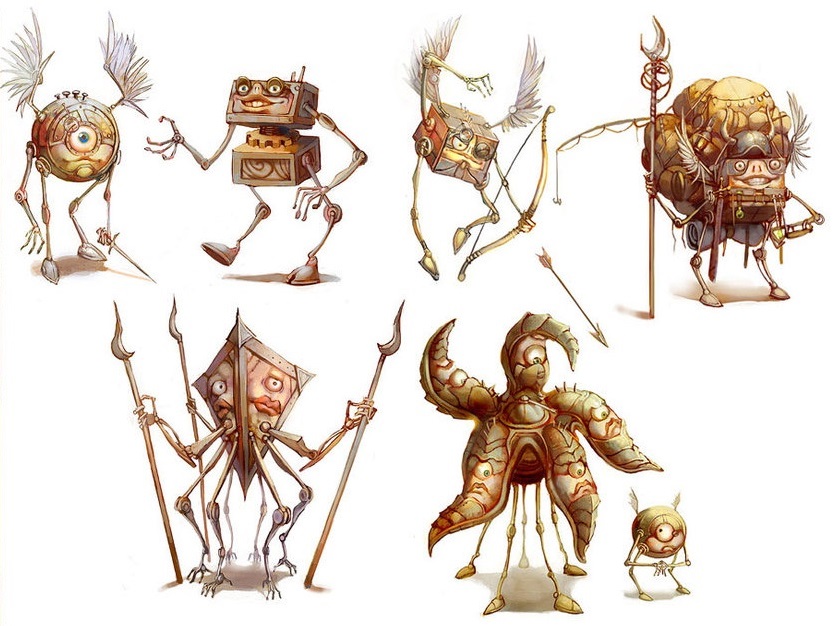
Some monsters in Call of Cthulhu supplements are weird in a horrific way, as any Lovecraft fan would expect, while others are just plain peculiar. Here is a prime example of the latter, converted from Ye Booke of Monstres. The illustration below is from that book, and resembles a D&D modron more than anything else.


Inhabitant of L'gy'hx

This creature is about three feet tall, with a body that looks like a metal cube. From each face of the cube sprout two short, thin legs ending in three-toed feet or hands. It walks on its bottom-most legs, and carries metal tools in the others. 

INHABITANT OF L'GY'HX (CR 3)
XP 800
CN Medium aberration
Init +0; Senses darkvision 60 ft.; Perception +7
Defense
AC 20, touch 10, flat-footed 20 (+10 natural)
hp 34 (4d8+16)
Fort +4, Ref +1, Will +4
DR 10/adamantine; Immune electricity
Offense
Speed 20 ft.
Melee adamantine spiked chain +9 (2d4+5 plus chain grapple) or adamantine dagger +9 (1d4+5/19-20)
Space 5 ft; Reach 5 ft. (10 ft. with spiked chain)
Special Attacks chain grapple
Statistics
Str 21, Dex 10, Con 16, Int 17, Wis 10, Cha 11
Base Atk +; CMB +8 (+12 chain grapple); CMD 18
Feats Combat Expertise, Toughness
Skills Appraise +7, Craft (blacksmithing, weaponsmithing) +7, Knowledge (dungeoneering) +7, Knowledge (engineering) +10, Perception +7, Profession (miner) +4
Languages Aklo, L'gy'hx
Ecology
Environment any land or underground (Uranus)
Organization solitary, work gang (2-4), or colony (12-20 plus 3rd-5th level fighter)
Treasure NPC gear (adamantine dagger or adamantine spiked chain, other gear; metal only)
Special Abilities
Chain Grapple (Ex) An inhabitant of L'gy'hx who successfully hits with a spiked chain may immediately make a grapple attempt as a free action, as per the grab ability. Every round that the hold is maintained, the creature can inflict spiked chain damage.

The inhabitants of L'gy'hx (Uranus) are not a hostile race, and are rather curious about other intelligent beings and any samples of worked metals they might possess. This metallic race is skilled in working adamantine, which is plentiful on their world--in fact, it makes up much of their own bodies.

The shans visited L'gy'hx after Shaggai's destruction. The natives eventually drove them off-planet due to the shans' obscene worship of Azathoth. Some of the inhabitants of L'hy'hx unwillingly accompanied the shans to Earth as slaves. Some of these aliens might visit Earths to free their kin from the shans. (See Call of Cthulhu d20 about the Insects of Shaggai, also called shans.)

Inhabitants of L'gy'hx almost always carry adamantine weapons and tools. They are proficient with simple weapons and spiked chains, but no armor or shields.

L'gy'hx Characters

Most L'gy'hx leaders are fighters, who typically learn Improved Trip as soon as possible in order to more quickly neutralize foes with their spiked chains. Those with sufficient wealth wield enchanted weapons, and are fond of shock and shocking burst weapons, which can be devastating when employing a chain grapple.  Some champions are dedicated to destroying the shans and freeing enslaved kin; these usually have ghost touch weapons in order to more easily damage the incorporeal shans.

The inhabitants of L'gy'hx worship the two-headed bat deity Lrogg, an avatar of Nyarlathotep (chaotic evil). Clerics of Lrogg may choose two of the following domains: Chaos, Destruction, Magic, Trickery.

Wednesday, December 2, 2015

Dreamlands Pathfinder Bestiary: Shade

This creature is converted from The Complete Dreamlands (for Call of Cthulhu).

Shade

This shadowy blob has no definite form. It extrudes a menacing black tendril  as it moves closer.

SHADE (CR 3)
XP 800
N Medium outsider (extraplanar)
Init +2; Senses darkvision 60 ft., low-light vision; Perception +9
Defense
AC 14, touch 12, flat-footed 12 (+2 Dex, +2 natural)
hp 18 (4d8)
Fort +1, Ref +6, Will +6
Defensive Abilities shadow blend; DR 10/magic; Resist cold 10
Weaknesses light blindness, light vulnerability
Offense
Speed 30 ft., climb 30 ft.; spider climb, water walk
Melee tendril +6 (1d6)
Statistics
Str 10, Dex 14, Con 10, Int 7, Wis 14, Cha 14
Base Atk +4; CMB +4; CMD 16
Feats Blind-Fight, Weapon Finesse
Skills Climb +15, Intimidation +9, Perception +9, Stealth +9 (+13 in shadowy light, +5 in bright light); Racial Modifiers +4 Stealth in shadowy light, -4 Stealth in bright light
Languages Aklo (cannot speak)
Ecology
Environment any (Plane of Shadow)
Organization solitary, gang (2-5), or swarm (6-12)
Treasure none
Special Abilities
Light Vulnerability (Ex) A shade is not harmed by simple exposure to light, but suffers from light blindness. In addition, deliberate melee attacks with light sources do damage as follows: candle 1d3, lamp 1d4, torch 1d6, lantern 1d8. Spells with the light descriptor do 1d6 damage per spell level (1d3 for 0-level spells). Those that normally inflict damage treat shades as creatures vulnerable to sunlight. A shade grows visible smaller when damaged by light (though always remaining Medium size), and evaporate entirely if reduced to 0 hp through light-based atacks.
Shadow Blend (Su) In any conditions other then full daylight, a shade can disappear into the shadows, giving it total concealment. Artificial illumination, even a light or continual flame spell, does not negate this ability. A daylight spell, however, will.
Spider Climb (Ex) A shade can climb sheer surfaces as though with a spider climb spell.
Water Walk (Ex) A shade can cross liquids as if they were solid ground, as if under the effects of a water walk spell.

Shades appear to be globes of darkness with no definite form, even if viewed by true seeing or the like. They are native to the Dark Dimension (as the Plane of Shadows is known in the Dreamlands). They are the servants and companions of Zo-Kalar, god of life and death, and can be summoned by mortals using summon monster IV, lesser planar ally, or lesser planar binding. They are often confused with incorporeal undead, but are living creatures of semi-tangible shadowstuff.

Exceptionally durable or lucky shades may survive long enough to gain class levels. Most advance as rogues or shadow bloodline sorcerers (Advanced Player's Guide 140). Those who become clerics of Zo-Kalar (neutral) may choose from the following domains: Darkness, Healing, Repose, Travel, and Trickery.