Welcome back to my ongoing series of capsule reviews of "Unearthed Arcana" with an eye for how to use them with the Freeport setting. This column covers UA articles from late November 2019 to March 2020.
For my past columns about using D&D Fifth Edition sourcebooks with Freeport: The City of Adventure, see the Freeport 5E Index.
Fighter, Rogue, and Wizard (11/25/2019): This installment presents the Psychic Warrior archetype for fighters, the Soulknife for rogues, and the Psionics arcane tradition for wizards. Despite Mike Mearls not being listed among the authors, these subclasses are heavily indebted to ideas that were first presented in the Mike Mearls Happy Fun Hour. Essentially, the Mystic class remained unwieldy after multiple iterations, because it was designed to cover too many character concepts under the single huge umbrella of "psionics." The most problematic "edge cases" actually work better as psionic-themed subclasses of other classes. With those elements moved elsewhere, the Mystic (or psion) gets closer to having its own clear, distinct role and feel.
The Psychic Warrior no longer casts psychic spells, but gains augmented attack and defenses that improve with level. A Soulknife can create a blade of pure psychic energy that eventually frightens its victims, and at very high level, can target an enemy's mind directly. A wizard of the Psionics tradition focuses on psychic-themed spells, and as they advance in level, gain the ability to assume a form composed of pure psychic energy.
Finally, this installment introduces some new psionic spells for sorcerers, warlocks, and wizards that essentially translate older editions' "psionic attack/defense modes" into spells. There are also two new feats, Telekinetic and Telepathic, which increase Intelligence and give some cantrip-level psionic abilities.
(My mini-review of the last iteration of the Mystic class provided some context for the World of Freeport. This article merely changes the mechanical options for converting a couple of classes to 5E.)
Subclasses, Part 1 (1/14/2020): The Path of the Beast barbarian is a partial shapechanger who can grow natural weapons in combat. As they advance, they can adapt to new movement modes, and spread their rage to allies and enemies. This archetype is suitable for characters with a connection to lycanthropes, druids, or fey or animal spirits--of which there are many examples in Rolland and in the more exotic lands of the World of Freeport.
Monks who follow the Way of Mercy tradition are both skilled healers as well as bringers of swift death to the evil and the ailing. Many wear masks to shroud their identities in mystery. These monks would be appropriate for followers of a god of medicine, or one who holds power over life and death.
Paladins who swear the Oath of the Watchers are guardians against extraplanar threats. This manifests as heightened vigilance and methods to punish unworldly foes. This archetype is very well suited to servants of the Inquisition and other champions who hunt the devils and demons who plague Freeport from time to time. (Note that while most Sacred Oaths suggest one or more alignments common to their members, this one does not. In Freeport, that might mean this oath is equally valid for both idealistic crusaders and their more jaded, corrupt associates.)
The Noble Genie is a warlock patron who grants powers reminiscent of geniekind: creating a mystical tether between you and a willing ally, gaining elemental resistance, and even creating a conduit to your patron's realm. Genies play a prominent role in the World of Freeport, from the azhar's efreet ancestors to the powerful conjurors who used bound genies to build wonders such as the Wizard's Guild in Freeport.
Subclasses, Part 2 (2/6/2020): Bards who join the College of Creation learn to use the esoteric power of music to manipulate the world around them, from summoning lingering notes that bolster inspiration, to animating a dancing item, to literally creating nonmagical objects out of nothing. The theme of this archetype reminds me of the Finnish creation myth in which the world itself emerges from a bard's song; DMs may wish to take that a step further and tie this tradition to the doomed world from which Lowyatar is the sole survivor (see Cults of Freeport).
The Unity Domain for clerics emphasizes teamwork and emotional bonds. This domain would be an excellent way to translate the Community domain from Third Edition. (That is one gap that Green Ronin's The Book of the Righteous did not fill.)
The Clockwork Soul is a sorcerous origin tied to Mechanus, the plane of ultimate order. The archetype's powers focus on warding magic and reducing the extremes of random chance (usually by denying advantage or disadvantage). The World of Freeport includes enough constructs (particularly in adventures such as Hell in Freeport and The Ironjack Legacy) that this subclass has a solid place there.
Subclasses, Part 3 (2/24/2020): The Armorer artificer specialist creates a powerful bond with their armor, turning it into fully enclosed power armor. This installment also provides some new artificer infusions, most of them involving armor or helms. The Armorer seems especially appropriate for experimenters who blur the lines between man and machine, such as the Manikins (Hell in Freeport) or Ironjack.
The Circle of Stars for druids involves studying the night sky and channeling the power of starlight. Some of the features gained are tied to astrological foretelling, while others alter wild shape to take on a starry form tied to a constellation's power. (At higher levels, this starry form becomes incorporeal. The article includes a useful sidebar about applying damage resistance.) The powers of this subclass are thematically appropriate for both the Order of Starry Wisdom and the Wanderer, though druids are not obvious candidates for either cult.
The Fey Wanderer ranger archetype is a guardian of the borders between the Feywild and the material plane. They are imbued with fey magic that allows them to better negotiate with beings from both worlds, to resist some of the snares of the fey, and to bend the minds of others. This subclass is probably most common in the elven kingdom of Rolland, but might also be appropriate for rangers (human and otherwise) who have learned something about the strange, rare fey peculiar to the Serpent's Teeth.
Spells and Magic Tattoos (3/26/2020): This installment introduces several new summoning spells that come with a special stat block to use with that spell. The spell's level determines the summoned spirit's AC, hit points, and number of attacks. The caster chooses one of two or three options that determine some of its other stats; for example, a bestial spirit can be an air, land, or sea creature, with appropriate movement types. These spells provide an interesting alternative to the handful of summoning spells in the PH, where the player needs to be familiar with the relevant Monster Manual entries. Summoning spells are frighteningly commonplace in Freeport, so using these spells could save the GM some effort when running summoner NPCs.
This article also includes rules for magical tattoos, which take up an amount of space on the body determined by its rarity (from a few inches for common tattoos, or half your body for legendary ones). The sample tattoos presented include a variety of effects, from enhancing attacks to storing a spell to changing your appearance. Magical tattoos are highly appropriate for Freeport, where mundane tattoos are common among sailors, exotic martial artists, and other groups.
Sunday, March 29, 2020

Friday, March 20, 2020
The Adventures of Patricia "Trick" Tillinghast
Patricia "Trick" Tillinghast is one of the two main characters who I played in "Grey Angels," a Buffy/Angel RPG campaign that ran from 2005 to 2009, and that later resumed as a play-by-post game from 2012 to 2014. I have talked about Trick in a very piecemeal fashion in several past Studded Plate columns:
Just before this past Christmas, GA's co-GMs announced their wish to run a reunion story arc to finally wrap up some of the major plot lines that were still unresolved when we last shelved the campaign. We did some discussion online about what had happened to our characters since we last saw them (in 2010, in game), bringing them up to the current day (2019-2020), then did some plot-light PBP roleplaying to get reacquainted with our old friends and the changes they underwent in the jump forward. We're hoping to start some real-time RPing this spring, though that will also need to be done online since we no longer all live in the same state. (The others still live in the Greater Boston area, but I moved to Kentucky during our last PBP-only period.)
I never expected to be able to play Trick again, and the jump ahead means that many of the changes we were planning for her have taken effect, so I am very excited about this reunion game!
- The characters who become a part of you (3/19/2015): How Trick affected my tastes in music.
- #RPGaDay 2016: Days 1-6 (8/6/2016): How Trick got a sister.
- #RPGaDay 2016: Day 11 (8/11/2016): How Trick has influenced how I play other heroes.
- #RPGaDay 2017: Day 7 (8/6/2017): How Trick got free of Dionysus (and bonus portrait).
- TBT: #Drawlloween 2016 (8/17/2017): Trick's Animal costume.
- #RPGaDay2018: Days 13-16 (8/17/2018): How Trick got free of Dionysus (shorter version).
- #RPGaDay2018: Days 28-31 (8/29/2018): No longer the straightest girl in town.
- #Inktober2018: Days 27-31 (10/31/2018): Two portraits of Trick.
- Cassilda Tillinghast (11/13/2018): My Pathfinder Society character who was very loosely inspired by Trick.
Just before this past Christmas, GA's co-GMs announced their wish to run a reunion story arc to finally wrap up some of the major plot lines that were still unresolved when we last shelved the campaign. We did some discussion online about what had happened to our characters since we last saw them (in 2010, in game), bringing them up to the current day (2019-2020), then did some plot-light PBP roleplaying to get reacquainted with our old friends and the changes they underwent in the jump forward. We're hoping to start some real-time RPing this spring, though that will also need to be done online since we no longer all live in the same state. (The others still live in the Greater Boston area, but I moved to Kentucky during our last PBP-only period.)
I never expected to be able to play Trick again, and the jump ahead means that many of the changes we were planning for her have taken effect, so I am very excited about this reunion game!
A Brief History of the World
To explain some of the changes Trick has gone through, I first need to summarize a few of the basic premises of the campaign:- The "Greyverse" is inherently connected to the "Buffyverse": Slayers, Watchers, vampires, and demons all exist, and all are more or less as portrayed in the Buffy and Angel TV shows. Several characters from those shows have made appearances in GA, but the GMs are deliberately not making any of them the focus of our campaign. It's the same world, but we're interested in different characters, locations, and adventures.
- Most of the campaign takes place in the fictional city of Shadowgard, located in northeastern Massachusetts, a few years after the mass activation of Slayers during Buffy's last season. This part of New England is the heart of Lovecraft country, so versions of Arkham and Innsmouth exist here. In game, Lovecraft's works were based on some germ of truth, though he regularly changed the details to pass them off as fiction.
- One of the main plots of "Grey Angels" is the resurgence of the Thyrian nation: a lost ancient civilization of Amazon-like warrior women who predated the Slayers (and served as inspiration for the Shadowmen's creation of the First Slayer). Many of the PCs are reincarnated Thyrians, and they and their friends spent much of the original campaign delving into prophecies about the return of Thyria, and learning how to unlock that power for themselves.
- The three senior Thyrians (all sisters, and initially Slayers) can join their powers with that of certain ancient relics in order to grant supernatural powers to new Thyrians. This can either unlock the full potential of a reincarnated Thyrian, or empower a trusted ally with no previous mystical ties to that group. At the time that the game last ended, this process had recently been formalized into a probationary period for training new candidates in the history and combat skills needed by all Thyrians.
- Over a dozen Thyrian "castes" or "legacies" exist, each with different powers, but all include enhanced physical traits and rapid healing similar to a Slayer's. Most, but far from all, Thyrians are women, and the organization as a whole is very outspoken about the rights of women and minorities of all kinds.
- The Thyrians also established a school for superpowered teens, the Phoenix Academy, in order to give those children a safer place to learn how to use and control their powers.
- The existence of the supernatural was forcibly revealed to the world in 2008 during the Ragnarok, a war in which a new pantheon of evil gods attempted to seize power. Battles took place in Shadowgard, New York City, London, and elsewhere. An alliance of Thyrians, Watchers, Slayers, and other heroes defeated the Dark Pantheon, and then shouldered the responsibility of educating the world about the true nature of reality.
 |
| Trick Tillinghast, by Tim Emrick (2006) |
The Old Adventures of Trick Tillinghast
During the original campaign, Trick started as a normal human with no supernatural gifts whatsoever. She was, however, a highly trained fencer who had become familiar with many other weapons through her obsession with the martial arts, medieval reenactment, and similar activities. Around the start of her junior year of high school, she had her first encounter with the supernatural, and joined her friends--a Slayer, a Totem Warrior, a witch, and a Watcher's daughter--in fighting the forces of darkness.
Partway through that year, she attracted the attention of the Greek god Dionysus, who gifted her with the powers of a Maenad to become his champion. At first, she was ecstatic about these gifts, because enhanced her skill and durability, making it far less likely that she would become a liability in a fight. However, her relationship with her patron soon soured, and she began to use her status as a Maenad as an excuse for increasingly wild behavior. By the end of a year as the wine god's champion, she wanted out--and mostly through sheer, bloody-minded stubbornness, she was released. She was fully human again, and now suffered from painful visions, but had her freedom again.
By then, however, Trick's bad behavior had alienated most of her friends, and as the time to apply for colleges approached, she felt an urgent need to get away and start over elsewhere. She matriculated at Columbia College in New York City, where she also worked with the local Watchers, Slayers, witches, and other champions. Though lacking any powers, she was easily the most experienced of the new class of student heroes, and found her niche in helping to train the others.
Trick's visions became an increasingly urgent problem for her, as her merely mortal body wasn't built to withstand them. (Think Cordelia after receiving Doyle's "gift.") She eventually found a solution when she was given the opportunity to become a Slayer--and after a horrifying vision of a monstrous attack on NYC, and her sorry fate if she refused this chance, she paid the price to become one. This gift was a godsend to her--she finally had the power she had always envied in her Slayer best friend, and could safely return to actively fighting against the forces of darkness.
A few months later, Trick's vision came true as the Ragnarok erupted in New York. That battle was the most harrowing of her life--she lost her girlfriend, ex-girlfriend, and ex-patron in one night, was forced to kill a human being for the first time, and dueled with fire giants as Central Park burned around them. The forces of good triumphed, but at a painful price.
 |
| Eva Amurri as Patricia Tillinghast, by Tim Emrick (2018) |
The New Adventures of Patricia Tillinghast
Just before "Grey Angels" was shelved last time, we had started discussion of jumping ahead a few years to a time when the brewing war with the Old Ones would come to a head. We had decided the following, as far as Trick was concerned:
- Following the Ragnarok, Trick was given a second chance with her girlfriend Diana, who had died during that conflict but was returned to life as a champion of Persephone. However, Diana had to spend each winter as a ghost in the underworld with her patron, which made it nearly impossible to maintain any relationship with a living lover, and the couple parted amicably after two bittersweet summers.
- Trick has a younger sister, Sheila, who was adopted after Trick rescued her from enslavement by the sidhe of Tir na n'Og. When Sheila turned 18, she finally spoke out publicly about her experiences in that world, which resulted in public pressure for the sidhe to change their society.
- After college, Trick vowed to reconcile with old friends, and sought a teaching position at the Phoenix Academy. She was determined to prove to herself and the Thyrian leadership that she was no longer the spoiled, angry, wild child that she had been in the past. She eventually applied to become a Thyrian herself, and impressed her trainers with her persistence and discipline.
- She now defaults to using her given name, Patricia, because it sounds far more professional than "Trick" for the educator and public figure she has become--though family and other longtime acquaintances occasionally still use her old nickname in private.
The reunion arc picks up some six years or so after Patricia's empowerment as a Thyrian Sword (a legacy that seemed tailor-made for her mastery of weapons!). She has become one of that organization's most formidable warriors, a devoted teacher to her students, and a skilled musician who has achieved some minor renown despite the demands of her higher calling.
The one part of her life that isn't on the track she hoped for is her love life. Patricia is an unapologetic hedonist who is disinclined to deny herself when she desires companionship. However, ever since losing Diana, she has yet to find another partner who she can fully connect with as a warrior, a teacher, and an artist. Almost all of her closest friends have ended up happily married over the past decade, so she's been feeling that lack in her own life more and more acutely.
As the campaign continues, I'll post some more updates on Patricia's continuing adventures--and introduce my other PC, Baz Olmstead. I've been playing Baz for a longer than I have Trick, but he achieved more closure last time around, and my larger-than-life lesbian knight-errant is by far the more fun to play of the two.
[UPDATE 4/17/2020: Trick's Nightwatch Dossier collects the links above as well as columns about her posted after this bio.]
[UPDATE 4/17/2020: Trick's Nightwatch Dossier collects the links above as well as columns about her posted after this bio.]
Monday, March 16, 2020
Pathfinder Society LEGO minis
A little over a year ago, I posted artwork I had created for my Pathfinder Society player characters, with a brief description of each character's concept and history. I have added a handful more characters to that stable, though I have not yet drawn portraits of my new heroes. I do, however, have LEGO minifigures built for all 17 characters, so am sharing those here.
 Ansari Zolta (human rogue/cleric of Cayden Cailean) recently completed the Seeker-tier (level 12+) series "Eyes of the Ten."
Ansari is Kelishite, so his mini mostly combines some Indiana Jones and Prince of Persia minifigure parts, with an old Pirates cutlass. [The round base is Kre-O, not LEGO. It's one of the few Kre-O parts that I'm actually very happy with.]
 Raudabjorn "Bjorn" Kjallakson (dwarf stonelord paladin of Torag) continues to fight as a crusader, and recently helped defend the city of Nerosyan from a siege of demons. He recently upgraded to a holy waraxe, to help him punish even more foes.
Bjorn's armor and weapons are from a mix of Castle, Kingdoms, and related sets. The gray-green cape is a hobbit-length elven cloak (LOTR).
 Bjorn has an earth elemental companion named Pyrite, who he doesn't call upon often because a Medium elemental is highly squishable at his tier. However, at next level, Pyrite will become Large and be much less of a liability. That future mini (shown here) uses one of the second-generation Hagrids with articulated hands (Harry Potter), with a werewolf head (from the Collectible Minifigures, or "CMF," theme) and silver gauntlets from a Gorilla Tribe character (Chima).
 Mahesh's political maneuvering has now earned him the title of Lord Mahesh, Viscount A'Zun (nagaji serpentine sorcerer).
His mini combines a royal outfit from the Castle theme with Ninjago Serpentine head and hands, plus a Harry Potter wand. His familiar Zuku uses the Snake Charmer's cobra (CMF).
 Mariko Snowtop (undine white-haired witch) recently reached Seeker tier , after competing in the Ruby Phoenix Tournament (earning yet another tattoo for her collection) and some high-level adventures involving the Hao Jin Tapestry. She and her familiar have died once, so she has a new king crab named Khaempferi.
Mariko has the alternate racial trait of Flesh Chameleon, so can change her coloring to look human. I have a second mini to use when she uses this disguise. Her natural undine form uses an Aayla Secura minifigure, with the lekku replaced by another Star Wars character's topknot. Her human disguise uses a Ninjago torso and legs. The wands are from Heroica games. The silver crab belongs to Zodiac Master (The LEGO Batman Movie Minifigures).
 Neferanu (oread brawler/living monolith) recently became a member of the Jeweled Sages, and only needs one more level to reach Seeker status.
Neferanu's torso is from the Adventurers theme's mummy Pharaoh; the headpiece from a CMF Egyptian warrior; and the head from the original Darth Vader minifigure. [The spiked "knuckles" in the photo are a BrickWarriors part (not LEGO) which I don't use anymore.]
His "embiggened" monolith form uses the body of Jun-Chi (Adventurers), a Garmadon head (Ninjago), and an Egyptian queen's hair (CMF). The head is attached with a 2x2 round jumper plate, to center it on the shoulders. The base uses four 1x2 jumper plates to center the 2x3 "footprint" on the 6x6 round plate.
 Jalon Greenbottle (half-elf inquisitor of Gorum) has started focusing on ranged combat, so uses his repeating crossbow more often than Gorum's favored weapon (greatsword). [I'm not as happy with Jalon's advancement as I am with most of my other characters, so he's not currently high on my priority list for play.]
Jalon wears a chrome conquistador breastplate over a redcoat's torso (both from Pirates/Armada). His head and hair are from a LOTR/Hobbit elf. His crossbow is one of the newer models that shoots 1x1 round tiles (though I never use that feature while gaming, for fear of losing the tiny parts).
 Nar-Lok (half-orc heavens shaman of Desna) has been adventuring with his new spirit animal, Daosvaria (a hatchling nightmare dragon) for some time now, and relies heavily on her for esoteric lore. (She is a sage familiar, so compensates for Nar-Lok's limited knowledge skills quite handily.) He has reached Seeker tier, and has played a single adventure at that level so far.
Nar-Lok's torso and legs are Zodiac Master's; the hat and cape are from a CMF wizard; and his face is a Stone Warrior's (Ninjago). The breastplate is a Chima accessory, and the compass (his wayfinder) is from Pirates of the Caribbean. [I don't currently have a LEGO mini for Daosvaria, as I use a tiny Pokemon figurine instead. I did use a Norbert dragon mini (Harry Potter) briefly, but it wasn't freakish enough.]
 K'Chaw (tengu cavalier) now has her axebeak mount, who she has named Good Girl. I have also worked out what K'Chaw's birth name is (Karasu Momoru) and why she goes by "K'Chaw" instead: it was a nickname given to her by a tribe of horse nomads that she lived with for a time; as her horsemanship improved, the name became a badge of honor.
K'Chaw is a Legend of Chima Raven Tribe character, with [IIRC] Ninjago samurai armor. Her shield (facing away in this shot) is an Amazon warrior's (CMF) with a bird design. The axebeak is an ostrich (Prince of Persia) with a much larger brick-built head. (A short bar fits into a hole where the original head attached.)
 Volutus (sylph sky druid) still hasn't seen a lot of play, except when there is a low-level Concordance-related adventure.
Volutus uses a Jack Sparrow body (PotC) and a Viking shield (CMF). I don't recall at the moment where the head and hair come from. [The scimitar is a BrickWarriors part, not LEGO.]
 Milo Nimblefingers (halfling cleric/rogue) has reached second level and multiclassed into rogue. We don't play our Core characters enough for me to be certain how long he'll stick with that class, but my best guess right now is that he'll remain about half cleric, half rogue throughout his career.
Milo uses a hobbit's head and hair on Gimli's body (LOTR), and an Indiana Jones bullwhip.
 Atticus Nox (tiefling investigator) is a Chelaxian scribe and barrister, who grew up benefiting from the status his diabolic heritage gave him in that corrupt empire. His partner Nephrael, my wife's character, has recently converted to a good god following a visit to Heaven without him. Atticus may follow suit one day, but is more likely to embrace the ways of Axis (which they both visited briefly in one adventure).
Atticus's body is the Lone Ranger's uniform (because the star badge is the closest thing I had to Asmodeus's pentagram). The tail and hands are from the Little Imp (CMF); the head is from the Monster 4 LEGO Game. His hair is Valkyrie's, from Thor: Ragnarok (Marvel Superheroes).
 Cassilda Tillinghast (human mindblade magus) has now reached the level at which her previous incarnation was created for The House on Hook Street. Now that Mariko has reached Seeker tier, Cassilda has become my new character with a hefty grudge against the Aspis Consortium. Much of her last couple of levels involved Aspis-related adventures in the Hao Jin Tapestry.
Cassilda's body and cape are from the Wicked Witch (LEGO Dimensions), with new head and hair (the latter is from a Friends minidoll). Her mindblade and shield spell are represented with some of the trans-blue accessories that come with sets featuring Iron Man or Thor (Marvel Superheroes).
[I have also very recently had the opportunity to start playing Trick Tillinghast--the Buffy/Angel RPG character on whom Cassilda is very loosely based--again, which pleases me immensely. I will be devoting one or more future columns to her very soon.]
 Mumbly Peg (kitsune hunter) has upgraded to her owlbear companion, Growler, and only needs a couple more adventures before he grows to Medium size. She will be taking a level or three of unchained rogue in the near future in order to boost her damage output while flanking; she already has the Boon Companion feat to avoid losing advancement for Growler while she does that. Peg is my only PFS character with a negative Int modifier, which can be a challenge to roleplay properly at times, but ganging up on things with her buddy is great fun!
 Peg's head, legs, and tail are from Furty, the single Fox Tribe Chima character. The armored torso is from a Castle/Kingdoms minifigure. The photo above shows her in human form as well. While Growler is Small, I'm using a baby bear (Friends). Once he is Medium, I'll be using a Raven Tribe character (Chima) on all fours, with some claws added (see photo at left).
 Raisa Lupescu is a Varisian human diviner and fortune-teller, who will be taking the Harrower prestige class once she qualifies for it. (I want to get full use out of my Harrow deck, and much of the in-game lore about these decks is fun). She is a cousin to one of my other characters, Cassilda Tillinghast (who is only half Varisian).
Raisa's body and cape are from the fortune-teller (CMF). Her hair and kerchief piece is Professor Trelawney's (Harry Potter). She holds a 1x1 tile printed with a spellbook from an old Castle set. (I originally wanted to have her hold the two 1x2 Tarot card tiles that came with the fortune-teller, to represent her Harrow deck, but I've decided that they would be too likely to get bumped out of her hands and lost.)
 Sibyl Pierce prefers to go by just "Pierce," and wears simple, practical clothes that obscure her gender. She is an Ulfen woman who learned the basics of zen archery from a wandering Tien monk, whose example she now follows.
She is built with a Green Ninja body (Ninjago), a back quiver (Castle and elsewhere), and an elven longbow (LOTR/Hobbit). Her hair is Elsa's blond wig with braid, from the Disney CMF series. This version of Elsa's hair works better with this pose--turning her head to the left to look at her target--than the straight-down braid from the Frozen minidoll sets (which would run into her quiver and shoulder).
 Sister Darla is a nosferatu-born dhampir warpriest who was raised from infancy by the church of Pharasma as a living weapon against the kinds of monsters responsible for her existence. She is the beneficiary of last year's GM race boon, which allows a dhampir PC.
Darla's gray head is the Emperor's (Star Wars); her armor is from a Black Knight (CMF); her helm from an older Castle/Kingdoms set; and her dagger from Prince of Persia. (I have used this blade with multiple PCs presented in this column. They make great large daggers, small scimitars, or shortswords.) The tile on her shield is the Hypnobrai symbol from Ninjago; the spiral design makes it ideal for a holy symbol for Pharasma.
 Falling Rock is a Shoanti human ranger who specializes in smashing things with his earthbreaker. He was created for a group who is playing through the Giantslayer and Shattered Star Adventure Paths (plus a little bit of Emerald Spire) in "PFS mode." He's my first serious attempt at a DPS-focused character, and he seems to be doing OK at it so far. I chose ranger over fighter so that he would have more skill points, and more useful class skills for this campaign. (He may multiclass into fighter later if I feel that I need additional combat feats more than skill points.) He is now the most experienced of my new characters, thanks to the sustained time spent with the Adventure Paths.
His body is from a Castle minifigure (Dragon Knights subtheme, IIRC?). The head is from an obscure Star Wars character whose name I've forgotten. An earthbreaker is essentially a big, spiked maul, easily represented by a couple clip-plates on a 1x1 SNOT brick, with a long bar handle.
 Thibdab is my single Pathfinder Society Second Edition character to date. He is a goblin redeemer champion of Sarenrae. His back story is that he started his career as a squire to my 1E cavalier, K'Chaw, who later sponsored his eventual admission to training as a Pathfinder himself. He seeks to serve as an example to others of how goblins can constructively cooperate with the Society.
Thibdab is a complete melange of parts: head from the CMF goblin; helmet from an old trolls Castle set; torso and short legs from a Ninjago Stone Warrior; sword from Prince of Persia; shield from a Wonder Woman movie set.

Ansari is Kelishite, so his mini mostly combines some Indiana Jones and Prince of Persia minifigure parts, with an old Pirates cutlass. [The round base is Kre-O, not LEGO. It's one of the few Kre-O parts that I'm actually very happy with.]
 Raudabjorn "Bjorn" Kjallakson (dwarf stonelord paladin of Torag) continues to fight as a crusader, and recently helped defend the city of Nerosyan from a siege of demons. He recently upgraded to a holy waraxe, to help him punish even more foes.
Bjorn's armor and weapons are from a mix of Castle, Kingdoms, and related sets. The gray-green cape is a hobbit-length elven cloak (LOTR).
 Bjorn has an earth elemental companion named Pyrite, who he doesn't call upon often because a Medium elemental is highly squishable at his tier. However, at next level, Pyrite will become Large and be much less of a liability. That future mini (shown here) uses one of the second-generation Hagrids with articulated hands (Harry Potter), with a werewolf head (from the Collectible Minifigures, or "CMF," theme) and silver gauntlets from a Gorilla Tribe character (Chima).
 Mahesh's political maneuvering has now earned him the title of Lord Mahesh, Viscount A'Zun (nagaji serpentine sorcerer).
His mini combines a royal outfit from the Castle theme with Ninjago Serpentine head and hands, plus a Harry Potter wand. His familiar Zuku uses the Snake Charmer's cobra (CMF).
 Mariko Snowtop (undine white-haired witch) recently reached Seeker tier , after competing in the Ruby Phoenix Tournament (earning yet another tattoo for her collection) and some high-level adventures involving the Hao Jin Tapestry. She and her familiar have died once, so she has a new king crab named Khaempferi.
Mariko has the alternate racial trait of Flesh Chameleon, so can change her coloring to look human. I have a second mini to use when she uses this disguise. Her natural undine form uses an Aayla Secura minifigure, with the lekku replaced by another Star Wars character's topknot. Her human disguise uses a Ninjago torso and legs. The wands are from Heroica games. The silver crab belongs to Zodiac Master (The LEGO Batman Movie Minifigures).
 Neferanu (oread brawler/living monolith) recently became a member of the Jeweled Sages, and only needs one more level to reach Seeker status.
Neferanu's torso is from the Adventurers theme's mummy Pharaoh; the headpiece from a CMF Egyptian warrior; and the head from the original Darth Vader minifigure. [The spiked "knuckles" in the photo are a BrickWarriors part (not LEGO) which I don't use anymore.]
His "embiggened" monolith form uses the body of Jun-Chi (Adventurers), a Garmadon head (Ninjago), and an Egyptian queen's hair (CMF). The head is attached with a 2x2 round jumper plate, to center it on the shoulders. The base uses four 1x2 jumper plates to center the 2x3 "footprint" on the 6x6 round plate.
 Jalon Greenbottle (half-elf inquisitor of Gorum) has started focusing on ranged combat, so uses his repeating crossbow more often than Gorum's favored weapon (greatsword). [I'm not as happy with Jalon's advancement as I am with most of my other characters, so he's not currently high on my priority list for play.]
Jalon wears a chrome conquistador breastplate over a redcoat's torso (both from Pirates/Armada). His head and hair are from a LOTR/Hobbit elf. His crossbow is one of the newer models that shoots 1x1 round tiles (though I never use that feature while gaming, for fear of losing the tiny parts).
 Nar-Lok (half-orc heavens shaman of Desna) has been adventuring with his new spirit animal, Daosvaria (a hatchling nightmare dragon) for some time now, and relies heavily on her for esoteric lore. (She is a sage familiar, so compensates for Nar-Lok's limited knowledge skills quite handily.) He has reached Seeker tier, and has played a single adventure at that level so far.
Nar-Lok's torso and legs are Zodiac Master's; the hat and cape are from a CMF wizard; and his face is a Stone Warrior's (Ninjago). The breastplate is a Chima accessory, and the compass (his wayfinder) is from Pirates of the Caribbean. [I don't currently have a LEGO mini for Daosvaria, as I use a tiny Pokemon figurine instead. I did use a Norbert dragon mini (Harry Potter) briefly, but it wasn't freakish enough.]
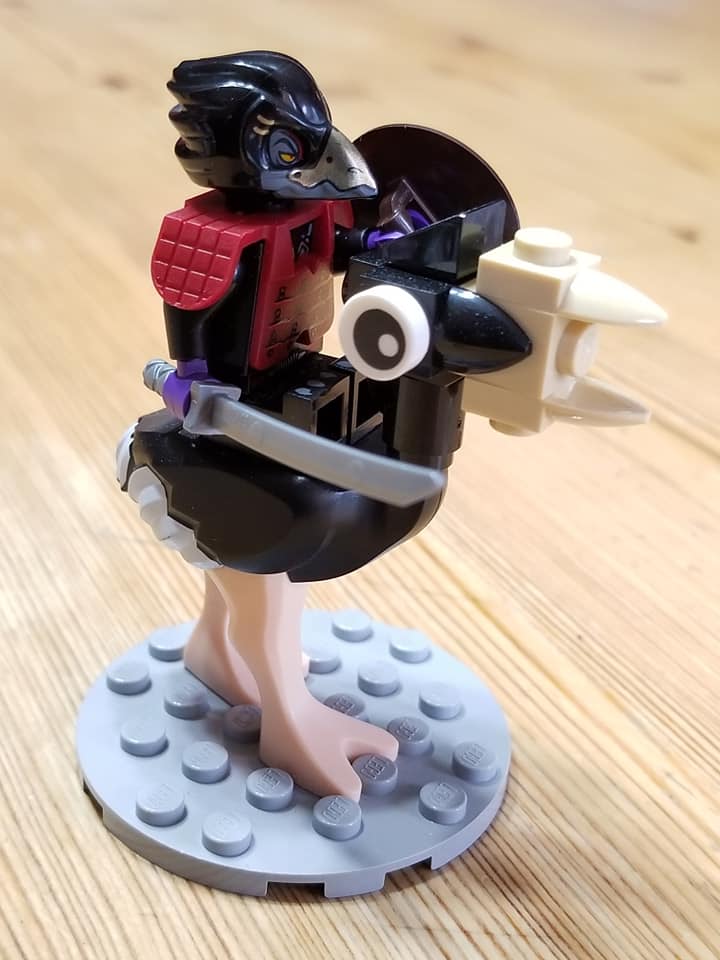 K'Chaw (tengu cavalier) now has her axebeak mount, who she has named Good Girl. I have also worked out what K'Chaw's birth name is (Karasu Momoru) and why she goes by "K'Chaw" instead: it was a nickname given to her by a tribe of horse nomads that she lived with for a time; as her horsemanship improved, the name became a badge of honor.
K'Chaw is a Legend of Chima Raven Tribe character, with [IIRC] Ninjago samurai armor. Her shield (facing away in this shot) is an Amazon warrior's (CMF) with a bird design. The axebeak is an ostrich (Prince of Persia) with a much larger brick-built head. (A short bar fits into a hole where the original head attached.)
 Volutus (sylph sky druid) still hasn't seen a lot of play, except when there is a low-level Concordance-related adventure.
Volutus uses a Jack Sparrow body (PotC) and a Viking shield (CMF). I don't recall at the moment where the head and hair come from. [The scimitar is a BrickWarriors part, not LEGO.]
 Milo Nimblefingers (halfling cleric/rogue) has reached second level and multiclassed into rogue. We don't play our Core characters enough for me to be certain how long he'll stick with that class, but my best guess right now is that he'll remain about half cleric, half rogue throughout his career.
Milo uses a hobbit's head and hair on Gimli's body (LOTR), and an Indiana Jones bullwhip.
 Atticus Nox (tiefling investigator) is a Chelaxian scribe and barrister, who grew up benefiting from the status his diabolic heritage gave him in that corrupt empire. His partner Nephrael, my wife's character, has recently converted to a good god following a visit to Heaven without him. Atticus may follow suit one day, but is more likely to embrace the ways of Axis (which they both visited briefly in one adventure).
Atticus's body is the Lone Ranger's uniform (because the star badge is the closest thing I had to Asmodeus's pentagram). The tail and hands are from the Little Imp (CMF); the head is from the Monster 4 LEGO Game. His hair is Valkyrie's, from Thor: Ragnarok (Marvel Superheroes).
 Cassilda Tillinghast (human mindblade magus) has now reached the level at which her previous incarnation was created for The House on Hook Street. Now that Mariko has reached Seeker tier, Cassilda has become my new character with a hefty grudge against the Aspis Consortium. Much of her last couple of levels involved Aspis-related adventures in the Hao Jin Tapestry.
Cassilda's body and cape are from the Wicked Witch (LEGO Dimensions), with new head and hair (the latter is from a Friends minidoll). Her mindblade and shield spell are represented with some of the trans-blue accessories that come with sets featuring Iron Man or Thor (Marvel Superheroes).
[I have also very recently had the opportunity to start playing Trick Tillinghast--the Buffy/Angel RPG character on whom Cassilda is very loosely based--again, which pleases me immensely. I will be devoting one or more future columns to her very soon.]


The New Kids on the (LEGO) Block
The following five characters are all new in the past year, and all have at least 1 XP, but only one has reached 3rd level so far. Two of them (Raisa and Darla) are "GM babies," who only have XP from GM credit or playing pregens, but have not yet seen play. (Pierce was another until earlier this month.) Raisa Lupescu is a Varisian human diviner and fortune-teller, who will be taking the Harrower prestige class once she qualifies for it. (I want to get full use out of my Harrow deck, and much of the in-game lore about these decks is fun). She is a cousin to one of my other characters, Cassilda Tillinghast (who is only half Varisian).
Raisa's body and cape are from the fortune-teller (CMF). Her hair and kerchief piece is Professor Trelawney's (Harry Potter). She holds a 1x1 tile printed with a spellbook from an old Castle set. (I originally wanted to have her hold the two 1x2 Tarot card tiles that came with the fortune-teller, to represent her Harrow deck, but I've decided that they would be too likely to get bumped out of her hands and lost.)
 Sibyl Pierce prefers to go by just "Pierce," and wears simple, practical clothes that obscure her gender. She is an Ulfen woman who learned the basics of zen archery from a wandering Tien monk, whose example she now follows.
She is built with a Green Ninja body (Ninjago), a back quiver (Castle and elsewhere), and an elven longbow (LOTR/Hobbit). Her hair is Elsa's blond wig with braid, from the Disney CMF series. This version of Elsa's hair works better with this pose--turning her head to the left to look at her target--than the straight-down braid from the Frozen minidoll sets (which would run into her quiver and shoulder).
 Sister Darla is a nosferatu-born dhampir warpriest who was raised from infancy by the church of Pharasma as a living weapon against the kinds of monsters responsible for her existence. She is the beneficiary of last year's GM race boon, which allows a dhampir PC.
Darla's gray head is the Emperor's (Star Wars); her armor is from a Black Knight (CMF); her helm from an older Castle/Kingdoms set; and her dagger from Prince of Persia. (I have used this blade with multiple PCs presented in this column. They make great large daggers, small scimitars, or shortswords.) The tile on her shield is the Hypnobrai symbol from Ninjago; the spiral design makes it ideal for a holy symbol for Pharasma.

His body is from a Castle minifigure (Dragon Knights subtheme, IIRC?). The head is from an obscure Star Wars character whose name I've forgotten. An earthbreaker is essentially a big, spiked maul, easily represented by a couple clip-plates on a 1x1 SNOT brick, with a long bar handle.
 Thibdab is my single Pathfinder Society Second Edition character to date. He is a goblin redeemer champion of Sarenrae. His back story is that he started his career as a squire to my 1E cavalier, K'Chaw, who later sponsored his eventual admission to training as a Pathfinder himself. He seeks to serve as an example to others of how goblins can constructively cooperate with the Society.
Thibdab is a complete melange of parts: head from the CMF goblin; helmet from an old trolls Castle set; torso and short legs from a Ninjago Stone Warrior; sword from Prince of Persia; shield from a Wonder Woman movie set.
Tuesday, February 18, 2020
What I'm playing, and what I'm planning

My "Time of the Tarrasque" Pathfinder home game remains on hold. The player who had a scheduling issue has been in his new job long enough to have our usual game day free again, so now we just have to contend with 1. wonky schedules from the holidays (mostly settled by now), 2. the last half year of inertia, and 3. me finding a way to move forward with less risk of burnout. I have a few ideas for how to deal with some of that in the short-term (such as a brief skip ahead to the next exciting bit, with a little bit of hand-waved XP and gear to go with it).
There is one project that I want to resolve before we resume that game. I've been running a Greek myth-based BESM game for my wife Erika for the past decade or more, on and off. We've reached the endgame stretch, and she and I both want to give it a proper conclusion rather then let it collect dust in limbo. That game is also a homebrew campaign, and while it is not nearly as crunch-intensive as "Time of the Tarrasque," we are at a point where I need more prep per session than I used to for most of its history. (These days, I'm juggling gods, mortal and demigod heroes, and the imminent threat of Typhon's return, all of which demands a bit more brainpower to pull off.) I'm hoping to wrap that up this winter and spring, and be able to devote my full attention to Tarrasque again sometime before summer.
 |
| Falling Rock, my Shoanti ranger for Giantslayer/Shattered Star |
- I'm still very active in Pathfinder Society, as both player and GM. I'll be reaching ing my 3rd star as a PFS GM (60 games GMed) sometime in the next month or two.
- Some of us regular PFS GMs have started a separate group in order to play through a couple of adventure paths in PFS mode. We've just finished Book 1 of Giantslayer, and are ready to start Book 1 of Shattered Star. We'll be alternating between those two AP's after each book (with one GM for each series), and playing occasional bits of Emerald Spire to fill in some advancement gaps.
- I GMed my first Starfinder game at Fallicon (Lexington, KY) back in November, and have run and played a few more Starfinder Society scenarios since then.
- Our local group isn't nearly as keen on Pathfinder 2E as they are on PF1 and SF. However, Erika was recently (and finally!) made a Venture-Agent. In order to fulfill those duties, she needs to be willing and able to run 2E as well as 1E at the store and at cons, so we'll be trying to get that on the schedule a bit more often going forward. (Ideally, she also needs to become more familiar with SF, but there are a handful of us who can run that while she focuses on learning how to run one new system at a time.)
My children's high school has a D&D club, which they have both deep-dived into, and both are running games of their own. Now that they have a lot of school friends that they can play with regularly (both in person and online), Erika and I don't get to game with them as often as we did in the past. (They have both cut way back on PFS, though one of them still plays when it's not a school night and they don't have another game going on.) That will change somewhat when Tarrasque resumes, since our eldest child joined that game shortly before the latest hiatus, and is just as eager to get back to it as the other players are.
The same kid has recently started running a (very occasional) D&D 5E campaign for that adult home group to help fill time during the hiatus. All of the PCs are "mudborn," a small race of anthropomorphic axolotls. That's been great fun, and we'll all looking forward to doing more. (I greatly envy this kid's free time, when they can just do more prep/tinkering whenever the mood hits!)
Looking further ahead, all four of us will be attending Lexicon again (here in Lexington, KY) at the end of April. We're also looking into the possibility of attending GenCon, but that's more likely to happen next year due to some other travel plans this summer taking precedence.
 |
| "Hammer of Hylax," Trox envoy from a Starfinder Society scenario |
Expect to see more posts here as we get closer to resuming "Time of the Tarrasque." I also intend to get back to producing more installments of my "Building the Bestiary" series. In addition, PFS and other games provide a constant demand for me to produce new brick-built RPG minis that fall outside the limited purview of that BtB column, so I may start a second series to showcase some of the more interesting models among those minis.
Wednesday, November 20, 2019
Unearthed Arcana and Freeport, Part 13: Class Feature Variants
Welcome back to my ongoing series of capsule reviews of "Unearthed Arcana" with an eye for how to use them with the Freeport setting. For this 13th installment, we have a single whopping 13-page entry from this month.
For my past columns about using D&D Fifth Edition sourcebooks with Freeport: The City of Adventure, see the Freeport 5E Index.
Class Feature Variants (11/4/2019): This document presents a variety of alternate class features covering all classes in the Player's Handbook. These options fall into the following categories:
The expanded options are also fairly straightforward, as they are simply new choices for class features that a character may only choose in limited numbers: new maneuvers, fighting styles, metamagic options, and warlock invocations (and a new type of pact boon).
The expanded spell lists seem unnecessary to me. Some players will welcome more choices, while others will complain that it makes the spellcasting classes feel less distinct. (My initial take leans towards the latter.)
Several enhancements are essentially rules for making retraining character features more easy. For example, most of the spellcasting classes get Spell Versatility (allowing you to change a spell known after a long rest) or Cantrip Versatility (allowing you to change a known cantrip when you gain a level). The new Maneuver Versatility feature has a similar effect on the battle master's maneuvers. Proficiency Versatility allows a character of any class to change one skill proficiency whenever they gain an Ability Score Improvement. Many of these rules seem open to abuse, or at least to making such changes seem trivial. On the other hand, having a rule (albeit an optional one) for changing cantrips or skills at all will be a welcome addition for many players.
Other enhanced class features include: another use for bardic inspiration; another use for Channel Divinity; a Wild Companion feature for druids that expends uses of wild shape; choosing alternate weapon lists for monks, and new uses for ki; a new option for the Beast Master ranger's companion; and a new use for the rogue's Cunning Action. These changes add new abilities at no cost, but a few of them may help address some genuine issues within the core rules (such as the beast master companion's underwhelming execution).
There is very little in this installment that needs any special calling out for a Freeport campaign. However, at the very least, the new Fighting Style and Martial Versatility options, the Elemental Spell metamagic option, and several of the new warlock invocations would be very welcome additions to the electric, exotic mix that is Freeport.
For my past columns about using D&D Fifth Edition sourcebooks with Freeport: The City of Adventure, see the Freeport 5E Index.
Class Feature Variants (11/4/2019): This document presents a variety of alternate class features covering all classes in the Player's Handbook. These options fall into the following categories:
- Replaced class features: The character trades away one class feature for a new one.
- Enhanced class features: The existing class feature is expanded to do a little more than before. (The following three items are specific kinds of enhancement.)
- Expanded options: Class features that require a choice from several options get new options.
- Expanded spell lists: The class's spell list adds new spells from other classes' lists.
- Retraining: The character can change one of their spells, maneuvers, or other class features more easily.
The expanded options are also fairly straightforward, as they are simply new choices for class features that a character may only choose in limited numbers: new maneuvers, fighting styles, metamagic options, and warlock invocations (and a new type of pact boon).
The expanded spell lists seem unnecessary to me. Some players will welcome more choices, while others will complain that it makes the spellcasting classes feel less distinct. (My initial take leans towards the latter.)
Several enhancements are essentially rules for making retraining character features more easy. For example, most of the spellcasting classes get Spell Versatility (allowing you to change a spell known after a long rest) or Cantrip Versatility (allowing you to change a known cantrip when you gain a level). The new Maneuver Versatility feature has a similar effect on the battle master's maneuvers. Proficiency Versatility allows a character of any class to change one skill proficiency whenever they gain an Ability Score Improvement. Many of these rules seem open to abuse, or at least to making such changes seem trivial. On the other hand, having a rule (albeit an optional one) for changing cantrips or skills at all will be a welcome addition for many players.
Other enhanced class features include: another use for bardic inspiration; another use for Channel Divinity; a Wild Companion feature for druids that expends uses of wild shape; choosing alternate weapon lists for monks, and new uses for ki; a new option for the Beast Master ranger's companion; and a new use for the rogue's Cunning Action. These changes add new abilities at no cost, but a few of them may help address some genuine issues within the core rules (such as the beast master companion's underwhelming execution).
There is very little in this installment that needs any special calling out for a Freeport campaign. However, at the very least, the new Fighting Style and Martial Versatility options, the Elemental Spell metamagic option, and several of the new warlock invocations would be very welcome additions to the electric, exotic mix that is Freeport.
Wednesday, November 13, 2019
"Missing" weapons in D&D 5th Edition
One of the primary design goals of the fifth edition of the Dungeons & Dragons RPG was to develop much simpler rules than in most previous editions of the game. One of the many areas that was simplified was equipment, including the weapons list. In this column, I will be comparing the weapon rules in 5E with those in v.3.5, because that is the previous edition with which I have the most experience. Then I will give suggestions for how to handle the "missing" weapons that appeared in the v.3.5 Player's Handbook but not in the 5E version.
Some of the weapon rules that 5E changed include:
Some of the weapon rules that 5E changed include:
- Weapons are now only simple or martial. There is no more "feat tax" in order to use an exotic weapon without penalty (in part because feats themselves became optional). The few previously exotic weapons that remain in the game (hand crossbow, net, and whip) are now martial weapons.
- All weapons have the same effect on a critical hit. Players no longer need to keep track of which weapons have expanded threat ranges or higher crit multipliers. This makes some of the finer distinctions between v.3.5 weapons moot; for example, a punching dagger is now just a dagger.
- There are no double weapons. Many of v.3.5's exotic weapons were double-ended weapons that allowed extra attacks using the two-weapon fighting rules. They were very feat-intensive to use effectively, so don't translate well to 5E; also, most were fictional fantasy weapons with few historical precedents. The one non-exotic double weapon, the quarterstaff, is now a versatile weapon, using a larger damage die if wielded with both hands.
- The finesse and light properties have been decoupled. Light weapons define what can be used as a second weapon in two-weapon fighting, but not all are finesse weapons (club, sickle, handaxe, light hammer). Finesse weapons now allow a character to use Dexterity for attack and damage instead of Strength, but include some non-light weapons (rapier, scimitar, whip).
- Many weapons have fewer size options. Flails and war picks only come in one size, and spears are limited to spear and pike.
- Combat maneuvers are uncommon at best. Most combat maneuvers (trip, disarm, etc.) are now limited to the battle master archetype or monster attacks, and special weapons no longer give a bonus to those maneuvers. As with the simplification of critical hits above, this reduces the need for fine distinctions between some weapons, most notably the many kinds of polearms. It also means that many Asian weapons traditionally associated with the monk class can be treated as more conventional weapons of the same approximate size and damage type (a kama as a sickle, a shuriken as a dart, etc.). Most of these equivalents are simple weapons, so monks will be proficient with them.
- Bows are much less complicated. All ranged attacks (except for some thrown weapons) use Dexterity to modify both attack and damage, so there is no need to spend extra money for a composite bow in order to benefit from a high Strength score.
- Nonlethal damage is not tracked separately. If you want to knock a creature out without killing it, you simply make that choice when you deliver the final blow.
Easy Equivalencies
With these changes in mind, it becomes clear that with many "missing" weapons, we can simply use the stats for the most similar weapon listed in the 5E Player's Handbook. The following equivalencies should require no further justification:
- Battleaxe includes dwarven waraxe.
- Club includes nunchaku, sai, and sap.
- Dagger includes punching dagger, and probably spiked gauntlet.
- Dart includes shuriken.
- Flail includes heavy flail.
- Glaive and halberd (which have identical stats) can include guisarme.
- Handaxe includes throwing axe.
- Longbow and shortbow include their composite versions.
- Longsword includes bastard sword.
- Mace includes light and heavy maces.
- Maul includes greatclub.
- Pike includes longspear and ranseur.
- Sickle includes kama.
- Unarmed strike includes gauntlet.
- Spear includes shortspear.
- War pick includes light and heavy picks.
A couple weapons only need a little more discussion:
- Falchion: It's a two-handed sword, albeit it a curved one, so treat it as a greatsword.
- Kukri: Treat as a scimitar, which is a finesse weapon in 5E.
Double Weapons
With double-ended exotic weapons, I'm inclined to follow the example of the quarterstaff, and treat some of them as whatever versatile weapon best fits their approximate size and damage type. This means that, for example, the gnome-hooked hammer becomes a warhammer. (Note that Small races use the same size weapons as Medium characters, so a warhammer wielded in two hands does a respectable 1d10--the same as the smallest heavy weapons!)
The orc double axe becomes a battleaxe, and the two-bladed sword becomes a longsword. Alternately, you could bump these up to greataxe and greatsword, respectively, since both are obviously large two-handed weapons. The dwarven urgrosh requires a bit more thought, having (like the hooked hammer) two dissimilar ends, but is probably best replaced by the greataxe.
The dire flail is not very similar to any existing versatile or heavy weapon. I would treat it as a maul.
A DM who wishes to preserve some of the original flavor of exotic double weapons can use the following suggestions:
- Start with stats appropriate for each end of the weapon: battleaxes for a double axe; battleaxe and spear for the urgrosh; longswords for a two-bladed sword; warhammer and war pick for a hooked hammer; and flails for the dire flail.
- Double the weight of the heavier weapon to get the double weapon's weight.
- Add the costs of the two weapons, then multiply the total by at least 2 or 3.
- All double weapons have the two-handed property. Most should also be heavy (except for the hooked hammer, which was designed for use by a Small race).
- The second attack is made using a bonus action, per the standard two-weapon fighting rules. However, note that none of these weapons has an end with the light property! Therefore, only someone with the Dual Wielder feat can attack with both ends in the same round.
- DMs using these guidelines could build alternate quarterstaff stats using two clubs, which do have the light property, so could be used with the two-weapon fighting rules without the feat.
In my opinion, this solution just emphasizes how awkward using a double weapon really is. They also remain expensive in terms of money and feat usage. Why not just use two separate weapons, or one larger one? (I know the answer is because they're exotic, and thus cool. But sometimes the payoff isn't enough to justify the investment.)
Shields and Armor as Weapons
5E includes no rules for shield bashes, spiked shields, or spiked armor.
Under the existing rules, striking someone with your shield would probably be treated as an improvised weapon attack. A character proficient in martial weapons should be able to use their proficiency bonus on a shield bash attack, probably doing the same damage as a club. However, I wouldn't consider a shield to be a light weapon, so you couldn't attack with your main weapon and shield in the same round without Dual Wielder.
Shield and armor spikes can probably be priced at 50 gp, as in v.3.5, and would deal damage as daggers. Treat armor spikes as light martial weapons, but not finesse weapons.
What's Left?
This still leaves the following weapons: bolas, repeating crossbow (light and heavy), scythe, and spiked chain. These are enough unlike the other weapons discussed here to merit stats designed from scratch.
Bolas: martial ranged weapon, 5 gp, 1d4 bludgeoning, 2 lbs., special, thrown (20/60). Bolas have damage and range similar to a light hammer, but entangle the target like a net.
Repeating crossbow: Weapons with the loading property don't take an action to load, but can only make one attack per action. This is probably fast enough to make a repeating crossbow more or less irrelevant, but DMs who want to make them available can make the following changes to any crossbow:
Scythe: martial melee weapon, 18 gp, 1d10 slashing, 10 lbs., heavy, two-handed.
Spiked Chain: martial melee weapon, 25 gp, 1d10 piercing, 10 lbs., finesse, reach, two-handed.
Bolas: martial ranged weapon, 5 gp, 1d4 bludgeoning, 2 lbs., special, thrown (20/60). Bolas have damage and range similar to a light hammer, but entangle the target like a net.
Repeating crossbow: Weapons with the loading property don't take an action to load, but can only make one attack per action. This is probably fast enough to make a repeating crossbow more or less irrelevant, but DMs who want to make them available can make the following changes to any crossbow:
- Multiply weight by 1.5.
- Multiply cost by 10.
- The magazine holds 5 bolts, which weigh and cost the same as 20 normal bolts (1 gp, 1.5 lbs.).
- A repeating crossbow does not gain the loading property until all 5 bolts are fired. It then gains the loading property for 1 round to represent the time needed to load a new magazine. (Alternately, simply ignore the loading property altogether.)
Scythe: martial melee weapon, 18 gp, 1d10 slashing, 10 lbs., heavy, two-handed.
Spiked Chain: martial melee weapon, 25 gp, 1d10 piercing, 10 lbs., finesse, reach, two-handed.
Wednesday, October 30, 2019
Fallicon cometh...
I've never been a dedicated convention-goer. When I was a high-school and college student (back in the ancient days of AD&D 1st and 2nd edition), I dreamed of someday going to GenCon, but never had the money for such a trip. SF conventions intrigued me, too, but never quite to the same extent.
I didn't attend my first convention, for any fandom, until my early 20s. Shortly after moving to Boston for graduate school, I made a new friend at a temp job who was active on committees for Arisia, a speculative fiction con in Boston. He was thrilled to have another F&SF nerd to chatter with, however briefly, during our daily drudge. The con was coming up very soon, so he offered me one of his spare complimentary tickets. It was great fun--particularly meeting a couple of artists whose work I admired--and I attended the next couple of years on his comp tickets, too. (I'm embarrassed to admit that I can't recall that generous gentleman's name anymore. Tony, I think?)
By that time, I had found the Boston-area LARP community, and my interest in Arisia waned (though I played my first LARP at an Arisia). That's also around the time that I met and started dating my future wife, Erika. LARPing was one of our many shared interests. We attended an all-LARP convention, InterCon, for a few years running, as well as the very first couple of Vericons (a gaming convention at Harvard). But then impending parenthood diverted too much of our time and money to continue LARPing regularly. We attended once (for a single day, I believe?) when the kids were very little, and one last time (for the full con) when they were in early grade school.
In 2003, GenCon moved from Milwaukee to Indianapolis, which was only an hour from my childhood home (where my mother still lives). I had been living in Boston for a decade at that point, which still made the con an expensive trip. In 2011, we combined a family visit with my long-awaited first time attending GenCon. (Erika and the kids--now 6 and 7--came on a family day pass that Sunday.) I played many, many games (including the Iron GM competition, as a player), met some of my favorite game designers (including Steve Jackson and the core staff of Green Ronin, both of whom I had done some freelance work for by that time), and generally reveled in the spectacle of games, cosplay, and art.
Despite moving to Kentucky a couple years later--only half a day's drive from Indy--I still haven't managed to get back to GenCon again. Much of the reason is financial, but there is also the awkwardness of my kids' school year starting earlier here than in Boston--many years, it's been the very same week as the con.
However, I have found some consolation recently by learning more about local game conventions here in Lexington. This past spring, all four of us attended Lexicon, a weekend gaming convention with a robust Paizo gaming track. (We were talked into going--and Erika into GMing a few scenarios--by friends we'd made through Pathfinder Society.) Unlike some bigger cons we're been urged to try (like CincyCon in Cincinnati), Lexicon was close enough to drive home each night, which made it surprisingly affordable.
This coming weekend (November 1-3) is Fallicon, a PFS charity event for Extra Life. This year it's being hosted by our Friendly Local Gaming Store, D20 Hobbies--a mere 15-20 minute drive from our home. Erika is helping to organize it, and is GMing a few games. I will also be running my very first tabletop RPG at a con this weekend--which will also be my first time GMing Starfinder. The kids game just about as regularly as we do these days, so they are both very excited, too. We've been scrambling the last few days to make sure all the characters they intend to play are fully updated, and Erika and I have been doing GM prep (her far more than me, though I'm also supplying maps for her and some other GMs). My daughter even designed an adorable goblin sticker for donors to the raffle.
But someday--someday--I will make it back to GenCon...
I didn't attend my first convention, for any fandom, until my early 20s. Shortly after moving to Boston for graduate school, I made a new friend at a temp job who was active on committees for Arisia, a speculative fiction con in Boston. He was thrilled to have another F&SF nerd to chatter with, however briefly, during our daily drudge. The con was coming up very soon, so he offered me one of his spare complimentary tickets. It was great fun--particularly meeting a couple of artists whose work I admired--and I attended the next couple of years on his comp tickets, too. (I'm embarrassed to admit that I can't recall that generous gentleman's name anymore. Tony, I think?)
By that time, I had found the Boston-area LARP community, and my interest in Arisia waned (though I played my first LARP at an Arisia). That's also around the time that I met and started dating my future wife, Erika. LARPing was one of our many shared interests. We attended an all-LARP convention, InterCon, for a few years running, as well as the very first couple of Vericons (a gaming convention at Harvard). But then impending parenthood diverted too much of our time and money to continue LARPing regularly. We attended once (for a single day, I believe?) when the kids were very little, and one last time (for the full con) when they were in early grade school.
In 2003, GenCon moved from Milwaukee to Indianapolis, which was only an hour from my childhood home (where my mother still lives). I had been living in Boston for a decade at that point, which still made the con an expensive trip. In 2011, we combined a family visit with my long-awaited first time attending GenCon. (Erika and the kids--now 6 and 7--came on a family day pass that Sunday.) I played many, many games (including the Iron GM competition, as a player), met some of my favorite game designers (including Steve Jackson and the core staff of Green Ronin, both of whom I had done some freelance work for by that time), and generally reveled in the spectacle of games, cosplay, and art.
Despite moving to Kentucky a couple years later--only half a day's drive from Indy--I still haven't managed to get back to GenCon again. Much of the reason is financial, but there is also the awkwardness of my kids' school year starting earlier here than in Boston--many years, it's been the very same week as the con.
However, I have found some consolation recently by learning more about local game conventions here in Lexington. This past spring, all four of us attended Lexicon, a weekend gaming convention with a robust Paizo gaming track. (We were talked into going--and Erika into GMing a few scenarios--by friends we'd made through Pathfinder Society.) Unlike some bigger cons we're been urged to try (like CincyCon in Cincinnati), Lexicon was close enough to drive home each night, which made it surprisingly affordable.
This coming weekend (November 1-3) is Fallicon, a PFS charity event for Extra Life. This year it's being hosted by our Friendly Local Gaming Store, D20 Hobbies--a mere 15-20 minute drive from our home. Erika is helping to organize it, and is GMing a few games. I will also be running my very first tabletop RPG at a con this weekend--which will also be my first time GMing Starfinder. The kids game just about as regularly as we do these days, so they are both very excited, too. We've been scrambling the last few days to make sure all the characters they intend to play are fully updated, and Erika and I have been doing GM prep (her far more than me, though I'm also supplying maps for her and some other GMs). My daughter even designed an adorable goblin sticker for donors to the raffle.
But someday--someday--I will make it back to GenCon...
Subscribe to:
Posts (Atom)