Showing posts with label pathfinder. Show all posts

Sunday, September 15, 2024

Let Me Tell You About My Character: Remastered Edition

Thibdab of the Dragonskull Tribe, with his new riding drake mount, Tyneri.

Following the uproar over Wizards of the Coast's proposed Open Game License 1.1 in January 2023, Paizo has made a herculean (and still ongoing) effort to remove or change any content in Pathfinder Second Edition that could even potentially be claimed as Wizards' intellectual property. This isn't an edition change, but a "Remaster" of the current edition. Players are welcome to continue using any or all 2E "legacy" content in their home games, but the Pathfinder Society organized play campaign is requiring players to update to the new core rules where those rules differ from the original. Some examples of those changes include (but are not limited to):
  • For any character option (such as a feat, spell, or item) that is reprinted using the same name, the Remastered version must be used going forward. Options which have not yet been reprinted may continue to be used freely. 
  • When a class is released under the Remaster, no new characters of those classes can be built using the old chassis; new PCs must use the Remastered version of the class. Existing characters are not required to change to the new version, except where changes to specific character options are required to use the new text immediately.
  • Alignment has been removed from the game. Instead, the concept of edicts and anathema has been expanded, divine characters are sanctified (which may be holy, unholy, or neither, depending on the god), and alignment damage has been replaced with spirit damage (which counts as holy or unholy if its source is). And instead of forbidding evil characters from PFS play, PCs cannot be clerics or champions of gods that require unholy sanctification.
  • Schools of magic have been removed from the game. The school-based wizard subclasses have been replaced with actual magical schools built around various themes. Options that depended heavily on the old schools of magic (like the Rune-Lord archetype and school-themed staves) are no longer available for play.
To make the transition less onerous for players, all characters who received XP before November 2023  receive a free, complete rebuild. Players have until the end of December 2024 to use these rebuilds. The dates were chosen because Player Core (containing 8 of the 16 core classes) was released at GenCon 2023 and Player Core 2 (containing the remaining core classes) at GenCon 2024, and players would need some time to update their characters, if they wished to do so.

(NOTE: All of the above is, obviously, a gross oversimplification, because this column is meant to focus on my own characters, not attempt to explain the Remaster as a whole. Full details on how the Pathfinder Remaster affects PFS can be found here.)

I currently have nine active characters in PFS 2E, but I had to wait for Player Core 2 to be released before I could Remaster most of them. Six belonged to classes that appeared in that book, three had ancestries or versatile heritages that appear there, and three had non-multiclass archetypes. (There was also a great deal of overlap between those categories--like my catfolk monk/pirate.) In the end, I chose to rebuild only two before Player Core 2 dropped, because in one case, I decided to ditch their archetype, and the other one belongs to a non-core class that will not be reprinted before the deadline.

Thibdab (goblin champion 10) is a redeemer champion of Sarenrae, and his character choices have largely focused on his animal companion mount and becoming an extremely efficient healer. His last adventure brought him to 10th level, when he could take the Imposing Destrier feat to finally increase his wolf companion's size to Large. (He could--and did--ride it at Medium size, but the Bulk of a goblin in heavy armor encumbered his mount.) However, in the same adventure, he unlocked access to a riding drake companion. As a goblin of the Dragonskull Tribe, he couldn't resist make the switch! The Remaster changed the champion's access to an animal companion to be through a feat (Faithful Steed) rather than a class feature, so I made that change to his feats. 

As a healer, Thibdab has the lay on hands focus spell, Medicine skill at master rank, and nearly every Medicine skill feat available at his level. I changed his background from laborer to combat medic to give him one of those skill feats for free. I didn't know about the Medic archetype for most of his early career, but as part of his rebuild, I decided to give him the dedication feat for the small boost to healing. (Treat Condition and Holistic Care are skill feats, so are likely choices for the future. Doctor's Visitation seems powerful, but not really compatible with mounted combat.)

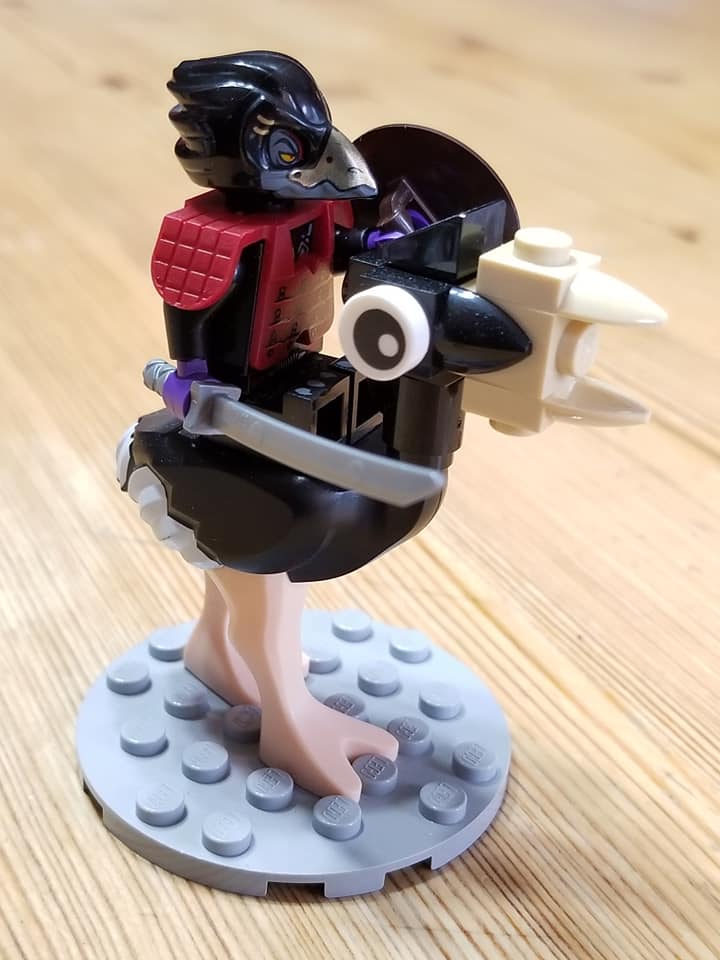
Thibdab's new mount's mini (shown at the top of this page) is the red Dragon Costume mini with the head replaced with a plain black head. Riding drakes are wingless, so I've replaced that part with the clear part used to add attachment points to the back of a minifigure. I have also changed Thibdab's legs to the short hinged type so that he could be posed while riding.

Millicent Velarno (human sorcerer 9) has the hag bloodline, so I would have liked to make her a changeling from the start, but that ancestry boon would have cost me nearly every Achievement Point I had accumulated by then. (She was my second PFS 2E character, built long before everyone was given 80 bonus AcP, and I wanted to keep a reserve in case of a character death or other dire fate.) The rebuilds in the boon store don't allow a change of ancestry or heritage, so I couldn't change that later on, either. But the Remaster rebuild is much more generous, so she's now a changeling (which have since become free), though still human. I kept her Linguist archetype, and made only minor tweaks to her spell list (mostly to clean up the assignment of her signature spells). Visually, the only change is that one of her eyes is now a different color from the other. I have not given her any ancestry feats granting claw attacks, because she has always actively avoided entering melee.

Xathel (elf investigator 7) started as a Thassilonian Delver (one of the Legacy Backgrounds I have access to from having played PFS 1E), and his adventures have included an Azlanti site and multiple visits to ancient dwarf ruins. So it was natural that I gave him the Archaeologist Dedication feat when I rebuilt him. He was originally an ancient elf, which gave him a free multiclass dedication at 1st level; I had taken rogue, for the extra skills. But Archaeologist took up the slack in skills, so I changed him to a whisper elf to make him even better at finding things. Beyond that, I made very few changes. 

I updated Xathel last of my nine PCs, partly because of adding the archetype, and partly because investigators gain skill increases and skill feats at an increased rate, so there were more choices (and math) to double-check.

Grazga (half-orc summoner 3) belongs to a class that will not be Remastered, or at least not anytime soon. That mostly just left her ancestry and heritage to update, since half-orcs are now called "dromaar" and are no longer restricted to being a human heritage. I kept her ancestry as-is, though, because as a Sarkorian god-caller, I felt that she needed to be at least partly human to have a blood-tie to her culture.


Samara Sawleaf
(leshy fighter 5) originally had the Mauler archetype, but once she reached 5th level, fighter weapon mastery made the dedication feat pretty much redundant for her chosen weapon group (polearms). After careful comparison of  fighter and mauler feats, I felt that the archetype didn't add enough to justify keeping it. Because of that decision, I was able to rebuild her before acquiring Player Core 2 (where the mauler was reprinted with no changes that I could find).

Samara's new mini uses the Halfling Druid's leaf-like cloak (from the new D&D Minifigures series), which is almost a perfect match for how I drew her cloak in her character portrait. 

Professor Felicity Featherwit (halfling rogue 6) is another character that I could have easily remastered before Player Core 2, but I was waiting to see if her versatile heritage (ganzi) would make the cut first. It did not, and I did not expect her Juggler archetype to appear there either, since it appeared in an Adventure Path. I was very happy with the way I had built her, so I think the biggest change to her is the fact that Remastered rogues are proficient with all martial weapons. That will not have any effect on her weapon choices, though, as she very much prefers finesse weapons (with which she uses Dexterity to calculate damage, being a thief).

Coracle Jibbs (catfolk monk 3) had to wait for Player Core 2 for his ancestry, class, and archetype (Pirate). But other than a couple tweaks to his Lore skills (Pirate now gives a new Lore rather than advancing Sailing Lore, and Catfolk Lore gives Additional Lore), he did not really change.


Veellox
(kobold oracle 2) was originally built as a dragonscale kobold who took the Dragon Disciple Dedication feat at 2nd level. That archetype was not reprinted, but the brand-new dragonblood versatile heritage does very much the same thing, just with ancestry feats rather than class feats. So he now has that heritage instead, and will have to wait until 3rd level to get a breath weapon through Ancestral Paragon. He doesn't have any abilities requiring him to choose a draconic exemplar yet, but I've already decided it will be a fortune dragon.

He was also originally a snare crafter, because of a boon from a Adventure Path chronicle that gave access to new snares. But he had yet to deploy any snares in game, because they take time and materials to set up, so don't seem terribly practical for PFS play. I decided to drop that idea, and change his background from Sewer Dragon to Merchant, to play up the "knowledgeable about wealth and trying to acquire more" aspect of being obsessed with dragons, and his chosen exemplar in particular.

The way oracular curses work changed substantially in the Remaster--the benefits of being cursebound were removed, and in some cases, the drawbacks were simplified. I've seen a number of complaints about these changes online, but Veellox is only 2nd level, so has rarely ever triggered his curse, so I'm not terribly attached to how it works. The original Ancestors curse was one of the most complicated to track, so the new curse is at least simpler to implement (and it has been triggered in both sessions I've played him since Remastering him). If I do decide that I still want to play with the concept of random ancestor spirits giving bonuses in return for obedience to their demands, that has been redone as the Meddling Futures feat. 

(Up until now, I've used a reptilian humanoid D&D mini to represent Veellox, largely due to a limited supply of suitable LEGO heads. But with the new D&D Minifigures series, I now have a dragonkin head to spare, and gold is one of the two colors in his scales (the other being green).

Aikhaheni (kitsune barbarian 2) is a duskwalker barbarian with the spirit instinct. His bonus damage while raging is now spirit damage rather than positive or negative, which fits nicely with his devotion to Pharasma. Apart from that he did not change at all, even in his minor gear. His ancestry did not appear in Player Core or Player Core 2, so will continue to follow the rules in the Ancestry Guide. 

Thursday, July 11, 2024

A Brief History of Multiclassing

To multiclass or not to multiclass? That is very good question, and not an easy one to answer.

Multiclassing, or advancing in more than one character class, has been implemented in many different ways over the long history of Dungeons & Dragons, as well as in other RPGs derived from it.  Multiclassing is a way to expand your character's abilities, but there is always a price or drawback to doing so, usually involving slowing (or even halting) advancement in your other class(es). 

Multiclassing in D&D

In 1st and 2nd Edition AD&D, you had to choose whether to multiclass when you first created your character. Only certain combinations of classes were allowed (determined by your race), and except for elf fighter/magic-user/thieves, you were limited to two classes. The costs of multi-classing were that your XP were divided between your classes, and your hit points were averaged between your classes. Typically, a multiclass character lagged behind their single-classed companions by a level or two (or more, if triple-classed), and had fewer Hit Dice and HP as a result. Also, in those editions, some classes cost more XP to advance in, so multi-classed magic-users lagged behind even more than usual. 

In 3rd Edition D&D, the choice to multiclass was made when you advanced to a new level. Each level you advanced was one level in one class, so your levels in all classes added up to your overall character level. You had to keep your classes within one level of each other or take a penalty to XP, but you ignored that limit for your "favored class" (which was determined by race, or was your first class for humans). This method was well integrated with the introduction of feats and skill ranks based on level, and allowed for the introduction of prestige classes. These special classes were slightly more powerful than a base class, but required characters to meet certain prerequisites before entering them (which could not be met before 6th level at minimum, and sometimes much higher). They otherwise used the multiclassing rules, and ignored favored class limitations.

Multiclassing in 3E (and the later v.3.5 revised rules) allowed for a more customized approach to character concepts. Some adventurers would split their levels fairly evenly between their two (or more) paths. Others might only take a level or two in another class (informally called "dipping a class") to pick up an entry-level ability, such as new armor and weapon proficiencies, or a few useful low-level spells. But every level in one class slowed progression in all others you took, which delayed access to higher-level abilities. Casters in particular sacrificed a significant amount of power by slowing down their spell progression. To offset this, a few prestige classes were designed to allow spellcasters to progress in caster level, but not their other level-based class features. And one prestige class, the mystic theurge, attempted to make advancing in two spellcasting classes a more viable option, with mixed results.

(I did not play much 4th Edition D&D, so don't recall how multiclassing worked in that version of the game, or even if it was an option at all.)

In 5th Edition D&D, multiclassing became an optional rule. This iteration of the game keeps the idea of character level equaling the total of your class levels, but adds prerequisites of minimum scores in the new class's key ability score(s), and has some special rules for acquiring spell slots that are shared between spellcasting classes. Prestige classes were removed from the game, though a few survive (in theme, at least) as subclasses.

Multiclassing in Other d20 Games

Most of my gaming experience these days is with Pathfinder and Starfinder, so with one exception, I'll be focusing on them for the rest of this column.

D20 Modern, which was based on the v.3.0 rules, made multiclassing central to every character's career. All characters started in one of six base classes (one focused on each ability score) for their first few levels, then chose an advanced class to distinguish themselves from other characters. I played very little d20 Modern (and only ever as a GM), but the core assumption that every character would multiclass was rather unique and memorable.

Pathfinder First Edition was a direct offshoot of D&D v.3.5, so its rules for multiclassing and prestige classes were almost identical to that game. The primary change was removing the XP penalty for uneven levels. Instead, your favored class (now always your first class) gave 1 bonus HP or skill rank at each level, which gave a new incentive for staying single-classed. Some classes were adjusted to avoid "front-loading" their class features, making it harder to cherry-pick signature abilities by "dipping."  All classes were given powerful capstone abilities at their highest levels, which could only be acquired by single-classed characters. (Pathfinder characters were strictly limited to 20th level.) Finally, some class options and feats could grant a few of the low-level abilities of another class (such as a few minor spell-like abilities, a bonus combat feat, etc.), which could help avoid the need to multiclass.

Starfinder was derived from Pathfinder 1E, but introduced many new rules of its own. It, too, allows multi-classing by choosing one class to advance at each level. However, it provides even more incentives to follow a single class. Most notably, spellcasting progression is slower in Starfinder than Pathfinder, so multiclassing is even more of a sacrifice for casters than in Pathfinder. Most other classes will quickly fall behind in effectiveness, too, particularly the operative and solarian, whose damage output scales with their level in the class. If a character does multiclass, it's strongly advised that they wait until after they've reached 3rd level in their first class, because that's when every class gains Weapon Specialization, which adds bonus damage to weapons with which they are proficient.

Starfinder also offers a new alternative to multi-classing: Archetypes replace some class features at specific levels, but give new abilities instead. This may cause the character to lose or delay access to some class features, or it may simply take the place of a class option like a soldier's bonus feat or an operative exploit. For casters, they typically have fewer spells known at their highest spell levels but their access to those levels isn't delayed. Overall, you retain the full benefits of your class level for purposes of level-based effects and access to most higher-level abilities. Archetypes are also not specific to any one class, but some have prerequisites, particularly if they expand upon the uses for a given skill or proficiency, or modify spellcasting. Finally, unless the GM adopts an optional rule, characters are limited to one archetype (or one per class, if multiclassed).

In Pathfinder Second Edition, multiclassing strongly resembles Starfinder's archetype rules, but you only ever advance in level in one class. However, when you get a new class feat, you can choose to spend it on an archetype dedication feat, which gives some minor initial benefit and allows you to spend future feats on that archetype's feats. Multiclass archetypes give you some (but never all) of the abilities of another class. Other archetypes are unique unto themselves, and may focus on a fighting style, altered ways to cast magic, new ways to use one or more specific skills, or some other theme. (Numerous 1E prestige classes have reappeared as archetypes in 2E, but without the multiclass tag.) Much like in Starfinder, archetypes may be taken by members of any class who meet the prerequisites for the dedication feat, but they are more flexible because you can invest as much or as little in the archetype as you want. There are limits to how many archetypes a character can take, because you can't take another dedication feat until you have taken at least two of that archetype's other feats. That usually means that you can't take a second dedication until at least 8th level, or a third before 16th. (A rare few archetypes include some feats that replace skill feats instead of class feats, allowing faster acquisition.)

When Starfinder Second Edition is released (in playtest at this year's GenCon, and in full next year), it will use the same game engine as Pathfinder 2E, making it fully compatible with that system. Presumably this means that multiclassing will follow the same archetype rules.

My Own History with Multiclassing

In pretty much all of the RPGs I've mentioned above, I prefer to remain single-classed in order to get faster access to the higher-level abilities of my character's first class. There have, of course, been some notable exceptions:

D&D 3E: I once played a fighter who multiclassed entirely for story-based reasons. He took a couple levels of ranger when the party started doing a lot of cross-country travel, and later took some levels in psychic warrior because the campaign's overall story arc involved the emergence of psionic powers among the oppressed classes in a tyrannical empire. I eventually regretted taking so many classes, because while he had an amazing Fortitude save from stacking three martial classes, his Will lagged behind too much, even after taking Iron Will.

At the other extreme, a player in one of my 3E campaigns created a cleric of the god of magic, who multiclassed into wizard. She didn't initially intend to aim for mystic theurge, but once she did, she also picked up a level of loremaster because that class was more interesting than a third wizard level would be. Out of all the characters that I've ever played or GMed, she had the most classes, at four (all by 9th level).

Pathfinder 1E: I have built a handful of characters with the intention of qualifying for a prestige class as soon as possible, including a brawler/living monolith and a rogue/shadowdancer, and a diviner who I never played enough to reach harrower levels. Beyond those, I can only think of four characters offhand who have multiclassed:

  • A rogue who took a level of cleric out of thanks to his god for granting him enough luck to survive that long. He later retrained that level back to rogue when it became clear that he could serve his god better by being a better rogue.
  • A cleric of Calistria, who multiclassed into rogue as soon as he could. He was originally built as part of an all-cleric party, and they needed to diversify their skill set at 2nd level. (One multiclassed into fighter; the rest stayed single-classed clerics.)
  • A ranger who dipped fighter to gain heavy armor proficiency and some bonus feats. 
  • A hunter/rogue whose teamwork feats plus sneak attack made for very effective flanking tactics with her animal companion.

Starfinder 1E: Out of my 14 Starfinder Society characters, only one is multi-classed. Shortly after acquiring a creature companion, my gnome envoy took a level of xenodruid mystic so that he could speak with animals, like his ancestors once did. That made his companion easier to control, and allowed him to use his language-dependent abilities to help it as well as his PC allies.

I have more characters who have taken archetypes: 

  • An explorer operative who took the Starfinder forerunner archetype. Her specialization and archetype compliment each other nicely (both do interesting things with Culture and Survival skills). I also already had a high-level operative combat monster, so I felt that sacrificing a few exploits to further differentiate this one was perfectly acceptable.
  • A phrenic adept whose species communicates primarily via telepathy, but very slowly (using telepathic message). This archetype solved that problem by giving him limited telepathy (on par with other telepathic PC species), and gave some interesting new abilities as well. The character is a mechanic, so suffers less from investing in an archetype than some other classes would.
  • A soldier who became a powered armor jockey. (His archetype starts at 6th level, which he only very recently reached, so I am still waiting to see how effective it is.)
  • Another soldier who became a Star Knight.
Pathfinder 2E: Out of 9 Pathfinder Society 2E characters, I have 4 with archetypes (only one of them a multiclass archetype):
  • A bookish (but still very social) sorcerer who became a linguist. 
  • An investigator with the ancient elf heritage, which gives a free multiclass dedication at 1st level. (Normally those are 2nd-level feats.) He took rogue, which provided a few more trained skills to fill in gaps in his already diverse knowledge base. 
  • A fighter who took the mauler archetype, which focuses on big, two-handed weapons.
  • A rogue who took the juggler archetype because of her background as a circus performer.
The release of the Remastered rules last year means that I will eventually be rebuilding these characters, but I will most likely keep the archetypes they have. The first two have classes that did not appear in Player Core, but that I expect to see in Player Core 2, which releases later this summer. The only archetypes in Player Core were the multiclass ones for that book's classes, so I also have to wait to see how many other archetypes get Remastered in the new book before I rebuild my linguist and mauler. The juggler archetype is from an Adventure Path, so I don't expect that to ever get the Remastered treatment, but will continue to exist as-is.

Update 9/15/2024: See Let Me Tell You About My Character: Remastered Edition about the changes I've made to my PFS 2E characters since writing the column above. The short version: The linguist and juggler kept their archetypes; the investigator changed from rogue multiclass to archaeologist; the fighter lost her archetype; and my champion gained one.

Wednesday, February 23, 2022

"Let Me Tell You About My Character..." (An Index)

Abe Sapien (used for my Buffy RPG character
Baz Olmstead when in Triton form)

The following pages are devoted to stories, artwork, and miniatures for my own player characters in various RPGs. They do not include the snippets of character info buried in my RPGaDay, Drawloween, and Inktober posts (except for those on Trick's personal index page), nor do they include PCs or NPCs from games I've GMed.


D&D 5E

Taphos (1/13/2016): Converted to 5E from a friend's homebrew RPG system.

Lendri (1/28/2016): Converted to 5E from a friend's homebrew RPG system.

A Brief History of Multiclassing (7/11/2024): How multiclassing changed across editions of D&D, Pathfinder, and Starfinder, with a few examples from my own PCs.


Grey Angels (Buffy/Angel/Fate)

Nightwatch Dossier: Patricia "Trick" Tillinghast (started 4/17/2020): This page is an index for columns about my PC, Trick Tillinghast, and the "Grey Angels" campaign in general.


Pathfinder Society

How do you go about creating a character for play? (8/30/2018): Uses some of my PFS PCs as examples.

Cassilda Tillinghast (11/13/2018): Art, stats, and bio for my first psychic caster PC.

Pathfinder Iconics Minis (12/5/2018): LEGO minis of the iconic characters for each core class.

A Baker's Dozen of Pathfinders (2/5/2019): Artwork and capsule bios of my PFS characters.

Pathfinder Society LEGO Minis (3/16/2020): Minis for my PFS characters (including new additions since 2019).

"Clever" Character Names Often...Aren't (2/9/2022): Origins of a few of my PFS & SFS PCs' names.

Pathfinder Society Minis and Artwork Update (2/23/2022): Some new artwork, plus my PFS 2E characters' minis.

A Brief History of Multiclassing (7/11/2024): How multiclassing changed across editions of D&D, Pathfinder, and Starfinder, with a few examples from my own PCs.

Let Me Tell You About My Character: Remastered Edition (9/15/2024): How the PF 2E Remaster affected my Society characters, plus a few updated LEGO minis.


Pathfinder (other campaigns)

The "Dungeon Interludes" Party (11/3/2016): LEGO minis for one of my wife's campaigns.


Starfinder Society

"Clever" Character Names Often...Aren't (2/9/2022): Origins of a few of my PFS & SFS PCs' names.

My Starfinder Society Minis and Artwork (3/3/2022): Bios and LEGO minis for my SFS PCs to date.

A Brief History of Multiclassing (7/11/2024): How multiclassing changed across editions of D&D, Pathfinder, and Starfinder, with a few examples from my own PCs.

Pathfinder Society Minis and Artwork Update

A few years ago now, I shared the portraits I'd drawn of my Pathfinder Society characters, along with capsule bios of each one. A year later, I shared photos of the LEGO minis I'd made for those characters, with a few new characters who had debuted since that previous post. I plan to do a similar article about my Starfinder Society characters sometime soon, but for now, I'm going to update two of those PFS First Edition PCs, then introduce the handful of PFS Second Edition characters I've created so far.


First Edition Pathfinder Updates

Very few of the minis for my 1E characters have required updating. K'Chaw's mini (tengu cavalier) has a new helmet, and Volutus's (sylph druid) has a new face, but only two PCs received substantial mini makeovers and/or new art. 

Cassilda Tillinghast

Cassilda Tillinghast (human mindblade magus) received a second portrait almost 2 years ago (see above). She can now manifest two psychic weapons at once, so I felt the need to depict that. I haven't updated her mini yet, but may do so whenever I get to play her in an in-person game again. 

Thanks to rapid advancement through two adventure paths, Falling Rock (Shoanti human ranger/fighter) soon surpassed my other characters in power, and has been retired at 19th level. (There is one more PFS scenario that we could legally play with those characters, taking them to 20th, but it's a multi-table special that can only be run at a con. And it's a fairly old one, so we may be waiting quite a long time before demand for it reaches critical mass again.) Falling Rock continued to get even scarier with his trusty earth breaker, and ended play with a +5 impact impervious merciful adamantine weapon. He also acquired mithral full plate very early in his career, which required a dramatic rebuild of his mini: he kept the old head, but he wears a Castle/Kingdom knight's armor, a Roman legionnaire's helmet (chosen to leave his face visible), and his new earth breaker is built around a fist/hammer piece from (IIRC) the Legend of Chima theme.

Falling Rock

I have also drawn a quick B&W sketch of Falling Rock in his new armor, charging forward with his weapon raised.

Falling Rock


Second Edition Pathfinders

I have played three characters in PFS 2E so far, and may be debuting my fourth in a month or two. I have not yet drawn portraits for any of them, but the active ones all have LEGO minis, and I built a mini for the newest character while writing this column. 

Thibdab (goblin redeemer champion of Sarenrae) has advanced several levels since he made an appearance at the end of my previous PFS minis column. He retains his original head (Goblin, Minifigures Series 13), sword (Prince of Persia), and shield (Wonder Woman), but now wears platemail (plain light gray breastplate, torso, and short legs).  Much like Falling Rock above, Thibdab's new samurai helmet was chosen because it leaves his face visible--he is, after all, a goblin champion, and should be identifiable as one. His first knight-master (K'Chaw, my 1E tengu cavalier) is from Tian Xia, so his headgear is a nod to that, too.

Thibdab has also acquired a wolf mount, which he named Kazaam! (the "!" is part of the name). The wolf started out Small, so was a more of a trained companion than a mount, but is now Medium and thus large enough to bear Thibdab into battle (though he's faster without a heavily-armored goblin on his back). Most of my time playing Thibdab has been online due to Covid, so I was able to use an image of a gray LEGO warg as his wolf's Roll20 token. The warg is far too large for in-person play, so I have a LEGO dog and a goblin microfigure for when Thibdab is mounted. A couple of 1x1 plates with clips hold a shield (from the Aztec Warrior, Minifigures Series 7) and sword (a non-LEGO scimitar), and the microfigure wears the magic helmet from the Heroica theme. 

Thibdab, afoot (L) and mounted on Kazaam! (R)

Millicent Velarno is a human sorceress with the hag bloodline. This photo inspired her look--all black, with a cloak and hood, and dramatic, spooky eye makeup--and still serves as her token on Roll20. I got a chance to play her in person at a local con last summer, so she needed a mini then. She wears a witch's black torso (Minifigures Series 2), plain black legs (more practical than skirts), a cloth Batman cape, and a black hood. Her head is Tonto's, from the very short-lived The Lone Ranger theme. Here, with only the makeup visible, Depp's highly controversial racial caricature has been repurposed for a more acceptable "goth witch" look. Since I built this mini, she has acquired a demon mask, which she wears constantly to make herself even more intimidating. I have a couple of monstrous Ninjago masks (the Thunder Keeper and the Omega oni) that I keep with her mini in case I decide the scary mask needs more attention.

Millicent Velarno (L) and Xathel (R)

Xathel is an elf investigator, with a bit of rogue. (I chose an elf heritage that allows a multiclassing archetype at 1st level, and rogue added even more to his long list of trained skills.) His body is that of a Mirkwood elf, but he has Bruce Banner's head (for the green eyes) and Zan/Jayna's hairpiece (The Batman Movie Minifigures). He wears a brown cape matching his elven garb, and wields a shortsword (Sting, from LOTR/Hobbit sets). 

My brand-new, unplayed 1st-level PC for 2E is Grazga, a half-orc summoner who belongs to the (mostly human) Sarkorian tribes, whose ancestral homeland was devastated by a demonic incursion. The resulting Worldwound has been recently healed (during one of the last adventure paths released for 1E), and now some of her people are working to reclaim those lands with help from the Pathfinders and other allies. Grazga is one of her tribe's spiritual leaders, known as "god-callers," who are bonded to eidolons considered to be minor divinities. Her companion is Dontorex, who looks like a feathered dinosaur. 

Grazga's mini uses one of the old "tribal warrior" bodies from the Old West theme, with the light brown hands and head from a Star Wars alien, and long, loose hair from a Hobbit theme dwarf. Her cape is red on one side and tan on the other, turned drab side out for camouflage. (Sadly, I forget the source for this piece, as it's one of the few non-monochrome capes I own.) I would have preferred a more brightly-colored, more dinosaur-like mini for Dontorex, but ended up compromising with a Vampire Bat torso (Minifigures Series 8), which comes with small wings attached to the arms. To preserve the color scheme, I used Bytar's head (a Constrictai Serpentine character from Ninjago). 

Grazga (L) and Dontorex (R)

Wednesday, February 9, 2022

"Clever" Character Names Often...Aren't

If you've been a gamer for very long, you've probably come across quite a few players who have named their heroes after characters from literature, TV, or film--and likely been guilty of it yourself at some point! Many players, both old and new, are prone to obsessively recreating their favorite heroes as faithfully as they can with any new RPG's rules set they try out. For a host of reasons (inexperience with the rules, strict power caps on starting characters, clashing opinions about the character within the player group, etc.) many end up frustrated when it doesn't work out to their satisfaction. And along the way, they often end up annoying their fellow players with their presumption. ("Oh, sure, you're Alannon. And what level are you again?"*)

One problem with trying to slavishly copy a fictional character is that you're not experiencing the full range of characters in the game. If you're hung up on the idea that your wizard has to be an old, mysterious know-it-all, just like Merlin, or Gandalf, or Elminster, then you'll miss out on all the other ways to play the class. And no matter how awesome those characters might be in their original settings, they might be a very poor fit for the campaign you've joined. Especially if you want to play the world's most powerful arch-mage, when you've joined a game that starts at 1st level! Instead, give some thought to playing the new kid on the block, who someday hopes to rub shoulders with those legends, and show us all how to do things differently than the predictable tropes of characters everyone knows.

There are times when it can be appropriate to use a name that copies that of an established fictional character, or that is a clever take-off of one. For example, players and GMs tend to be less strict about setting-appropriate names for one-shots or less serious games--and in deliberately silly games, anything goes, the punnier, the better. Less obvious homages can work in more serious games, particularly when the name or character are on the obscure side, and when the character is much more inspired by a fictional hero than based on one. 

In my own games, I do put up with a certain amount of silliness in names, because my players are there primarily to have fun, and to blow off steam from their busy lives. Their jokes are part of the price, and the joy, of having a loyal group of friends to game with. So, for example, my Pathfinder games have  featured animal companions and familiars named for Pokemon or dirty puns. If I ever tried to tackle a more historical game, I'd probably put more effort into policing names, but I'm also not sure that's really this group's kind of game in the first place.

Organized play is very much a crap-shoot when it comes to character names. For every serious, fantastic name that helps build immersion in the world, you'll have a Barbarella, a Harley Davidson, or  a Herlock Sholmes.**

In all fairness, I'll admit that not all of my Pathfinder Society and Starfinder Society characters' names are entirely serious:

  • I named my tengu cavalier "K'Chaw" as a joke, and only gave her a "real" birth name, and a story explaining the nickname, after playing her for a few levels. 
  • My kitsune hunter/rogue is named Mumbly Peg, after the "game" played with knives. She usually just goes by "Peg," so her full name rarely, if ever, gets any comments.
  • Nar-Lok, my creepy heavens shaman, gets his name from the Loc-Nar in the movie Heavy Metal.
  • My kiirinta (a moth-like fey species) mystic is named Tekeli-li, after the sound that the shoggoth makes at the end of At the Mountains of Madness (which Lovecraft lifted from the giant albino penguins in Poe's The Narrative of Arthur Gordon Pym).
  • My gnome envoy and musician is Toknomonicon, which was never meant to be anything more than a random mouthful of syllables. But once I had worked out that much, of course he had to be known for doing "Tokno remixes."
My mindblade magus, Cassilda Tillinghast, has a much more serious name, but it's still ultimately a pair of Cthulhu Mythos references. The surname comes from a past Buffy/Angel RPG character of mine, Patricia "Trick" Tillinghast, upon whom Cassilda was very loosely based. This surname was used by Lovecraft for the scientist in his short story, "From Beyond," because it was a historical New England family name. Because the game I played in was set in New England as well, I drew heavily on Lovecraft for my PCs' and their relatives' names (Trick's cousin is an Olmstead descended from Gilmans and Marshes, for example). The name Cassilda comes from Robert Chambers' "The King in Yellow" stories, where she is a central character in the cursed play that gives the cycle its name. I liked the sound of it, and it's obscure enough that you would need to have read Chambers or have played certain Yellow King-themed adventures (such as one of the later books of the Strange Aeons Adventure Path) to recognize it. Nobody who has seen me play my Cassilda has ever hinted at knowing anything about the other one yet. 

This is the kind of literary name that I like best: it alludes to a work of fiction, without copying any particular character too much (if at all). It's a cool name that stands on its own, with or without any explanation of its origin. And there's very little if any of that "Hey, see what I did there?" nudging and winking that the names that started me on this rant are shamelessly guilty of.

-----

* True story: One of the players in my college AD&D campaign named his wizard Alannon. I hadn't read any of the Shannara books at that point, but my roommate had, so he gave the the wizard's player serious side-eye for his choice of name. I let the player keep the name, but my roommate loved to rib him whenever "Alannon" spectacularly failed at an attempt to do something impressive.

** Real examples of character names I've encountered online, just in the past month or two!

Monday, February 8, 2021

The State of the Blog (and the Tim)

In the process of looking up something that I had shared here a couple of years ago, I realized that I had not posted anything new since August. I've been meaning to post a few things during that time, but lacked the motivation to make it happen. So here's a very quick update of where things stand in the many lands of Studded Plate. (Warning: There's a bit about a friend I lost very recently at the end of this column. I'm still figuring out how to talk about it online...or in general) 

Freeport and 5E: The 5E and Fantasy AGE versions of Death in Freeport were released just as I was finishing up that last post in August. I intend to run one version or the other sometime this year. I also have a few items to compose "Freeport and..." articles about at some point: the latest Unearthed Arcana articles (only two since August), Ghosts of Saltmarsh, and possibly Kobold Press's Tome of Beasts (which I'm slowly making my way through). And whenever I acquire Tasha's Cauldron of Everything, I will almost certainly have something to say about using that book with Freeport.

Time of the Tarrasque: This Pathfinder campaign went on hiatus back in 2019, and to be very honest, I'm not sure if it will ever restart at this point. 

The Kynthiad: The solo Greek myth BESM game that I run for my wife Erika is still going, though the end of the campaign is finally approaching. In our last few sessions, Kynthia has been instrumental in definitively ending the Trojan War--with Troy emerging victorious, and many Greek going home without their kings. Now we just have to figure out how she's going to stop Typhon's return, which will make a fitting conclusion to the story--and free up some headspace for me to run other games. 

Building the Bestiary: I would almost certainly have added another installment or two of this series by now, except that the pandemic has forced us to go online for most of our gaming, which means I'm producing far fewer LEGO minis for games. (We do play occasional games in person within our "bubble," but I've been GMing far fewer of those than I used to.)

On a related note, I have not purchased any of the new Minifigures series that have been released since the pandemic started. If and when I do, I will post reviews, but I don't know if that will happen before the end of mandatory social distancing.

Pathfinder Society and Starfinder Society: Erika and I are still heavily involved in organized play for Pathfinder (1E & 2E) and Starfinder. All of these games have been strictly online since March or so, except for occasional games within our "bubble" (such as the Starfinder AP we started recently). I earned my third GM Star for Pathfinder Society 1E just before the end of 2020, but Erika has shot way ahead of me there, and is closing in on her fifth (and final!) GM Star. She became a Venture Officer for our local store about a year ago, so has been running a lot of games for that venue, as well as for several online conventions. We're both playing a lot more PFS 2E and Starfinder now than we have in the past, because it's easier to find games to play in now that we're online. Erika has GMed a couple of 2E scenarios so far, and her first Starfinder game this past month. I haven't tried GMing 2E yet, but have a few Starfinder games under my belt, and intend to run more as I get more familiar with the system. (I still have a ways to go before my first GM Nova, though.)

Grey Angels: I have been intending to write more about the (new and old) adventures of Trick Tillinghast, one of my characters in the long-running "Grey Angels" campaign (using Buffy/Angel Unisystem) that revived for a "reunion arc" at the end of 2019. Sadly, our main GM, Cassandra Lease, died rather suddenly at the beginning of this month. All of us in the game have been close friends with her for upwards of 15 years, so we're all still reeling from this loss. At some future date, we may try to find some way to continue playing in the world that she invited us to help her create, because it would be a damn shame to never again revisit those characters. But we're nowhere near ready to contemplate how to do that yet, apart from agreeing that some day, when we're ready, we very much want to have a long, involved discussion about it. Sharing stories about Cass among her circle of friends has been very helpful to us, and very necessary. When I'm ready to, I will probably share some more stories from the game here, in her memory. She would have liked that. 


I received this Abe Sapien figure as a gift from Cass early on in the Grey Angels game. She used the movie version of Abe as the visual reference for the Tritons, the sea demon race from which my very first GA character, the mage Baz Olmstead, was descended.

Monday, March 16, 2020

Pathfinder Society LEGO minis

A little over a year ago, I posted artwork I had created for my Pathfinder Society player characters, with a brief description of each character's concept and history. I have added a handful more characters to that stable, though I have not yet drawn portraits of my new heroes. I do, however, have LEGO minifigures built for all 17 characters, so am sharing those here.

Ansari Zolta (human rogue/cleric of Cayden Cailean) recently completed the Seeker-tier (level 12+) series "Eyes of the Ten."

Ansari is Kelishite, so his mini mostly combines some Indiana Jones and Prince of Persia minifigure parts, with an old Pirates cutlass. [The round base is Kre-O, not LEGO. It's one of the few Kre-O parts that I'm actually very happy with.]

Raudabjorn "Bjorn" Kjallakson (dwarf stonelord paladin of Torag) continues to fight as a crusader, and recently helped defend the city of Nerosyan from a siege of demons. He recently upgraded to a holy waraxe, to help him punish even more foes.

Bjorn's armor and weapons are from a mix of Castle, Kingdoms, and related sets. The gray-green cape is a hobbit-length elven cloak (LOTR).

Bjorn has an earth elemental companion named Pyrite, who he doesn't call upon often because a Medium elemental is highly squishable at his tier. However, at next level, Pyrite will become Large and be much less of a liability. That future mini (shown here) uses one of the second-generation Hagrids with articulated hands (Harry Potter), with a werewolf head (from the Collectible Minifigures, or "CMF," theme) and silver gauntlets from a Gorilla Tribe character (Chima).

Mahesh's political maneuvering has now earned him the title of Lord Mahesh, Viscount A'Zun (nagaji serpentine sorcerer).

His mini combines a royal outfit from the Castle theme with Ninjago Serpentine head and hands, plus a Harry Potter wand. His familiar Zuku uses the Snake Charmer's cobra (CMF).

Mariko Snowtop (undine white-haired witch) recently reached Seeker tier , after competing in the Ruby Phoenix Tournament (earning yet another tattoo for her collection) and some high-level adventures involving the Hao Jin Tapestry. She and her familiar have died once, so she has a new king crab named Khaempferi.

Mariko has the alternate racial trait of Flesh Chameleon, so can change her coloring to look human. I have a second mini to use when she uses this disguise. Her natural undine form uses an Aayla Secura minifigure, with the lekku replaced by another Star Wars character's topknot. Her human disguise uses a Ninjago torso and legs. The wands are from Heroica games. The silver crab belongs to Zodiac Master (The LEGO Batman Movie Minifigures).

Neferanu (oread brawler/living monolith) recently became a member of the Jeweled Sages, and only needs one more level to reach Seeker status.

Neferanu's torso is from the Adventurers theme's mummy Pharaoh; the headpiece from a CMF Egyptian warrior; and the head from the original Darth Vader minifigure. [The spiked "knuckles" in the photo are a BrickWarriors part (not LEGO) which I don't use anymore.]

His "embiggened" monolith form uses the body of Jun-Chi (Adventurers), a Garmadon head (Ninjago), and an Egyptian queen's hair (CMF). The head is attached with a 2x2 round jumper plate, to center it on the shoulders. The base uses four 1x2 jumper plates to center the 2x3 "footprint" on the 6x6 round plate.

Jalon Greenbottle (half-elf inquisitor of Gorum) has started focusing on ranged combat, so uses his repeating crossbow more often than Gorum's favored weapon (greatsword). [I'm not as happy with Jalon's advancement as I am with most of my other characters, so he's not currently high on my priority list for play.]

Jalon wears a chrome conquistador breastplate over a redcoat's torso (both from Pirates/Armada). His head and hair are from a LOTR/Hobbit elf. His crossbow is one of the newer models that shoots 1x1 round tiles (though I never use that feature while gaming, for fear of losing the tiny parts).

Nar-Lok (half-orc heavens shaman of Desna) has been adventuring with his new spirit animal, Daosvaria (a hatchling nightmare dragon) for some time now, and relies heavily on her for esoteric lore. (She is a sage familiar, so compensates for Nar-Lok's limited knowledge skills quite handily.) He has reached Seeker tier, and has played a single adventure at that level so far.

Nar-Lok's torso and legs are Zodiac Master's; the hat and cape are from a CMF wizard; and his face is a Stone Warrior's (Ninjago).  The breastplate is a Chima accessory, and the compass (his wayfinder) is from Pirates of the Caribbean. [I don't currently have a LEGO mini for Daosvaria, as I use a tiny Pokemon figurine instead. I did use a Norbert dragon mini (Harry Potter) briefly, but it wasn't freakish enough.]

K'Chaw (tengu cavalier) now has her axebeak mount, who she has named Good Girl. I have also worked out what K'Chaw's birth name is (Karasu Momoru) and why she goes by "K'Chaw" instead: it was a nickname given to her by a tribe of horse nomads that she lived with for a time; as her horsemanship improved, the name became a badge of honor.

K'Chaw is a Legend of Chima Raven Tribe character, with [IIRC] Ninjago samurai armor. Her shield (facing away in this shot) is an Amazon warrior's (CMF) with a bird design. The axebeak is an ostrich (Prince of Persia) with a much larger brick-built head. (A short bar fits into a hole where the original head attached.)

Volutus (sylph sky druid) still hasn't seen a lot of play, except when there is a low-level Concordance-related adventure.

Volutus uses a Jack Sparrow body (PotC) and a Viking shield (CMF). I don't recall at the moment where the head and hair come from. [The scimitar is a BrickWarriors part, not LEGO.]

Milo Nimblefingers (halfling cleric/rogue) has reached second level and multiclassed into rogue. We don't play our Core characters enough for me to be certain how long he'll stick with that class, but my best guess right now is that he'll remain about half cleric, half rogue throughout his career.

Milo uses a hobbit's head and hair on Gimli's body (LOTR), and an Indiana Jones bullwhip.

Atticus Nox (tiefling investigator) is a Chelaxian scribe and barrister, who grew up benefiting from the status his diabolic heritage gave him in that corrupt empire. His partner Nephrael, my wife's character, has recently converted to a good god following a visit to Heaven without him. Atticus may follow suit one day, but is more likely to embrace the ways of Axis (which they both visited briefly in one adventure).

Atticus's body is the Lone Ranger's uniform (because the star badge is the closest thing I had to Asmodeus's pentagram). The tail and hands are from the Little Imp (CMF); the head is from the Monster 4 LEGO Game. His hair is Valkyrie's, from Thor: Ragnarok (Marvel Superheroes).

Cassilda Tillinghast (human mindblade magus) has now reached the level at which her previous incarnation was created for The House on Hook Street. Now that Mariko has reached Seeker tier, Cassilda has become my new character with a hefty grudge against the Aspis Consortium. Much of her last couple of levels involved Aspis-related adventures in the Hao Jin Tapestry.

Cassilda's body and cape are from the Wicked Witch (LEGO Dimensions), with new head and hair (the latter is from a Friends minidoll). Her mindblade and shield spell are represented with some of the trans-blue accessories that come with sets featuring Iron Man or Thor (Marvel Superheroes).

[I have also very recently had the opportunity to start playing Trick Tillinghast--the Buffy/Angel RPG character on whom Cassilda is very loosely based--again, which pleases me immensely. I will be devoting one or more future columns to her very soon.]

Mumbly Peg (kitsune hunter) has upgraded to her owlbear companion, Growler, and only needs a couple more adventures before he grows to Medium size. She will be taking a level or three of unchained rogue in the near future in order to boost her damage output while flanking; she already has the Boon Companion feat to avoid losing advancement for Growler while she does that. Peg is my only PFS character with a negative Int modifier, which can be a challenge to roleplay properly at times, but ganging up on things with her buddy is great fun!

Peg's head, legs, and tail are from Furty, the single Fox Tribe Chima character. The armored torso is from a Castle/Kingdoms minifigure. The photo above shows her in human form as well. While Growler is Small, I'm using a baby bear (Friends). Once he is Medium, I'll be using a Raven Tribe character (Chima) on all fours, with some claws added (see photo at left).

The New Kids on the (LEGO) Block

The following five characters are all new in the past year, and all have at least 1 XP, but only one has reached 3rd level so far. Two of them (Raisa and Darla) are "GM babies," who only have XP from GM credit or playing pregens, but have not yet seen play. (Pierce was another until earlier this month.)

Raisa Lupescu is a Varisian human diviner and fortune-teller, who will be taking the Harrower prestige class once she qualifies for it. (I want to get full use out of my Harrow deck, and much of the in-game lore about these decks is fun). She is a cousin to one of my other characters, Cassilda Tillinghast (who is only half Varisian).

Raisa's body and cape are from the fortune-teller (CMF). Her hair and kerchief piece is Professor Trelawney's (Harry Potter). She holds a 1x1 tile printed with a spellbook from an old Castle set. (I originally wanted to have her hold the two 1x2 Tarot card tiles that came with the fortune-teller, to represent her Harrow deck, but I've decided that they would be too likely to get bumped out of her hands and lost.)

Sibyl Pierce prefers to go by just "Pierce," and wears simple, practical clothes that obscure her gender. She is an Ulfen woman who learned the basics of zen archery from a wandering Tien monk, whose example she now follows.

She is built with a Green Ninja body (Ninjago), a back quiver (Castle and elsewhere), and an elven longbow (LOTR/Hobbit). Her hair is Elsa's blond wig with braid, from the Disney CMF series. This version of Elsa's hair works better with this pose--turning her head to the left to look at her target--than the straight-down braid from the Frozen minidoll sets (which would run into her quiver and shoulder).

Sister Darla is a nosferatu-born dhampir warpriest who was raised from infancy by the church of Pharasma as a living weapon against the kinds of monsters responsible for her existence. She is the beneficiary of last year's GM race boon, which allows a dhampir PC.

Darla's gray head is the Emperor's (Star Wars); her armor is from a Black Knight (CMF); her helm from an older Castle/Kingdoms set; and her dagger from Prince of Persia. (I have used this blade with multiple PCs presented in this column. They make great large daggers, small scimitars, or shortswords.) The tile on her shield is the Hypnobrai symbol from Ninjago; the spiral design makes it ideal for a holy symbol for Pharasma.

Falling Rock is a Shoanti human ranger who specializes in smashing things with his earthbreaker. He was created for a group who is playing through the Giantslayer and Shattered Star Adventure Paths (plus a little bit of Emerald Spire) in "PFS mode." He's my first serious attempt at a DPS-focused character, and he seems to be doing OK at it so far. I chose ranger over fighter so that he would have more skill points, and more useful class skills for this campaign. (He may multiclass into fighter later if I feel that I need additional combat feats more than skill points.) He is now the most experienced of my new characters, thanks to the sustained time spent with the Adventure Paths.

His body is from a Castle minifigure (Dragon Knights subtheme, IIRC?). The head is from an obscure Star Wars character whose name I've forgotten. An earthbreaker is essentially a big, spiked maul, easily represented by a couple clip-plates on a 1x1 SNOT brick, with a long bar handle.

Thibdab is my single Pathfinder Society Second Edition character to date. He is a goblin redeemer champion of Sarenrae. His back story is that he started his career as a squire to my 1E cavalier, K'Chaw, who later sponsored his eventual admission to training as a Pathfinder himself. He seeks to serve as an example to others of how goblins can constructively cooperate with the Society.

Thibdab is a complete melange of parts: head from the CMF goblin; helmet from an old trolls Castle set; torso and short legs from a Ninjago Stone Warrior; sword from Prince of Persia; shield from a Wonder Woman movie set.

Tuesday, February 18, 2020

What I'm playing, and what I'm planning

It's been nearly three months since my last blog. I've been busy with many games, I just haven't had a lot to present here.

My "Time of the Tarrasque" Pathfinder home game remains on hold. The player who had a scheduling issue has been in his new job long enough to have our usual game day free again, so now we just have to contend with 1. wonky schedules from the holidays (mostly settled by now), 2. the last half year of inertia, and 3. me finding a way to move forward with less risk of burnout. I have a few ideas for how to deal with some of that in the short-term (such as a brief skip ahead to the next exciting bit, with a little bit of hand-waved XP and gear to go with it).

There is one project that I want to resolve before we resume that game. I've been running a Greek myth-based BESM game for my wife Erika for the past decade or more, on and off. We've reached the endgame stretch, and she and I both want to give it a proper conclusion rather then let it collect dust in limbo. That game is also a homebrew campaign, and while it is not nearly as crunch-intensive as "Time of the Tarrasque," we are at a point where I need more prep per session than I used to for most of its history. (These days, I'm juggling gods, mortal and demigod heroes, and the imminent threat of Typhon's return, all of which demands a bit more brainpower to pull off.) I'm hoping to wrap that up this winter and spring, and be able to devote my full attention to Tarrasque again sometime before summer.

Falling Rock, my Shoanti ranger
for Giantslayer/Shattered Star
Meanwhile, I am still gaming regularly, it just hasn't been as much of my own games:

  • I'm still very active in Pathfinder Society, as both player and GM. I'll be reaching ing my 3rd star as a PFS GM (60 games GMed) sometime in the next month or two.
  • Some of us regular PFS GMs have started a separate group in order to play through a couple of adventure paths in PFS mode. We've just finished Book 1 of Giantslayer, and are ready to start Book 1 of Shattered Star. We'll be alternating between those two AP's after each book (with one GM for each series), and playing occasional bits of Emerald Spire to fill in some advancement gaps.
  • I GMed my first Starfinder game at Fallicon (Lexington, KY) back in November, and have run and played a few more Starfinder Society scenarios since then. 
  • Our local group isn't nearly as keen on Pathfinder 2E as they are on PF1 and SF. However, Erika was recently (and finally!) made a Venture-Agent. In order to fulfill those duties, she needs to be willing and able to run 2E as well as 1E at the store and at cons, so we'll be trying to get that on the schedule a bit more often going forward. (Ideally, she also needs to become more familiar with SF, but there are a handful of us who can run that while she focuses on learning how to run one new system at a time.)
My children's high school has a D&D club, which they have both deep-dived into, and both are running games of their own. Now that they have a lot of school friends that they can play with regularly (both in person and online), Erika and I don't get to game with them as often as we did in the past. (They have both cut way back on PFS, though one of them still plays when it's not a school night and they don't have another game going on.) That will change somewhat when Tarrasque resumes, since our eldest child joined that game shortly before the latest hiatus, and is just as eager to get back to it as the other players are.

The same kid has recently started running a (very occasional) D&D 5E campaign for that adult home group to help fill time during the hiatus. All of the PCs are "mudborn," a small race of anthropomorphic axolotls. That's been great fun, and we'll all looking forward to doing more. (I greatly envy this kid's free time, when they can just do more prep/tinkering whenever the mood hits!)

Looking further ahead, all four of us will be attending Lexicon again (here in Lexington, KY) at the end of April. We're also looking into the possibility of attending GenCon, but that's more likely to happen next year due to some other travel plans this summer taking precedence. 

"Hammer of Hylax," Trox envoy
from a Starfinder Society scenario
Expect to see more posts here as we get closer to resuming "Time of the Tarrasque." I also intend to get back to producing more installments of my "Building the Bestiary" series. In addition, PFS and other games provide a constant demand for me to produce new brick-built RPG minis that fall outside the limited purview of that BtB column, so I may start a second series to showcase some of the more interesting models among those minis. 


Thursday, August 22, 2019

My GM Pet Peeves, and How to Not be THAT Player

Earlier this week, the inestimable Owen K.C Stephens asked his Facebook followers, "What is ONE thing someone else in a game group you play with regularly, be they a GM or player, does that makes things less fun for you, but that for some reason you can't or won't mention to them?"

I immediately thought of several things that bother me during play, both as a player and a GM, but I tend to avoid confronting the other player about them. Doing so can potentially lead to a bigger disruption of the game than the bad behavior. However, not doing anything to curb those annoying habits might mean that your (and the other players') dissatisfaction and resentment continues to fester unchecked, which isn't healthy, either.

I've decided to present a handful of my personal pet peeves here, and--more importantly--try to give some advice for how to avoid being guilty of them yourself. I encounter these issues far more often in organized play than in home games. The latter gives more control over who you play with, so it's usually easier to avoid the players who set you off. But even in a group you've been with for some time, and are very comfortable with, you'll want to stay alert for these behaviors. 

The player who doesn't know what their character's go-to attack and skill modifiers are, or where to find them on the character sheet, even after playing the character for quite some time.


Your GM has many characters to keep track of, while you just have the one (and maybe a companion). Therefore, you, not your GM, should be responsible for being the expert on what your PC can do. At the very least, you need to know what your modifiers are for the activities your character will engage in most often--whether that's your signature attack, your best noncombat skill, or just what your Perception and Initiative modifiers are. 

Naturally, players who are new to the system, or to RPGs in general, should be cut some slack here. But once you've played a character for a while, you should be ready and able to answer the GM's most common questions about their stats. And yes, those numbers will constantly change as you advance in level and acquire better gear, but you still need to be able to find them quickly on your character sheet in order to keep the game moving along at a reasonable pace.


The player who has to be reminded of a basic rule that directly impacts their character's options, every single fight, week after week.


This peeve is very closely related to the last one, but involves more general knowledge and mastery of the rules. If your GM has to keep reminding you week after week that you can only attack once after moving more than 5 ft., or that you can't combine a standard action (like Vital Strike) with a charge, or that trying to shoot someone adjacent to you provokes attacks of opportunity, it will get old fast. Invest just a little more time in learning the rules, and everyone at the table will have more fun.

Ideally, everyone should possess their own copy of the rulebook and have a working knowledge of how to find a rule they need, even if they haven't read the entire text. (I don't hold other people to my own practice of reading RPG rulebooks from cover to cover...as much as I might sometimes wish they would.) Review the rules that affect your character most often until you start to internalize them. For example, Pathfinder's action economy of standard, move, swift, immediate, and full-round actions can be one of the more confusing parts of the game, but it's also one of the basic rules elements that everyone needs to learn in order to attain any degree of mastery of that system. 

The player who built their character around a single killer combo, but then can't explain clearly how it works, or how they calculated the bonuses they're claiming. 


It comes with the territory of a crunchy system like Pathfinder that part of the appeal is optimizing a character to do one or two things really, really well. Exploiting the rules to the fullest requires a broad knowledge of all the resources available for the game, which requires a significant investment of time and money to acquire those books, to study them, and to experiment with new combinations. Your awesome new build may be perfectly legal, by both the letter and the spirit of the rules, but if you can't clearly explain it works--or how in the heck you got such a surprisingly large attack or damage bonus--then the GM and other players will quickly lose patience with your shenanigans. 

I've found this to be a chronic problem in organized play, especially among players who rely too heavily on a program like Hero Lab to build their characters. Hero Lab is a wonderful tool--I use it all the time myself--but it's far too tempting to use it as a crutch for actually reading the rules. It doesn't contain the full text of every rule it employs, it doesn't always tell you where all the numbers come from, and it is far from error-free. Organized play campaigns usually have strict rules about owning a sourcebook in order to use its content, and a Hero Lab data package does not count  for that. In addition, not all players have the time, funds, or inclination to acquire a library as large as yours might be, so you will occasionally get a GM who has never read the book(s) your character relies on for their core concept. If you can't adequately and efficiently explain that unfamiliar content to them--or can't account for each part of that surprisingly large bonus you just claimed--your GM will get frustrated with your poor grasp of the rules. They may even suspect you of cheating. Pathfinder Society has an audit process that GMs can invoke if they suspect cheating, but they don't do this lightly because it wastes valuable play time, and ruins the fun for everyone at the table. But if one player is stopping play frequently to fumble over explaining how their bizarro character is supposed to work, that still wastes the other players' time, and their goodwill. 

The best way to avoid annoying GMs in this way is to carefully review the rules for your character until you can quickly and concisely explain how their abilities work. Be prepared to show the GM the original rules text if they request it, and to account for all your math in calculating your bonuses. If your character will be consistently creating effects that help allies or hinder enemies, be able to recite those effects quickly and clearly. Better yet, copy the pertinent details onto index cards that you and the other players can use for easy reference at the table. If you make a good-faith effort to keep your PC's unusual game mechanics from becoming a burden on the GM, they will be much happier about having you at the table! (Or, if those rules are overly burdensome on you, then you may wish to rethink whether you can actually play that character effectively.)

The player who doesn't pay attention to the game except when it's their turn, so the rest of us have to waste a lot of time telling them what's happened since their last turn. 


Almost nothing irritates a GM more than being ignored, yet players constantly engage in pointless table chatter, playing games or surfing social media on their phones, and many other distractions. The worst offenders have to be yanked back to attention when it's their turn, then have the entire past round since their last turn explained to them, and immediately lose interest again as soon as their turn is over. They also never look at the [bleep]ing map to see where their character is in relation to their allies or enemies, which means they waste even more time deciding what to do on their turn.

(I should pause here to confess that I'm as guilty of off-topic chatter as any of my players, but that's a very minor offense compared to the sheer stubborn obliviousness of some people I've played with.)

I've considered banning phone use entirely at my table, but I'm afraid that would ultimately hurt the game more than help. The internet is often the easiest and fastest way to look up a rule, and some players keep all their character sheets and rulebooks on their phones. I also like to take pictures of cool maps and miniatures during games that I play or run, and I appreciate others wanting to do the same. But lingering on social media for longer than it takes to post those game photos, or playing games completely unrelated to the one we've all gathered for, tends to erode my patience very quickly--especially if the player is distracting others with their antics.

I understand that some players focus better if they have something to do with their hands when they're not taking notes or rolling dice. I have many friends who cross-stitch, or knit, or draw during game. I don't have a problem with that, as long as they are paying enough attention to know when they need to pause their project to take their turn, or roll a save, or otherwise react to what's going on in game. But if your crafty thing is too noisy or takes up too much table space, or if it takes effort to get your attention when I need it, then we have a problem.

Ultimately, I see this as an issue of mutual respect and common courtesy. If spending time with these people and playing this game is important to you, then show that through your actions. Pay attention, and practice active listening. Use the other players' turns to think about your next turn, so that you'll need less time to deliberate over your actions then. If the group wanders off topic, help the GM nudge them back on target, rather than providing yet another tangent.