Showing posts with label lmtyamc. Show all posts

Saturday, December 28, 2024

Starfinder Second Edition Playtest: Introducing "Encore"

Like many young vesk, he was trained in the ways of the warrior, but his family also insisted on lessons in a smattering of the arts to instill a bit of culture in him as well.  In one of his first real battles, he died  a painful but glorious death, chanting passages from epic poems until his very last breath. As his life ebbed away, he heard a exquisitely beautiful voice calling to him to return, because he was not yet done making art to please the gods. He awoke as a borai, alone on the battlefield, with a talisman of the sibling-gods Zon-Shelyn clutched in his hand. He made his way home, but like most borai, found that his loved ones had difficulty accepting his new living dead status. The resurrected vesk embraced that pain, vowing to prove himself worthy to be welcomed back into his family, just as his new patron gods had been eventually reunited after a long separation.

Until that time comes, he has set aside his past, refusing to speak his old name or those of his family.  Instead, he has adopted the name "Encore," because he sees this new life as a borai as exactly that--one last chance to be remembered and applauded before the curtain goes down on him for the final time. 

Encore has a pronounced fatalistic streak, but has no desire to die until his last song is finished. He embraces pain as a teacher who helps him appreciate the beauty of life all the more for its fragility. In combat, he is constantly moving and whirling like a dancer, creating macabre art with his painglaive as he fights. He rarely intends to be cruel. Instead, he simply treats battle as an artform--a fusion of pain and beauty, life and death--and one that the artists most beloved by the gods will survive to create anew time after time.

This borai's hide is a sickly gray, with the scars of his mortal wounds still visible in places. Some of these scars cross the lines of spikes along his jaw and skull, leaving broken gaps in his "beard." The only real effort Encore makes to soften his disturbing appearance is to wear sunshades to hide his dimly glowing red eyes--until he decides that he truly wants to terrify someone.

Encore is a player character created for the Starfinder Second Edition Playtest. He was originally created at 1st level in order to play Playtest Scenario #1. I have since created a 10th-level version which I used for Playtest Scenario #3, and also plan to play that version of him in Empires Devoured, a higher-level playtest module which starts at 10th level. I may post that advanced stat block once we begin that adventure.


ENCORE (Borai Vesk, Disciple, Soldier 1)

(Medium; borai, humanoid, undead, vesk)

Perception +2; darkvision, low-light vision

Skills Acrobatics +4, Athletics +5, Crafting +3, Intimidation +5, Lore (Zon-Shelyn) +3, Performance +5

Str +2, Dex +1, Con +4, Int +0, Wis -1, Cha +2

Items painglaive, stellar cannon (2 magazines of 8), freebooter armor, climbing kit, comm unit, commercial cable line (50 feet), commercial sunshades, data chip (Zon-Shelyn text), holy talisman (Zon-Shelyn), hygiene kit, ordinary container, credstick (6 credits)

AC 18; Fort +9, Ref +4, Will +4

HP 24

Speed 20 feet

Melee [1 action] painglaive +5 (powered, reach, tech), Damage 1d10+2 slashing

Melee [1 action] first +1 (agile, finesse, nonlethal, unarmed), Damage 1d4+2 bludgeoning

Ranged [Area Fire, 2 actions] stellar cannon +5 (analog, area [burst 10 feet, DC 17], unwieldy, range increment 50 feet), Damage 1d10 piercing

Baleful Glare [1 action] (borai, concentrate, emotion, fear, mental, visual) A target within 30 feet must make a Will save or be frightened 1 (or 2 on a critical failure). The target is then immune for 24 hours.

Punitive Strike [reaction] Trigger A creature within reach use a manipulate action, ranged Strike, or move action, or leaves a square during a move action; Effect Make a melee Strike against the triggering creature. On a hit, the creature is also suppressed. If the triggering action was a move, it is disrupted.

Whirling Swipe [2 actions] (soldier) A two-handed weapon gains the area (burst) trait with a radius of 5 feet (or the weapon's reach) and unwieldy until the end of Encore's turn. Encore is excluded from the burst, which is centered on one corner of his square. Damage is the same as a melee Strike with that weapon, with a basic Reflex save (DC 17).

Other Class Features close quarters fighting style, primary target, suppressing fire, walking armory

Skill Feats Holy Talisman

Sunday, September 15, 2024

Let Me Tell You About My Character: Remastered Edition

Thibdab of the Dragonskull Tribe, with his new riding drake mount, Tyneri.

Following the uproar over Wizards of the Coast's proposed Open Game License 1.1 in January 2023, Paizo has made a herculean (and still ongoing) effort to remove or change any content in Pathfinder Second Edition that could even potentially be claimed as Wizards' intellectual property. This isn't an edition change, but a "Remaster" of the current edition. Players are welcome to continue using any or all 2E "legacy" content in their home games, but the Pathfinder Society organized play campaign is requiring players to update to the new core rules where those rules differ from the original. Some examples of those changes include (but are not limited to):
  • For any character option (such as a feat, spell, or item) that is reprinted using the same name, the Remastered version must be used going forward. Options which have not yet been reprinted may continue to be used freely. 
  • When a class is released under the Remaster, no new characters of those classes can be built using the old chassis; new PCs must use the Remastered version of the class. Existing characters are not required to change to the new version, except where changes to specific character options are required to use the new text immediately.
  • Alignment has been removed from the game. Instead, the concept of edicts and anathema has been expanded, divine characters are sanctified (which may be holy, unholy, or neither, depending on the god), and alignment damage has been replaced with spirit damage (which counts as holy or unholy if its source is). And instead of forbidding evil characters from PFS play, PCs cannot be clerics or champions of gods that require unholy sanctification.
  • Schools of magic have been removed from the game. The school-based wizard subclasses have been replaced with actual magical schools built around various themes. Options that depended heavily on the old schools of magic (like the Rune-Lord archetype and school-themed staves) are no longer available for play.
To make the transition less onerous for players, all characters who received XP before November 2023  receive a free, complete rebuild. Players have until the end of December 2024 to use these rebuilds. The dates were chosen because Player Core (containing 8 of the 16 core classes) was released at GenCon 2023 and Player Core 2 (containing the remaining core classes) at GenCon 2024, and players would need some time to update their characters, if they wished to do so.

(NOTE: All of the above is, obviously, a gross oversimplification, because this column is meant to focus on my own characters, not attempt to explain the Remaster as a whole. Full details on how the Pathfinder Remaster affects PFS can be found here.)

I currently have nine active characters in PFS 2E, but I had to wait for Player Core 2 to be released before I could Remaster most of them. Six belonged to classes that appeared in that book, three had ancestries or versatile heritages that appear there, and three had non-multiclass archetypes. (There was also a great deal of overlap between those categories--like my catfolk monk/pirate.) In the end, I chose to rebuild only two before Player Core 2 dropped, because in one case, I decided to ditch their archetype, and the other one belongs to a non-core class that will not be reprinted before the deadline.

Thibdab (goblin champion 10) is a redeemer champion of Sarenrae, and his character choices have largely focused on his animal companion mount and becoming an extremely efficient healer. His last adventure brought him to 10th level, when he could take the Imposing Destrier feat to finally increase his wolf companion's size to Large. (He could--and did--ride it at Medium size, but the Bulk of a goblin in heavy armor encumbered his mount.) However, in the same adventure, he unlocked access to a riding drake companion. As a goblin of the Dragonskull Tribe, he couldn't resist make the switch! The Remaster changed the champion's access to an animal companion to be through a feat (Faithful Steed) rather than a class feature, so I made that change to his feats. 

As a healer, Thibdab has the lay on hands focus spell, Medicine skill at master rank, and nearly every Medicine skill feat available at his level. I changed his background from laborer to combat medic to give him one of those skill feats for free. I didn't know about the Medic archetype for most of his early career, but as part of his rebuild, I decided to give him the dedication feat for the small boost to healing. (Treat Condition and Holistic Care are skill feats, so are likely choices for the future. Doctor's Visitation seems powerful, but not really compatible with mounted combat.)

Thibdab's new mount's mini (shown at the top of this page) is the red Dragon Costume mini with the head replaced with a plain black head. Riding drakes are wingless, so I've replaced that part with the clear part used to add attachment points to the back of a minifigure. I have also changed Thibdab's legs to the short hinged type so that he could be posed while riding.

Millicent Velarno (human sorcerer 9) has the hag bloodline, so I would have liked to make her a changeling from the start, but that ancestry boon would have cost me nearly every Achievement Point I had accumulated by then. (She was my second PFS 2E character, built long before everyone was given 80 bonus AcP, and I wanted to keep a reserve in case of a character death or other dire fate.) The rebuilds in the boon store don't allow a change of ancestry or heritage, so I couldn't change that later on, either. But the Remaster rebuild is much more generous, so she's now a changeling (which have since become free), though still human. I kept her Linguist archetype, and made only minor tweaks to her spell list (mostly to clean up the assignment of her signature spells). Visually, the only change is that one of her eyes is now a different color from the other. I have not given her any ancestry feats granting claw attacks, because she has always actively avoided entering melee.

Xathel (elf investigator 7) started as a Thassilonian Delver (one of the Legacy Backgrounds I have access to from having played PFS 1E), and his adventures have included an Azlanti site and multiple visits to ancient dwarf ruins. So it was natural that I gave him the Archaeologist Dedication feat when I rebuilt him. He was originally an ancient elf, which gave him a free multiclass dedication at 1st level; I had taken rogue, for the extra skills. But Archaeologist took up the slack in skills, so I changed him to a whisper elf to make him even better at finding things. Beyond that, I made very few changes. 

I updated Xathel last of my nine PCs, partly because of adding the archetype, and partly because investigators gain skill increases and skill feats at an increased rate, so there were more choices (and math) to double-check.

Grazga (half-orc summoner 3) belongs to a class that will not be Remastered, or at least not anytime soon. That mostly just left her ancestry and heritage to update, since half-orcs are now called "dromaar" and are no longer restricted to being a human heritage. I kept her ancestry as-is, though, because as a Sarkorian god-caller, I felt that she needed to be at least partly human to have a blood-tie to her culture.


Samara Sawleaf
(leshy fighter 5) originally had the Mauler archetype, but once she reached 5th level, fighter weapon mastery made the dedication feat pretty much redundant for her chosen weapon group (polearms). After careful comparison of  fighter and mauler feats, I felt that the archetype didn't add enough to justify keeping it. Because of that decision, I was able to rebuild her before acquiring Player Core 2 (where the mauler was reprinted with no changes that I could find).

Samara's new mini uses the Halfling Druid's leaf-like cloak (from the new D&D Minifigures series), which is almost a perfect match for how I drew her cloak in her character portrait. 

Professor Felicity Featherwit (halfling rogue 6) is another character that I could have easily remastered before Player Core 2, but I was waiting to see if her versatile heritage (ganzi) would make the cut first. It did not, and I did not expect her Juggler archetype to appear there either, since it appeared in an Adventure Path. I was very happy with the way I had built her, so I think the biggest change to her is the fact that Remastered rogues are proficient with all martial weapons. That will not have any effect on her weapon choices, though, as she very much prefers finesse weapons (with which she uses Dexterity to calculate damage, being a thief).

Coracle Jibbs (catfolk monk 3) had to wait for Player Core 2 for his ancestry, class, and archetype (Pirate). But other than a couple tweaks to his Lore skills (Pirate now gives a new Lore rather than advancing Sailing Lore, and Catfolk Lore gives Additional Lore), he did not really change.


Veellox
(kobold oracle 2) was originally built as a dragonscale kobold who took the Dragon Disciple Dedication feat at 2nd level. That archetype was not reprinted, but the brand-new dragonblood versatile heritage does very much the same thing, just with ancestry feats rather than class feats. So he now has that heritage instead, and will have to wait until 3rd level to get a breath weapon through Ancestral Paragon. He doesn't have any abilities requiring him to choose a draconic exemplar yet, but I've already decided it will be a fortune dragon.

He was also originally a snare crafter, because of a boon from a Adventure Path chronicle that gave access to new snares. But he had yet to deploy any snares in game, because they take time and materials to set up, so don't seem terribly practical for PFS play. I decided to drop that idea, and change his background from Sewer Dragon to Merchant, to play up the "knowledgeable about wealth and trying to acquire more" aspect of being obsessed with dragons, and his chosen exemplar in particular.

The way oracular curses work changed substantially in the Remaster--the benefits of being cursebound were removed, and in some cases, the drawbacks were simplified. I've seen a number of complaints about these changes online, but Veellox is only 2nd level, so has rarely ever triggered his curse, so I'm not terribly attached to how it works. The original Ancestors curse was one of the most complicated to track, so the new curse is at least simpler to implement (and it has been triggered in both sessions I've played him since Remastering him). If I do decide that I still want to play with the concept of random ancestor spirits giving bonuses in return for obedience to their demands, that has been redone as the Meddling Futures feat. 

(Up until now, I've used a reptilian humanoid D&D mini to represent Veellox, largely due to a limited supply of suitable LEGO heads. But with the new D&D Minifigures series, I now have a dragonkin head to spare, and gold is one of the two colors in his scales (the other being green).

Aikhaheni (kitsune barbarian 2) is a duskwalker barbarian with the spirit instinct. His bonus damage while raging is now spirit damage rather than positive or negative, which fits nicely with his devotion to Pharasma. Apart from that he did not change at all, even in his minor gear. His ancestry did not appear in Player Core or Player Core 2, so will continue to follow the rules in the Ancestry Guide. 

Thursday, July 11, 2024

A Brief History of Multiclassing

To multiclass or not to multiclass? That is very good question, and not an easy one to answer.

Multiclassing, or advancing in more than one character class, has been implemented in many different ways over the long history of Dungeons & Dragons, as well as in other RPGs derived from it.  Multiclassing is a way to expand your character's abilities, but there is always a price or drawback to doing so, usually involving slowing (or even halting) advancement in your other class(es). 

Multiclassing in D&D

In 1st and 2nd Edition AD&D, you had to choose whether to multiclass when you first created your character. Only certain combinations of classes were allowed (determined by your race), and except for elf fighter/magic-user/thieves, you were limited to two classes. The costs of multi-classing were that your XP were divided between your classes, and your hit points were averaged between your classes. Typically, a multiclass character lagged behind their single-classed companions by a level or two (or more, if triple-classed), and had fewer Hit Dice and HP as a result. Also, in those editions, some classes cost more XP to advance in, so multi-classed magic-users lagged behind even more than usual. 

In 3rd Edition D&D, the choice to multiclass was made when you advanced to a new level. Each level you advanced was one level in one class, so your levels in all classes added up to your overall character level. You had to keep your classes within one level of each other or take a penalty to XP, but you ignored that limit for your "favored class" (which was determined by race, or was your first class for humans). This method was well integrated with the introduction of feats and skill ranks based on level, and allowed for the introduction of prestige classes. These special classes were slightly more powerful than a base class, but required characters to meet certain prerequisites before entering them (which could not be met before 6th level at minimum, and sometimes much higher). They otherwise used the multiclassing rules, and ignored favored class limitations.

Multiclassing in 3E (and the later v.3.5 revised rules) allowed for a more customized approach to character concepts. Some adventurers would split their levels fairly evenly between their two (or more) paths. Others might only take a level or two in another class (informally called "dipping a class") to pick up an entry-level ability, such as new armor and weapon proficiencies, or a few useful low-level spells. But every level in one class slowed progression in all others you took, which delayed access to higher-level abilities. Casters in particular sacrificed a significant amount of power by slowing down their spell progression. To offset this, a few prestige classes were designed to allow spellcasters to progress in caster level, but not their other level-based class features. And one prestige class, the mystic theurge, attempted to make advancing in two spellcasting classes a more viable option, with mixed results.

(I did not play much 4th Edition D&D, so don't recall how multiclassing worked in that version of the game, or even if it was an option at all.)

In 5th Edition D&D, multiclassing became an optional rule. This iteration of the game keeps the idea of character level equaling the total of your class levels, but adds prerequisites of minimum scores in the new class's key ability score(s), and has some special rules for acquiring spell slots that are shared between spellcasting classes. Prestige classes were removed from the game, though a few survive (in theme, at least) as subclasses.

Multiclassing in Other d20 Games

Most of my gaming experience these days is with Pathfinder and Starfinder, so with one exception, I'll be focusing on them for the rest of this column.

D20 Modern, which was based on the v.3.0 rules, made multiclassing central to every character's career. All characters started in one of six base classes (one focused on each ability score) for their first few levels, then chose an advanced class to distinguish themselves from other characters. I played very little d20 Modern (and only ever as a GM), but the core assumption that every character would multiclass was rather unique and memorable.

Pathfinder First Edition was a direct offshoot of D&D v.3.5, so its rules for multiclassing and prestige classes were almost identical to that game. The primary change was removing the XP penalty for uneven levels. Instead, your favored class (now always your first class) gave 1 bonus HP or skill rank at each level, which gave a new incentive for staying single-classed. Some classes were adjusted to avoid "front-loading" their class features, making it harder to cherry-pick signature abilities by "dipping."  All classes were given powerful capstone abilities at their highest levels, which could only be acquired by single-classed characters. (Pathfinder characters were strictly limited to 20th level.) Finally, some class options and feats could grant a few of the low-level abilities of another class (such as a few minor spell-like abilities, a bonus combat feat, etc.), which could help avoid the need to multiclass.

Starfinder was derived from Pathfinder 1E, but introduced many new rules of its own. It, too, allows multi-classing by choosing one class to advance at each level. However, it provides even more incentives to follow a single class. Most notably, spellcasting progression is slower in Starfinder than Pathfinder, so multiclassing is even more of a sacrifice for casters than in Pathfinder. Most other classes will quickly fall behind in effectiveness, too, particularly the operative and solarian, whose damage output scales with their level in the class. If a character does multiclass, it's strongly advised that they wait until after they've reached 3rd level in their first class, because that's when every class gains Weapon Specialization, which adds bonus damage to weapons with which they are proficient.

Starfinder also offers a new alternative to multi-classing: Archetypes replace some class features at specific levels, but give new abilities instead. This may cause the character to lose or delay access to some class features, or it may simply take the place of a class option like a soldier's bonus feat or an operative exploit. For casters, they typically have fewer spells known at their highest spell levels but their access to those levels isn't delayed. Overall, you retain the full benefits of your class level for purposes of level-based effects and access to most higher-level abilities. Archetypes are also not specific to any one class, but some have prerequisites, particularly if they expand upon the uses for a given skill or proficiency, or modify spellcasting. Finally, unless the GM adopts an optional rule, characters are limited to one archetype (or one per class, if multiclassed).

In Pathfinder Second Edition, multiclassing strongly resembles Starfinder's archetype rules, but you only ever advance in level in one class. However, when you get a new class feat, you can choose to spend it on an archetype dedication feat, which gives some minor initial benefit and allows you to spend future feats on that archetype's feats. Multiclass archetypes give you some (but never all) of the abilities of another class. Other archetypes are unique unto themselves, and may focus on a fighting style, altered ways to cast magic, new ways to use one or more specific skills, or some other theme. (Numerous 1E prestige classes have reappeared as archetypes in 2E, but without the multiclass tag.) Much like in Starfinder, archetypes may be taken by members of any class who meet the prerequisites for the dedication feat, but they are more flexible because you can invest as much or as little in the archetype as you want. There are limits to how many archetypes a character can take, because you can't take another dedication feat until you have taken at least two of that archetype's other feats. That usually means that you can't take a second dedication until at least 8th level, or a third before 16th. (A rare few archetypes include some feats that replace skill feats instead of class feats, allowing faster acquisition.)

When Starfinder Second Edition is released (in playtest at this year's GenCon, and in full next year), it will use the same game engine as Pathfinder 2E, making it fully compatible with that system. Presumably this means that multiclassing will follow the same archetype rules.

My Own History with Multiclassing

In pretty much all of the RPGs I've mentioned above, I prefer to remain single-classed in order to get faster access to the higher-level abilities of my character's first class. There have, of course, been some notable exceptions:

D&D 3E: I once played a fighter who multiclassed entirely for story-based reasons. He took a couple levels of ranger when the party started doing a lot of cross-country travel, and later took some levels in psychic warrior because the campaign's overall story arc involved the emergence of psionic powers among the oppressed classes in a tyrannical empire. I eventually regretted taking so many classes, because while he had an amazing Fortitude save from stacking three martial classes, his Will lagged behind too much, even after taking Iron Will.

At the other extreme, a player in one of my 3E campaigns created a cleric of the god of magic, who multiclassed into wizard. She didn't initially intend to aim for mystic theurge, but once she did, she also picked up a level of loremaster because that class was more interesting than a third wizard level would be. Out of all the characters that I've ever played or GMed, she had the most classes, at four (all by 9th level).

Pathfinder 1E: I have built a handful of characters with the intention of qualifying for a prestige class as soon as possible, including a brawler/living monolith and a rogue/shadowdancer, and a diviner who I never played enough to reach harrower levels. Beyond those, I can only think of four characters offhand who have multiclassed:

  • A rogue who took a level of cleric out of thanks to his god for granting him enough luck to survive that long. He later retrained that level back to rogue when it became clear that he could serve his god better by being a better rogue.
  • A cleric of Calistria, who multiclassed into rogue as soon as he could. He was originally built as part of an all-cleric party, and they needed to diversify their skill set at 2nd level. (One multiclassed into fighter; the rest stayed single-classed clerics.)
  • A ranger who dipped fighter to gain heavy armor proficiency and some bonus feats. 
  • A hunter/rogue whose teamwork feats plus sneak attack made for very effective flanking tactics with her animal companion.

Starfinder 1E: Out of my 14 Starfinder Society characters, only one is multi-classed. Shortly after acquiring a creature companion, my gnome envoy took a level of xenodruid mystic so that he could speak with animals, like his ancestors once did. That made his companion easier to control, and allowed him to use his language-dependent abilities to help it as well as his PC allies.

I have more characters who have taken archetypes: 

  • An explorer operative who took the Starfinder forerunner archetype. Her specialization and archetype compliment each other nicely (both do interesting things with Culture and Survival skills). I also already had a high-level operative combat monster, so I felt that sacrificing a few exploits to further differentiate this one was perfectly acceptable.
  • A phrenic adept whose species communicates primarily via telepathy, but very slowly (using telepathic message). This archetype solved that problem by giving him limited telepathy (on par with other telepathic PC species), and gave some interesting new abilities as well. The character is a mechanic, so suffers less from investing in an archetype than some other classes would.
  • A soldier who became a powered armor jockey. (His archetype starts at 6th level, which he only very recently reached, so I am still waiting to see how effective it is.)
  • Another soldier who became a Star Knight.
Pathfinder 2E: Out of 9 Pathfinder Society 2E characters, I have 4 with archetypes (only one of them a multiclass archetype):
  • A bookish (but still very social) sorcerer who became a linguist. 
  • An investigator with the ancient elf heritage, which gives a free multiclass dedication at 1st level. (Normally those are 2nd-level feats.) He took rogue, which provided a few more trained skills to fill in gaps in his already diverse knowledge base. 
  • A fighter who took the mauler archetype, which focuses on big, two-handed weapons.
  • A rogue who took the juggler archetype because of her background as a circus performer.
The release of the Remastered rules last year means that I will eventually be rebuilding these characters, but I will most likely keep the archetypes they have. The first two have classes that did not appear in Player Core, but that I expect to see in Player Core 2, which releases later this summer. The only archetypes in Player Core were the multiclass ones for that book's classes, so I also have to wait to see how many other archetypes get Remastered in the new book before I rebuild my linguist and mauler. The juggler archetype is from an Adventure Path, so I don't expect that to ever get the Remastered treatment, but will continue to exist as-is.

Update 9/15/2024: See Let Me Tell You About My Character: Remastered Edition about the changes I've made to my PFS 2E characters since writing the column above. The short version: The linguist and juggler kept their archetypes; the investigator changed from rogue multiclass to archaeologist; the fighter lost her archetype; and my champion gained one.

Thursday, March 3, 2022

My Starfinder Society Minis and Artwork

Zefira Lachlan (L) and Boomer (R)

Last month, I shared some updates to my artwork and LEGO minis for my Pathfinder Society characters, and this time I will present my Starfinder Society character's minis. I have only drawn portraits for two of these SFS PCs, so will include those here rather than splitting them off into a separate post as I did for my PFS artwork. The capsule descriptions below are roughly in the order that I started playing these characters.

Zefira Lachlan (current)

Zefira Lachlan is a daredevil operative with the ace pilot theme. She was the first SFS character I ever played, and is still the highest-level one (10th). She is human, a choice that I made entirely because she was an attempt to recreate my Serenity RPG pilot character in a new system. This Zefira's story has unfolded very differently in a universe that features easy FTL travel, widespread magic use, and hundreds of sentient alien species! She is still a hotshot pilot and a gambler, but has diversified into mastering other forms of movement, high-tech hacking and repair skills, and first contact encounters. 

Zefira started out with the lightest possible armor, so the first minis I built for her used Catwoman's costume and similar bodysuits. (The version at the top of this page uses the Jewel Thief from Minifigures Series 15.) Jessica Alba's look in Dark Angel was my photo reference for both Zefiras, so I gave her a light caramel head and long black hair. She has since upgraded to much better armor (though still light and maneuverable), and I've added a helmet now that she has a jetpack (the latter is Jango Fetts's, from the Star Wars theme). Her current body armor belongs to Proxima Midnight, from the Marvel Avengers line. In a recent column, I briefly complained about the tendency of female minifigures to be cartoonishly sexualized, but this armor's print job does a decent job of making her gender apparent without going overboard--precisely the balance I wanted for Zefira.

Boomer

B-M-R Mk II, known as "Boomer" among their fellow Starfinders, is a nonbinary android technomancer with the scholar theme. When not conducting astronomical surveys or performing repairs and maintenance on Society equipment, they work as a lawyer representing the Society's interests (and those of other androids). They have blue hair with some silver streaks, and some of the glowing blue circuits on their face form runes that serve as their spell cache. (This coloring might have been inspired by her faction leader, who is also a blue-haired android, but if so it wasn't deliberate--I only became truly familiar with Historia-7 much later, once I started GMing for SFS.)

I chose the Galaxy Patrol body (Minifigures Series 7; see the top of this page) because the dark blue with silver accents complemented Boomer's own coloring, and the torso has a tiny "WIZ" printed on its chest. The mini has the Cyborg's head and hair (Series 16), and a neck bracket that holds a 1x1 tile from a microscale Star Wars snowspeeder to suggest the jump jets installed in their suit.

Voran Eclipse

Voran Eclipse is a copaxi, an alien race whose individual members are each composed of a coral-like colonial organism. Because of this, Voran prefers "they" pronouns, but unlike with Boomer, the plural "they" is implied. They are a solarian with the xenoseeker theme, and manifest a solar weapon in the shape of a jagged blade of violet energy, which I've represented by a trans-blue and purple lightning bolt (Star Wars and other themes). Voran's body is a Berserker (one of Hela's minions; Marvel) with slightly spiky Ninjago shoulder plates added. Copaxi do not have faces, per se, so this alien's lightly textured head is turned backwards, with its fangs covered by Maleficent's headdress (Disney Minifigures). This last piece provides the distinctive antlers possessed by all copaxi. Since this picture was taken, Voran has started using a riot shield, for which I use a trans-cyan oval shield (like Qimok's, below) for a science fiction look. Voran actually wears heavy armor, but I prefer to emphasize their copaxi features for their mini.

Copaxi were originally made available for play through a boon earned from playing the scenario that introduced them, but three seasons later, this race is now available for play without a boon. I also earned the race boon for my skittermander Qimok (see below) before that race was made freely available to all. Tekeli-li and Euphemia (also below) belong to races that still require boons, either earned by playing certain scenarios (as I did) or purchased with Achievement Points.

Toknomonicon

Toknomonicon is a gnome envoy with the icon theme. He is a famous musician who uses his celebrity to help polish the Starfinder Society's image, and in return his missions inspire new compositions. As both a feychild gnome and a lay devotee of Shelyn and Arshea, Tokno prefers flamboyant clothing, decorated with feathers and sashes in many colors. He also dyes his hair to match. His mini's orange torso is from a LEGO Universe astronaut; the starburst makes a decent substitute for the Starfinder Society's compass rose. His headpiece is a version of Wyldstyle's striped hair with attached goggles (The LEGO Movie).

Toknomonicon and Tune-Bot 2000

I made Tokno a musician largely because of the "Toon-Bot 2000" boon, which gives him a robot that plays musical accompaniment. It's a largely silly but colorful boon, so despite the Tune-Bot having no stat block, I built one by adding transparent 1x1 pyramids to a boom box. A 1x1 cylinder atop a 2x2 radar dish makes it appear to hover.

Tokno on Wanda

Wanda (from the back)

On a recent adventure, Tokno successfully used his envoy abilities to befriend an alien animal used as a guard beast by the cruel jinsul, while traveling with another Starfinder who had an animal companion mount. This experience inspired him to acquire a companion of his own (and me to look up and learn the animal companion rules). Wanda is a wolliped, a large furry beast with eight legs, four eyes, and large tusks. She is a brick-built model, scaled to fit a 2" x 2" (6 x 6 studs) base. She has a space on her back for Tokno to sit, and a slope brick to suggest a saddle, but I was unable to build a deep recess like a riding animal minifigure would have. (Fortunately, Tokno has short legs!)

Tekeli-li

Tekeli-li is a kiirinta, a small moth-like fey species. He is a star shaman mystic and priest of Desna who tends to a small flock of her worshipers on Absalom Station. (The new "pretty space moth" portrait of Desna in Galactic Magic just makes this choice of god even more perfect for him!) Tekeli-li's head is from one of the insectoid aliens from the Galaxy Squad theme; his torso is from the Alien Trooper (Minifigures Series 13) and his wings are Butterfly Girl's (Series 17). His name's origin is explained here.


Qimok

Qimok is a skittermander soldier with the armor storm fighting style and the gladiator theme. He was trained as a gladiator, but his species' compulsion to help others led him to find work with the Starfinders as protection for the less durable members of a mission's team. Qimok's mini is built around the torso and back assembly from an Outrider alien (Marvel Avengers). This gives him the six arms of a skittermander, though the placement precludes putting second hands on his doshko (a spiked polearm) and laser rifle. He holds a shield in one hand, leaving his sixth hand free to grab, punch, or help, as needed. (Sadly, I forget the source of the head, as I bought it as an individual part, but I believe it is a Ninjago monster. The toothy grin seemed right for a skittermander.)

Euphemia Lasro

Euphemia Lasro is a pahtra, a feline humanoid species. She is an explorer operative and has the spacefarer theme, so is eager to explore new planets and systems for the Society, and is trained to survive in the wilderness. Euphemia was originally inspired by Captain Amelia from Treasure Planet, and I use some 3D artwork of that character for her token in online SFS games. I've only very recently started playing her, so had not built a mini for her until I was preparing for this column. My collection lacked a satisfactory match to Amelia's uniform (despite owning numerous Pirates, Armada, and Pirates of the Caribbean minifigs), but Zori Bliss's body (Star Wars) provided female light armor with enough gold accents to give a similar effect. I added epaulets as a final military touch. Her head is a Lion Tribe character (Legends of Chima) and her hair is a werewolf's (Minifigures Series 4). The rifle is a common Star Wars weapon.

The last three characters here are new, and have not yet debuted in Society play. They are in the wings for when I need to start playing a new 1st-level character, once Tekeli-li, Qimok, and Euphemia (all currently 2nd level) advance out of the lowest subtier. Because of this, their minis, like Euphemia's, are mere days old at the time of this writing.

(L to R): Glaukos, Z'Kar, Talgoth

Glaukos is a stellifera, a psychic cuttlefish-like species who can create a "hydrobody" around themselves for both protection and to allow them to use larger species' equipment (including armor and weapons). Glaukos is a mechanic with an experimental armor prototype and the sensate theme. I will probably give him the phrenic adept archetype at 2nd level, to enhance his race's inborn psychic abilities--which will make him my first Starfinder PC (for Society or not) with an archetype. His bulky space armor (a combination of the Toy Robot, Minifigures Series 6, and Space Miner, Series 12) is topped by a squid-like Alien Trooper head (Series 13), in an attempt to suggest that the Diminutive stellifera is occupying the "head" of a hydrobody wearing the armor. He wields a flame pistol, so I attached the hose from Hazmat Guy's sprayer (Series 4) to the stud on the back of his armor.

Z'Kar is a vesk vanguard. She has the stormrunner theme, so most of her skills are devoted to surviving the harsh climate of her home planet. Her entropic strike class feature makes a manufactured melee weapon less mandatory, so she spent most of her starting credits on the best (light) armor a 1st-level character could afford. She carries a cheap pistol, a few tools, and not much else. As a cave vesk, Z'Kar has pale scales, so I've used a white-skinned Ninjago pirate's head; the printed mask and the helmet help hide the fact that I don't have any better parts for a near-albino reptilian character. Her body is Falcon's (Marvel Avengers), and the "power blast" piece used to suggest her entropic strike's energy is Frozone's (Disney Minifigures, Series 2).

I created Talgoth as an exercise in building a PC with the new precog class in Galactic Magic. He is a half-orc with the cultist theme, hailing from the drow homeworld of Apostae, where he was raised by a blasphemous cult that attempted to sacrifice him to their patron. He should have died then, but instead had visions of the cult's god awakening, and manifested precog powers that allowed him to escape. He now tries to stay far, far away from the drow, and seeks an answer to how the doom he foresaw can be averted. For now, the Starfinder Society seems as good a place as any to do both. As a starting character whose most noteworthy abilities are ephemeral powers, his mini is very simple: light space armor (I forget the theme this torso is from), a LOTR orc head and hair, a hunting rifle, and a knife.

(Previous "Let Me Tell You About My Character..." columns are indexed here.)

Wednesday, February 23, 2022

"Let Me Tell You About My Character..." (An Index)

Abe Sapien (used for my Buffy RPG character
Baz Olmstead when in Triton form)

The following pages are devoted to stories, artwork, and miniatures for my own player characters in various RPGs. They do not include the snippets of character info buried in my RPGaDay, Drawloween, and Inktober posts (except for those on Trick's personal index page), nor do they include PCs or NPCs from games I've GMed.


D&D 5E

Taphos (1/13/2016): Converted to 5E from a friend's homebrew RPG system.

Lendri (1/28/2016): Converted to 5E from a friend's homebrew RPG system.

A Brief History of Multiclassing (7/11/2024): How multiclassing changed across editions of D&D, Pathfinder, and Starfinder, with a few examples from my own PCs.


Grey Angels (Buffy/Angel/Fate)

Nightwatch Dossier: Patricia "Trick" Tillinghast (started 4/17/2020): This page is an index for columns about my PC, Trick Tillinghast, and the "Grey Angels" campaign in general.


Pathfinder Society

How do you go about creating a character for play? (8/30/2018): Uses some of my PFS PCs as examples.

Cassilda Tillinghast (11/13/2018): Art, stats, and bio for my first psychic caster PC.

Pathfinder Iconics Minis (12/5/2018): LEGO minis of the iconic characters for each core class.

A Baker's Dozen of Pathfinders (2/5/2019): Artwork and capsule bios of my PFS characters.

Pathfinder Society LEGO Minis (3/16/2020): Minis for my PFS characters (including new additions since 2019).

"Clever" Character Names Often...Aren't (2/9/2022): Origins of a few of my PFS & SFS PCs' names.

Pathfinder Society Minis and Artwork Update (2/23/2022): Some new artwork, plus my PFS 2E characters' minis.

A Brief History of Multiclassing (7/11/2024): How multiclassing changed across editions of D&D, Pathfinder, and Starfinder, with a few examples from my own PCs.

Let Me Tell You About My Character: Remastered Edition (9/15/2024): How the PF 2E Remaster affected my Society characters, plus a few updated LEGO minis.


Pathfinder (other campaigns)

The "Dungeon Interludes" Party (11/3/2016): LEGO minis for one of my wife's campaigns.


Starfinder Society

"Clever" Character Names Often...Aren't (2/9/2022): Origins of a few of my PFS & SFS PCs' names.

My Starfinder Society Minis and Artwork (3/3/2022): Bios and LEGO minis for my SFS PCs to date.

A Brief History of Multiclassing (7/11/2024): How multiclassing changed across editions of D&D, Pathfinder, and Starfinder, with a few examples from my own PCs.

Pathfinder Society Minis and Artwork Update

A few years ago now, I shared the portraits I'd drawn of my Pathfinder Society characters, along with capsule bios of each one. A year later, I shared photos of the LEGO minis I'd made for those characters, with a few new characters who had debuted since that previous post. I plan to do a similar article about my Starfinder Society characters sometime soon, but for now, I'm going to update two of those PFS First Edition PCs, then introduce the handful of PFS Second Edition characters I've created so far.


First Edition Pathfinder Updates

Very few of the minis for my 1E characters have required updating. K'Chaw's mini (tengu cavalier) has a new helmet, and Volutus's (sylph druid) has a new face, but only two PCs received substantial mini makeovers and/or new art. 

Cassilda Tillinghast

Cassilda Tillinghast (human mindblade magus) received a second portrait almost 2 years ago (see above). She can now manifest two psychic weapons at once, so I felt the need to depict that. I haven't updated her mini yet, but may do so whenever I get to play her in an in-person game again. 

Thanks to rapid advancement through two adventure paths, Falling Rock (Shoanti human ranger/fighter) soon surpassed my other characters in power, and has been retired at 19th level. (There is one more PFS scenario that we could legally play with those characters, taking them to 20th, but it's a multi-table special that can only be run at a con. And it's a fairly old one, so we may be waiting quite a long time before demand for it reaches critical mass again.) Falling Rock continued to get even scarier with his trusty earth breaker, and ended play with a +5 impact impervious merciful adamantine weapon. He also acquired mithral full plate very early in his career, which required a dramatic rebuild of his mini: he kept the old head, but he wears a Castle/Kingdom knight's armor, a Roman legionnaire's helmet (chosen to leave his face visible), and his new earth breaker is built around a fist/hammer piece from (IIRC) the Legend of Chima theme.

Falling Rock

I have also drawn a quick B&W sketch of Falling Rock in his new armor, charging forward with his weapon raised.

Falling Rock


Second Edition Pathfinders

I have played three characters in PFS 2E so far, and may be debuting my fourth in a month or two. I have not yet drawn portraits for any of them, but the active ones all have LEGO minis, and I built a mini for the newest character while writing this column. 

Thibdab (goblin redeemer champion of Sarenrae) has advanced several levels since he made an appearance at the end of my previous PFS minis column. He retains his original head (Goblin, Minifigures Series 13), sword (Prince of Persia), and shield (Wonder Woman), but now wears platemail (plain light gray breastplate, torso, and short legs).  Much like Falling Rock above, Thibdab's new samurai helmet was chosen because it leaves his face visible--he is, after all, a goblin champion, and should be identifiable as one. His first knight-master (K'Chaw, my 1E tengu cavalier) is from Tian Xia, so his headgear is a nod to that, too.

Thibdab has also acquired a wolf mount, which he named Kazaam! (the "!" is part of the name). The wolf started out Small, so was a more of a trained companion than a mount, but is now Medium and thus large enough to bear Thibdab into battle (though he's faster without a heavily-armored goblin on his back). Most of my time playing Thibdab has been online due to Covid, so I was able to use an image of a gray LEGO warg as his wolf's Roll20 token. The warg is far too large for in-person play, so I have a LEGO dog and a goblin microfigure for when Thibdab is mounted. A couple of 1x1 plates with clips hold a shield (from the Aztec Warrior, Minifigures Series 7) and sword (a non-LEGO scimitar), and the microfigure wears the magic helmet from the Heroica theme. 

Thibdab, afoot (L) and mounted on Kazaam! (R)

Millicent Velarno is a human sorceress with the hag bloodline. This photo inspired her look--all black, with a cloak and hood, and dramatic, spooky eye makeup--and still serves as her token on Roll20. I got a chance to play her in person at a local con last summer, so she needed a mini then. She wears a witch's black torso (Minifigures Series 2), plain black legs (more practical than skirts), a cloth Batman cape, and a black hood. Her head is Tonto's, from the very short-lived The Lone Ranger theme. Here, with only the makeup visible, Depp's highly controversial racial caricature has been repurposed for a more acceptable "goth witch" look. Since I built this mini, she has acquired a demon mask, which she wears constantly to make herself even more intimidating. I have a couple of monstrous Ninjago masks (the Thunder Keeper and the Omega oni) that I keep with her mini in case I decide the scary mask needs more attention.

Millicent Velarno (L) and Xathel (R)

Xathel is an elf investigator, with a bit of rogue. (I chose an elf heritage that allows a multiclassing archetype at 1st level, and rogue added even more to his long list of trained skills.) His body is that of a Mirkwood elf, but he has Bruce Banner's head (for the green eyes) and Zan/Jayna's hairpiece (The Batman Movie Minifigures). He wears a brown cape matching his elven garb, and wields a shortsword (Sting, from LOTR/Hobbit sets). 

My brand-new, unplayed 1st-level PC for 2E is Grazga, a half-orc summoner who belongs to the (mostly human) Sarkorian tribes, whose ancestral homeland was devastated by a demonic incursion. The resulting Worldwound has been recently healed (during one of the last adventure paths released for 1E), and now some of her people are working to reclaim those lands with help from the Pathfinders and other allies. Grazga is one of her tribe's spiritual leaders, known as "god-callers," who are bonded to eidolons considered to be minor divinities. Her companion is Dontorex, who looks like a feathered dinosaur. 

Grazga's mini uses one of the old "tribal warrior" bodies from the Old West theme, with the light brown hands and head from a Star Wars alien, and long, loose hair from a Hobbit theme dwarf. Her cape is red on one side and tan on the other, turned drab side out for camouflage. (Sadly, I forget the source for this piece, as it's one of the few non-monochrome capes I own.) I would have preferred a more brightly-colored, more dinosaur-like mini for Dontorex, but ended up compromising with a Vampire Bat torso (Minifigures Series 8), which comes with small wings attached to the arms. To preserve the color scheme, I used Bytar's head (a Constrictai Serpentine character from Ninjago). 

Grazga (L) and Dontorex (R)

Monday, March 16, 2020

Pathfinder Society LEGO minis

A little over a year ago, I posted artwork I had created for my Pathfinder Society player characters, with a brief description of each character's concept and history. I have added a handful more characters to that stable, though I have not yet drawn portraits of my new heroes. I do, however, have LEGO minifigures built for all 17 characters, so am sharing those here.

Ansari Zolta (human rogue/cleric of Cayden Cailean) recently completed the Seeker-tier (level 12+) series "Eyes of the Ten."

Ansari is Kelishite, so his mini mostly combines some Indiana Jones and Prince of Persia minifigure parts, with an old Pirates cutlass. [The round base is Kre-O, not LEGO. It's one of the few Kre-O parts that I'm actually very happy with.]

Raudabjorn "Bjorn" Kjallakson (dwarf stonelord paladin of Torag) continues to fight as a crusader, and recently helped defend the city of Nerosyan from a siege of demons. He recently upgraded to a holy waraxe, to help him punish even more foes.

Bjorn's armor and weapons are from a mix of Castle, Kingdoms, and related sets. The gray-green cape is a hobbit-length elven cloak (LOTR).

Bjorn has an earth elemental companion named Pyrite, who he doesn't call upon often because a Medium elemental is highly squishable at his tier. However, at next level, Pyrite will become Large and be much less of a liability. That future mini (shown here) uses one of the second-generation Hagrids with articulated hands (Harry Potter), with a werewolf head (from the Collectible Minifigures, or "CMF," theme) and silver gauntlets from a Gorilla Tribe character (Chima).

Mahesh's political maneuvering has now earned him the title of Lord Mahesh, Viscount A'Zun (nagaji serpentine sorcerer).

His mini combines a royal outfit from the Castle theme with Ninjago Serpentine head and hands, plus a Harry Potter wand. His familiar Zuku uses the Snake Charmer's cobra (CMF).

Mariko Snowtop (undine white-haired witch) recently reached Seeker tier , after competing in the Ruby Phoenix Tournament (earning yet another tattoo for her collection) and some high-level adventures involving the Hao Jin Tapestry. She and her familiar have died once, so she has a new king crab named Khaempferi.

Mariko has the alternate racial trait of Flesh Chameleon, so can change her coloring to look human. I have a second mini to use when she uses this disguise. Her natural undine form uses an Aayla Secura minifigure, with the lekku replaced by another Star Wars character's topknot. Her human disguise uses a Ninjago torso and legs. The wands are from Heroica games. The silver crab belongs to Zodiac Master (The LEGO Batman Movie Minifigures).

Neferanu (oread brawler/living monolith) recently became a member of the Jeweled Sages, and only needs one more level to reach Seeker status.

Neferanu's torso is from the Adventurers theme's mummy Pharaoh; the headpiece from a CMF Egyptian warrior; and the head from the original Darth Vader minifigure. [The spiked "knuckles" in the photo are a BrickWarriors part (not LEGO) which I don't use anymore.]

His "embiggened" monolith form uses the body of Jun-Chi (Adventurers), a Garmadon head (Ninjago), and an Egyptian queen's hair (CMF). The head is attached with a 2x2 round jumper plate, to center it on the shoulders. The base uses four 1x2 jumper plates to center the 2x3 "footprint" on the 6x6 round plate.

Jalon Greenbottle (half-elf inquisitor of Gorum) has started focusing on ranged combat, so uses his repeating crossbow more often than Gorum's favored weapon (greatsword). [I'm not as happy with Jalon's advancement as I am with most of my other characters, so he's not currently high on my priority list for play.]

Jalon wears a chrome conquistador breastplate over a redcoat's torso (both from Pirates/Armada). His head and hair are from a LOTR/Hobbit elf. His crossbow is one of the newer models that shoots 1x1 round tiles (though I never use that feature while gaming, for fear of losing the tiny parts).

Nar-Lok (half-orc heavens shaman of Desna) has been adventuring with his new spirit animal, Daosvaria (a hatchling nightmare dragon) for some time now, and relies heavily on her for esoteric lore. (She is a sage familiar, so compensates for Nar-Lok's limited knowledge skills quite handily.) He has reached Seeker tier, and has played a single adventure at that level so far.

Nar-Lok's torso and legs are Zodiac Master's; the hat and cape are from a CMF wizard; and his face is a Stone Warrior's (Ninjago).  The breastplate is a Chima accessory, and the compass (his wayfinder) is from Pirates of the Caribbean. [I don't currently have a LEGO mini for Daosvaria, as I use a tiny Pokemon figurine instead. I did use a Norbert dragon mini (Harry Potter) briefly, but it wasn't freakish enough.]

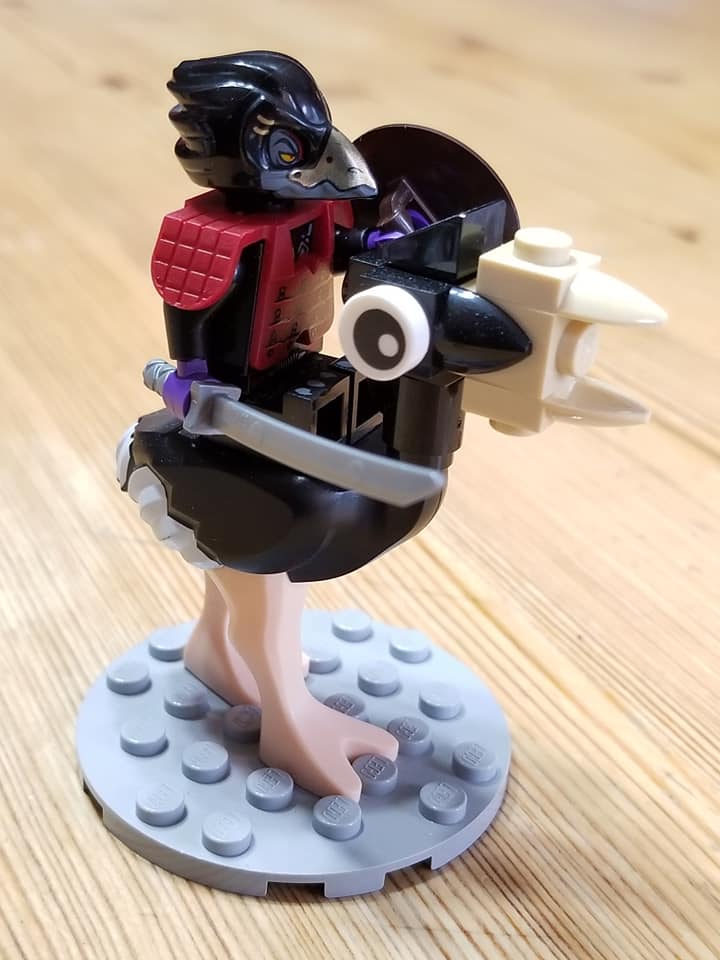
K'Chaw (tengu cavalier) now has her axebeak mount, who she has named Good Girl. I have also worked out what K'Chaw's birth name is (Karasu Momoru) and why she goes by "K'Chaw" instead: it was a nickname given to her by a tribe of horse nomads that she lived with for a time; as her horsemanship improved, the name became a badge of honor.

K'Chaw is a Legend of Chima Raven Tribe character, with [IIRC] Ninjago samurai armor. Her shield (facing away in this shot) is an Amazon warrior's (CMF) with a bird design. The axebeak is an ostrich (Prince of Persia) with a much larger brick-built head. (A short bar fits into a hole where the original head attached.)

Volutus (sylph sky druid) still hasn't seen a lot of play, except when there is a low-level Concordance-related adventure.

Volutus uses a Jack Sparrow body (PotC) and a Viking shield (CMF). I don't recall at the moment where the head and hair come from. [The scimitar is a BrickWarriors part, not LEGO.]

Milo Nimblefingers (halfling cleric/rogue) has reached second level and multiclassed into rogue. We don't play our Core characters enough for me to be certain how long he'll stick with that class, but my best guess right now is that he'll remain about half cleric, half rogue throughout his career.

Milo uses a hobbit's head and hair on Gimli's body (LOTR), and an Indiana Jones bullwhip.

Atticus Nox (tiefling investigator) is a Chelaxian scribe and barrister, who grew up benefiting from the status his diabolic heritage gave him in that corrupt empire. His partner Nephrael, my wife's character, has recently converted to a good god following a visit to Heaven without him. Atticus may follow suit one day, but is more likely to embrace the ways of Axis (which they both visited briefly in one adventure).

Atticus's body is the Lone Ranger's uniform (because the star badge is the closest thing I had to Asmodeus's pentagram). The tail and hands are from the Little Imp (CMF); the head is from the Monster 4 LEGO Game. His hair is Valkyrie's, from Thor: Ragnarok (Marvel Superheroes).

Cassilda Tillinghast (human mindblade magus) has now reached the level at which her previous incarnation was created for The House on Hook Street. Now that Mariko has reached Seeker tier, Cassilda has become my new character with a hefty grudge against the Aspis Consortium. Much of her last couple of levels involved Aspis-related adventures in the Hao Jin Tapestry.

Cassilda's body and cape are from the Wicked Witch (LEGO Dimensions), with new head and hair (the latter is from a Friends minidoll). Her mindblade and shield spell are represented with some of the trans-blue accessories that come with sets featuring Iron Man or Thor (Marvel Superheroes).

[I have also very recently had the opportunity to start playing Trick Tillinghast--the Buffy/Angel RPG character on whom Cassilda is very loosely based--again, which pleases me immensely. I will be devoting one or more future columns to her very soon.]

Mumbly Peg (kitsune hunter) has upgraded to her owlbear companion, Growler, and only needs a couple more adventures before he grows to Medium size. She will be taking a level or three of unchained rogue in the near future in order to boost her damage output while flanking; she already has the Boon Companion feat to avoid losing advancement for Growler while she does that. Peg is my only PFS character with a negative Int modifier, which can be a challenge to roleplay properly at times, but ganging up on things with her buddy is great fun!

Peg's head, legs, and tail are from Furty, the single Fox Tribe Chima character. The armored torso is from a Castle/Kingdoms minifigure. The photo above shows her in human form as well. While Growler is Small, I'm using a baby bear (Friends). Once he is Medium, I'll be using a Raven Tribe character (Chima) on all fours, with some claws added (see photo at left).

The New Kids on the (LEGO) Block

The following five characters are all new in the past year, and all have at least 1 XP, but only one has reached 3rd level so far. Two of them (Raisa and Darla) are "GM babies," who only have XP from GM credit or playing pregens, but have not yet seen play. (Pierce was another until earlier this month.)

Raisa Lupescu is a Varisian human diviner and fortune-teller, who will be taking the Harrower prestige class once she qualifies for it. (I want to get full use out of my Harrow deck, and much of the in-game lore about these decks is fun). She is a cousin to one of my other characters, Cassilda Tillinghast (who is only half Varisian).

Raisa's body and cape are from the fortune-teller (CMF). Her hair and kerchief piece is Professor Trelawney's (Harry Potter). She holds a 1x1 tile printed with a spellbook from an old Castle set. (I originally wanted to have her hold the two 1x2 Tarot card tiles that came with the fortune-teller, to represent her Harrow deck, but I've decided that they would be too likely to get bumped out of her hands and lost.)

Sibyl Pierce prefers to go by just "Pierce," and wears simple, practical clothes that obscure her gender. She is an Ulfen woman who learned the basics of zen archery from a wandering Tien monk, whose example she now follows.

She is built with a Green Ninja body (Ninjago), a back quiver (Castle and elsewhere), and an elven longbow (LOTR/Hobbit). Her hair is Elsa's blond wig with braid, from the Disney CMF series. This version of Elsa's hair works better with this pose--turning her head to the left to look at her target--than the straight-down braid from the Frozen minidoll sets (which would run into her quiver and shoulder).

Sister Darla is a nosferatu-born dhampir warpriest who was raised from infancy by the church of Pharasma as a living weapon against the kinds of monsters responsible for her existence. She is the beneficiary of last year's GM race boon, which allows a dhampir PC.

Darla's gray head is the Emperor's (Star Wars); her armor is from a Black Knight (CMF); her helm from an older Castle/Kingdoms set; and her dagger from Prince of Persia. (I have used this blade with multiple PCs presented in this column. They make great large daggers, small scimitars, or shortswords.) The tile on her shield is the Hypnobrai symbol from Ninjago; the spiral design makes it ideal for a holy symbol for Pharasma.

Falling Rock is a Shoanti human ranger who specializes in smashing things with his earthbreaker. He was created for a group who is playing through the Giantslayer and Shattered Star Adventure Paths (plus a little bit of Emerald Spire) in "PFS mode." He's my first serious attempt at a DPS-focused character, and he seems to be doing OK at it so far. I chose ranger over fighter so that he would have more skill points, and more useful class skills for this campaign. (He may multiclass into fighter later if I feel that I need additional combat feats more than skill points.) He is now the most experienced of my new characters, thanks to the sustained time spent with the Adventure Paths.

His body is from a Castle minifigure (Dragon Knights subtheme, IIRC?). The head is from an obscure Star Wars character whose name I've forgotten. An earthbreaker is essentially a big, spiked maul, easily represented by a couple clip-plates on a 1x1 SNOT brick, with a long bar handle.

Thibdab is my single Pathfinder Society Second Edition character to date. He is a goblin redeemer champion of Sarenrae. His back story is that he started his career as a squire to my 1E cavalier, K'Chaw, who later sponsored his eventual admission to training as a Pathfinder himself. He seeks to serve as an example to others of how goblins can constructively cooperate with the Society.

Thibdab is a complete melange of parts: head from the CMF goblin; helmet from an old trolls Castle set; torso and short legs from a Ninjago Stone Warrior; sword from Prince of Persia; shield from a Wonder Woman movie set.